How to Propagate Succulents: Leaves, Cuttings and Offsets
Quick Answer
Pick the method by what you have: separate rooted offsets, take 3 to 6 inch stem cuttings, behead a stretched rosette, or pull a whole leaf from a plant like Sedum or Crassula. Let cut ends callus for several days, set them on well-drained mix, and keep it barely damp. Expect weeks before roots form, and a month or two for a leaf to make a plantlet.
On this page
Key Takeaways
- Choose the method by genus: Iowa State lists offsets for Haworthia and Aloe, stem cuttings for Echeveria and Sedum, and whole leaves only for a few genera such as Sedum, Crassula and Kalanchoe.
- Callus every cut end before planting; sources range from about a day for snake plant leaf sections to 4 to 7 days for stem and leaf cuttings.
- A partial leaf will not root, so pull the whole leaf with its base intact and lay it on slightly damp, well-drained mix.
- Do not root succulent cuttings in a glass of water, and keep the mix damp, not wet.
- Expect weeks to a month for roots, and one to two months for a leaf to form a small plant.
Which Propagation Method Should You Use?
Match the method to what you are holding. Iowa State Extension says most succulents are easy to propagate by offsets, stem cuttings, or leaf cuttings [4], and its propagation guide adds a fourth option, beheading, for rosette-forming plants [1]. The method that works depends on the plant, so pick by genus first and by preference second.
| Method | What you take | Works for (per Iowa State) |
|---|---|---|
| Offset (pup) | A side shoot that already has its own roots and leaves or stems | Sempervivum, Aloe, Haworthia, Gasteria, Lithops, Agave, Bryophyllum, and all cacti [1] |
| Stem cutting | A 3 to 6 inch section of stem with the lower leaves removed | Aeonium, Echeveria, Sedum, Crassula, Kalanchoe, Graptopetalum, Euphorbia, and others [1] |
| Beheading | A whole rosette plus an inch or two of stem | Aeonium and Echeveria [1] |
| Whole-leaf cutting | One leaf pulled off cleanly, with its base intact | Graptopetalum, Pachyphytum, Sedum, Crassula, Kalanchoe [1] |
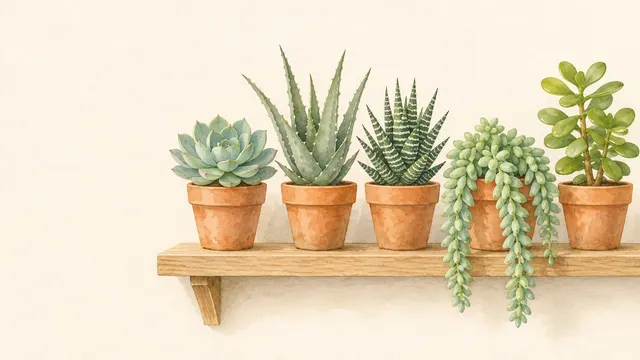
The flowchart below turns that table into a quick decision. If you are unsure what you own, our succulent types guide helps you name it.
Leaf cuttings are the slowest route. Illinois Extension says a small plant forms at the base of a leaf over one to two months, and a leaf cutting takes longer than a stem cutting or division to become a sizable plant [2]. If you have a choice, offsets and stem cuttings give you a bigger plant sooner.
How Do You Take and Callus a Stem Cutting?
Cut a clean section, strip the lower leaves, and let the cut end dry before planting. Iowa State Extension says to take a 3 to 6 inch stem section with clean, sharp pruners or scissors, remove the leaves from the lower half, and callus the cut end [1]. Illinois Extension suggests 3 to 4 inches from an active growing point, leaving a few leaves at the top [2]. For cacti, it says to wear gloves or use needle-nose pliers [2].
Why bother with the drying step? Callusing the cut end makes the cutting less likely to rot before it grows roots [1]. Sources give different callus times, so treat them as a range, not a rule. Iowa State says "several days" for stem cuttings and about a day for the snake plant leaf sections it covers [1]. Illinois Extension gives 4 to 7 days for both stem and leaf cuttings in its 2015 post [2] and about a week in its 2024 release [3]. Whichever number you follow, plant only once the cut end looks and feels dry.
After callusing, set the cutting in a well-drained mix. Iowa State names cactus potting soil or perlite [1]. Illinois Extension suggests 1 part potting mix to 1 part perlite, or 1 part coarse sand to 1 part potting mix, because these plants do not like constantly moist media [2]. For mixes in more detail, see the best soil for succulents. Place at least one or two nodes, the spots where leaves were removed, below the surface, since roots come from the nodes [2].
Do not root succulent cuttings in a glass of water. Iowa State says most succulents do not root well that way [1]. Rooting hormone is optional: it can sometimes help roots form faster, but most succulents root quickly without it [1].
What Is Beheading, and When Does It Help?
Beheading means cutting off a whole rosette with an inch or two of stem, callusing it, and rooting it like a stem cutting [1]. Iowa State names Aeonium and Echeveria for this method, and notes that side rosettes often form on the leftover stalk, so you can root those later [1]. It suits a rosette that has stretched out and lost its shape, since you restart the top and may get extra plants from the base.
Can You Grow a New Plant From a Single Leaf?
Yes, but only for some plants, and only if the leaf comes off whole. Iowa State lists whole-leaf cuttings for Graptopetalum, Pachyphytum, Sedum, Crassula, and Kalanchoe, and says "partial pieces of leaves will not root" [1]. Iowa State says to remove the whole leaf cleanly, including the tissue that attaches it to the stem [1]. A torn leaf with its base left on the plant is wasted.
Lay the leaf on slightly damp, well-drained mix with the stem end at the surface, and do not bury it. Keep the surface damp but not wet, and a spray bottle works well for this [1]. Iowa State says new roots and leaves or rosettes form in several weeks [1]. Illinois Extension reports a small plant forming at the leaf base over one to two months, after which the original leaf eventually dies off [2].
Two plants people ask about need a caveat. Iowa State does not list Haworthia for leaf cuttings; it puts Haworthia under offsets [1]. We would treat a Haworthia leaf as a long shot and divide pups instead. Echeveria is listed for stem cuttings and beheading, not whole leaves [1], so a loose echeveria leaf is a slow experiment, not a method to count on. Snake plant is the one common exception with a different rule: it roots from 3 to 5 inch leaf sections, covered in our snake plant propagation guide [1].
How Do You Separate and Pot Offsets?
Take only offsets that already have roots, then pot them in well-drained mix. Iowa State says to separate pups, side shoots, or runners that have both roots and leaves or stems, pot them in a container with a drainage hole, and water lightly. They establish within a few weeks [1]. Illinois Extension uses aloe as its example, since it forms many offsets that can be cut or divided and replanted [2].
Good candidates include the genera in the table above. A familiar one is hens and chicks, where the small rosettes on runners are the offsets; our hens and chicks guide covers it. Offsets give the fastest result because they are already small plants, and Illinois Extension notes that cuttings and divisions typically develop substantial roots within a few weeks to a month [2].
Repotting is a natural time to do this. Iowa State notes that repotting is a good time to propagate [4]. Choose a pot with a drainage hole for each new plant; our succulent pots guide explains the options.
How Long Until Cuttings Root, and How Do You Water Them?
Expect weeks, not days, and keep water light. The ranges from our sources are below.
| Starting point | Typical timeline reported | Source |
|---|---|---|
| Offset | Establishes within a few weeks | Iowa State [1] |
| Stem cutting or division | Substantial roots within a few weeks to a month | Illinois [2] |
| Leaf cutting | New roots and rosettes in several weeks; a small plant over one to two months | Iowa State [1]; Illinois [2] |
| Cuttings in general | Allow at least a month to root | Illinois (2024) [3] |
To check whether a cutting has rooted, tug it gently. Illinois Extension says resistance means rooting is occurring, and you can repot once the root system holds together when pulled; move it to a container 1 to 2 inches larger [2].
Water carefully while roots form. Iowa State says to water offsets lightly and to keep a leaf cutting's soil surface damp but not wet [1]. Once a new plant is established, it follows the usual rules in our succulent watering guide: water only when the soil is dry several inches down [4]. For general light and feeding, see the succulent care guide.
Can You Propagate Succulents in Winter?
You can, but expect it to be slower, and give it light. The sources we read do not name a best season for propagation; Illinois Extension's 2015 post says nothing on timing [2]. What they do say is that succulents go dormant in winter and need even less water [3], and Iowa State says to avoid fertilizing in winter when they are not growing [4].
Iowa State also says succulents need ten or more hours of bright, indirect light, that most need at least six to eight hours, and that low light makes plants lanky and pale [4]. Our view: a winter cutting is fine on a bright windowsill, but without strong light it may sit for weeks doing nothing, so judge it by the tug test and not the calendar. That is our opinion, not a finding from the sources. Do not "fix" a slow cutting by watering more, since overwatering is the larger risk indoors, as covered in our watering guide.
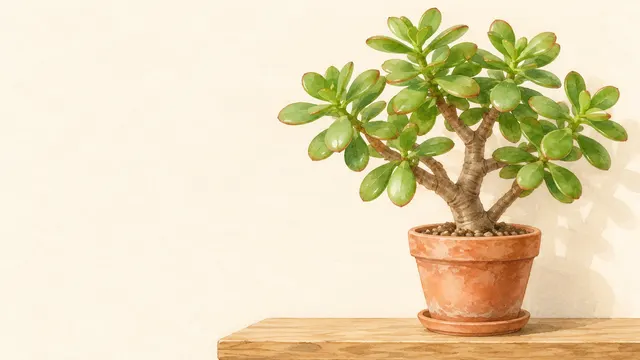
If you want to practice on a plant that Iowa State lists for both stem and whole-leaf cuttings, Crassula is one; see the jade plant guide [1].
Frequently Asked Questions
Can you propagate a succulent from a single leaf?
Some, yes. Iowa State Extension lists whole-leaf cuttings for Graptopetalum, Pachyphytum, Sedum, Crassula and Kalanchoe, and says partial pieces of leaves will not root. Pull the whole leaf cleanly, including the tissue that attaches it to the stem.
How long should succulent cuttings callus before planting?
It depends on the source. Iowa State says several days for stem cuttings and about a day for snake plant leaf sections. Illinois Extension gives 4 to 7 days in a 2015 post and about a week in 2024. Plant once the cut end is dry.
Can you root succulent cuttings in water?
Iowa State Extension says most succulents do not root well in a glass of water, so use a well-drained mix such as cactus soil or perlite instead.
How long does it take succulent cuttings to root?
Illinois Extension says cuttings and divisions typically develop substantial roots within a few weeks to a month, and a leaf cutting forms a small plant over one to two months. Iowa State says new roots and rosettes form in several weeks.
Do you need rooting hormone to propagate succulents?
No. Iowa State Extension says rooting hormone can sometimes help roots form faster, but most succulents root quickly without it, and Illinois Extension calls it optional.
Our Take
We think offsets and stem cuttings are the better first choice, and leaves are the one to try when nothing else is available. Iowa State lists far more genera for stem cuttings and offsets than for whole leaves, and Illinois Extension says a leaf takes one to two months just to form a small plant. In our view the most common beginner mistake is judging by the calendar instead of the cutting: a firm tug that meets resistance tells you more than a week count. We would also skip trying a Haworthia from a leaf and divide pups instead. This is our editorial opinion based on extension guidance, not a test we ran.
Sources
- How to Propagate Succulents. Iowa State University Extension and Outreach (Aaron Steil; last reviewed August 2023).
- Propagating Succulents and Cacti. University of Illinois Extension (Candice Anderson, June 4, 2015).
- Did you forget to water your plants? Try low-maintenance succulents. University of Illinois Extension news release (Nancy Kreith, January 8, 2024).
- Growing Succulents Indoors. Iowa State University Extension and Outreach (Aaron Steil; last reviewed December 2024).
Plant care advice is general guidance: adjust for your light, season and pot, and check the soil before you water. Pet toxicity follows the ASPCA list only; if a pet may have eaten part of a plant, contact your veterinarian or the ASPCA Animal Poison Control Center right away. Spotted an error? Tell us.
Related Guides
Succulent Care for Beginners
Succulent care for beginners: bright light, a soak-and-dry watering rhythm, gritty soil in a pot with drainage, and how to read wrinkled or mushy leaves.
The Best Soil for Succulents (and How to Mix Your Own)
Succulent soil guide: why regular potting soil stays too wet, how organic and mineral parts compare, four DIY recipes, the right pot, and when to repot.
How Often to Water Succulents
How often to water succulents: check about every 2 to 3 weeks, water only when dry several inches down, water less in winter, and tell rot from thirst.
Types of Succulents: An Illustrated Guide
Types of succulents grouped by shape: rosette, upright, tree-like, trailing, flowering, and cacti, with current botanical names, light needs, and pet listings.

Hens and Chicks Care: Sun, Water, Winter Dormancy and Offsets
Hens and chicks care: full sun, sharp drainage, sparing water, what winter dormancy looks like, indoor versus outdoor growing, and how to remove offsets.
Jade Plant Care: Light, Water, Pruning, and Propagation
Jade plant care: 4+ hours of direct sun, deep watering once the soil dries, less water in winter, a heavy pot, spring pruning, easy cuttings, leaf drop fixes.