The Best Soil for Succulents (and How to Mix Your Own)
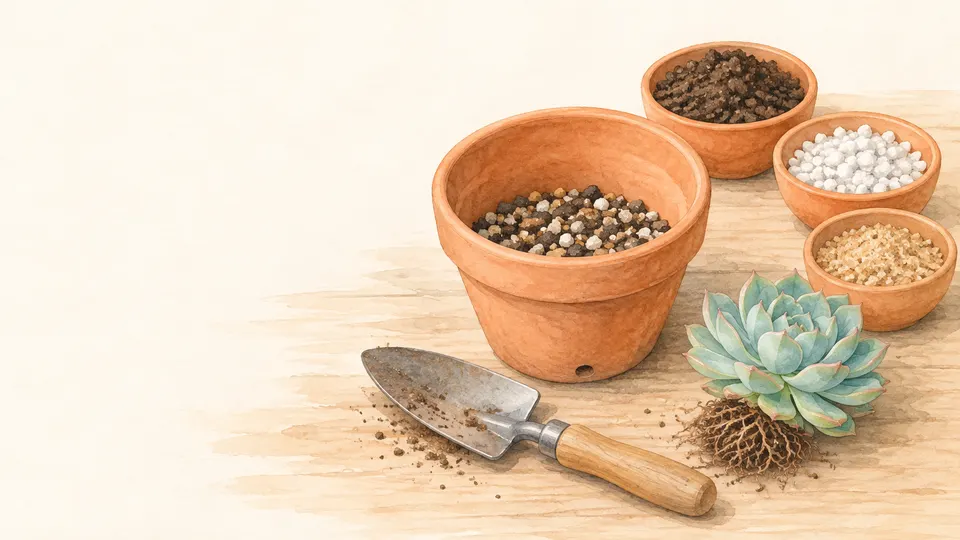
Quick Answer
The best succulent soil drains fast and dries quickly. Use a bagged cactus and succulent mix, or make your own from 1 part organic material (potting soil, pine bark, compost, or coir) and 2 parts mineral material (perlite, coarse sand, pumice, or fine gravel). Plant in a snug pot with a drainage hole, and replace the mix when it starts staying wet.
On this page
Key Takeaways
- Regular potting soil holds too much water for succulents and risks root rot; Iowa State recommends about one-third organic and two-thirds mineral material.
- Organic parts such as coir, bark, and compost hold water and slowly decompose; mineral parts such as perlite, pumice, and grit keep air spaces open.
- Published recipes range from 2 parts mineral to 1 part organic for most succulents and cacti to mixes with less drainage material for snake plants and holiday cacti.
- Fill pots loosely: in a comparison Iowa State adapted from D.W. Reed, pressing potting media down cut air-filled pores from 15% to 4%.
- Use a pot with a drainage hole, since a gravel layer is not a substitute, and repot into fresh mix when the old soil breaks down and stays wet.
Why Does Regular Potting Soil Fail Succulents?
Succulents need sharp-draining soil that dries quickly and does not hold too much moisture, and Iowa State Extension says typical potting soil retains too much water, which risks root rot [1]. Pick a mix that drains fast and dries quickly. [1] A fast-drying mix is what the soak-then-dry method in our succulent care guide depends on.
Three problems explain why regular potting soil, and especially garden soil, stays too wet in a pot on its own:
- Too much fine organic material. Soil that is too organic or fine-textured holds too much water, and Iowa State's advice for overwatered plants in such soil includes repotting into sharp-draining mix [6].
- Garden soil loses its air in a pot. Dug-up soil compacts and loses most of its air-filled pores once it goes into a container, and the shallow depth of a pot can also hold back drainage [2]. University of Maryland Extension adds that garden soil is too dense for good air and water movement in containers and can drown roots, especially in shallow pots [3].
- Roots need air as well as water. Water moving through a mix pushes air out of the pore spaces, and if the excess cannot drain away, fresh air cannot get back in and roots suffocate [3].
Missouri Botanical Garden frames it simply: match the soil mix to the plant's moisture needs, which it calls better than trying to match watering frequency to the mix, and use a coarser mix with good drainage for all cacti and succulents [4].
What Goes Into a Good Succulent Soil?
A succulent mix has two parts: an organic part that mainly holds water, and a mineral part that mainly adds air spaces. Iowa State's potting media article groups peat, coir, bark, and compost with components used to hold water, and perlite with components used for aeration [2]. Iowa State Extension recommends about one-third organic material and two-thirds mineral material [1], and University of Illinois Extension gives the same 1 to 2 split [7].
| Ingredient | What it does | Watch out for |
|---|---|---|
| Potting soil (organic) | Organic base; listed first by Iowa State [1] | Too wet on its own [1] |
| Coir (organic) | Holds water; can replace peat [2] | Hard to rewet once dry; soak days ahead [2] |
| Pine bark (organic) | Listed for succulent mixes [1]; coarser bark holds more air [2] | Use potting bark, not bark mulch [2] |
| Compost (organic) | A low dose of nutrition [2] | Varies; may decompose faster than peat [2] |
| Perlite (mineral) | Long-lasting air-filled pores [2] | Dusty when dry [2] |
| Pumice (mineral) | A mineral option for Iowa State and Illinois [1] [7] | Our sources give no detail on it |
| Coarse sand (mineral) | Adds porosity and weight [3] | Builder's sand, not play sand [3] |
| Fine gravel or grit (mineral) | In Iowa State's and the RHS recipes [1] [5] | Mix it in; a gravel layer is no substitute for a drainage hole (see pots below) [1] |
Organic and mineral parts age differently. Organic components such as peat and bark decompose over time, often over many years, while inorganic components change little [2]. So as a mix ages, it is mainly the organic share that changes.
What About Sand?
Sources differ here. Missouri Botanical Garden's cactus recipe uses sand as the main drainage ingredient [4], and Maryland Extension says coarse sand increases porosity [3]. Iowa State's potting media article cautions that sand does not aerate as well in a container as it does in the ground [2]. A practical middle path, which is our suggestion rather than any one source's, is to use only coarse sand if you use it at all, and to let perlite or pumice carry most of the mineral share.
How Do You Mix Your Own Succulent Soil?
We measure parts by volume, using the same scoop for each. Mix one of these published recipes:
| Recipe | Parts | Best for |
|---|---|---|
| Iowa State basic | 1 organic (potting soil, pine bark, compost, or coir) : 2 mineral (perlite, coarse sand, pumice, or fine gravel) | Most indoor succulents [1] |
| MBG cactus | 1 soil mix : 2 sand | Most cacti [4] |
| RHS sansevieria | 2 peat-free loam-based compost : 1 horticultural grit or fine gravel | Snake plants [5] |
| MBG jungle cactus | 1 soil mix : 1 peat : 1 sand | Christmas and Easter cacti [4] |
MBG is Missouri Botanical Garden.
The RHS and jungle cactus mixes add less drainage material than the basic mix: one part in three instead of two. Missouri Botanical Garden adds peat to its jungle cactus mix for moisture, and says that varying the sand content lets a mix hold more or less water [4]. Holiday cacti are forest plants that want more moisture than most cacti [4]; see our Christmas cactus care guide for their full routine. The RHS recipe comes from its guide to sansevierias [5]; our snake plant care guide covers that plant in depth.
Step by Step
- Pre-wet dry coir or peat. Once dry, they repel water, so rewet them several days before you mix [2]. The same can happen in the pot: Maryland Extension says soilless (peat- or coir-based) mixes tend to repel water [3], and a thorough succulent watering wets the entire root ball until water drains [1].
- Mix evenly. Even mixing is essential when you blend your own components [2].
- Check the moisture. Iowa State notes that sources differ on ideal moisture, but most say a squeezed handful should hold its shape, break apart easily, and release little to no water [2].
- Fill loosely. Overfill the pot, then brush the excess off level. Do not tap or press the mix down [2].
That last step matters more than it looks. Iowa State, adapting a table from D.W. Reed's book Water, Media, and Nutrition of Greenhouse Crops, reports how the filling method changed air-filled pores in a 4-inch pot [2]:
| How the pot was filled | Air-filled pores |
|---|---|
| Filled, then brushed level | 15% |
| Filled and tapped twice on the table | 9% |
| Filled, pressed down, and topped off | 4% |
Pressing the mix down cut its air space by roughly three-quarters in that comparison. Those measurements were for potting media generally, not a succulent mix, but we think the lesson carries over: avoid packing any mix down.
Should You Buy Cactus Mix or Make Your Own?
Either works. Commercial "Cactus and Succulent" mixes are great choices for new indoor succulent growers [1], and for snake plants the RHS recommends a free-draining, peat-free cactus compost [5]. You can also add amendments such as perlite and sand to regular potting soil to improve drainage [1].
Bagged mixes vary, so read the label. Some brands now list traits such as drainage, particle size, and water retention, and pre-mixed media often contain wetting agents and lime [2]. In our view, mixing your own makes the most sense if you already have potting soil and perlite on hand, or if a bagged cactus mix still stays wet too long in your home; stirring in extra perlite or pumice is an easy fix.
What Pot and Drainage Work Best With Succulent Soil?
The best soil still fails in the wrong pot. Every succulent pot needs a drainage hole. A "drainage layer" of coarse gravel in the bottom is not a suitable replacement for a hole, and plants in such pots often stay too wet to thrive [1].
Why does the bottom stay wet? After watering, the lowest part of any container holds a nearly saturated zone, and the finer the pores in the mix, the higher that zone reaches [2]. A coarser mix lowers it, and a drainage hole lets the excess leave.
| Choice | What sources say |
|---|---|
| Drainage hole | Required; gravel layers are not a substitute [1] |
| Pot without a hole | Double pot: plant in a slightly smaller pot with a hole and set it inside [1] |
| Saucer or outer pot | Never let water sit more than a few hours [1] |
| Material | Clay or terracotta is ideal because it is porous and dries faster [1] |
| Size | Just big enough for the roots [1]; about 1 inch wider than the old pot [4] |
| Tall plants | Pot diameter at least half the plant's height [4] |
Oversized pots work against you. In its sansevieria guide, the RHS warns that a much larger pot holds a lot of spare compost that tends to stay damp after watering, encouraging root rot [5].
Shallow or tall? Small or shallow containers suit succulents because the small soil volume dries quickly [1]. Yet because the saturated zone sits at the bottom, a taller pot leaves more mix above it, and growers use taller pots or airier mixes for plants that need excellent drainage [2].
Both points can hold at once: a small pot dries fast, but in a short pot the bulk of the roots sit in the potentially saturated zone, which can make watering more challenging [2]. Our takeaway is to keep pots small and snug, and to compensate for shallow dishes with an extra-gritty mix and careful watering. For timing, see how often to water succulents.
Signs Your Succulent Soil Needs Replacing
Succulent soil does not last forever. Over time, soil can break down and hold more water [1], and Maryland Extension notes that soilless media and compost lose nutrients and break down physically over time [3].
If a plant shows overwatering signs (yellowing, soft and mushy leaves and stems, a wet or damp soil surface, and in severe cases mold or fungus gnats), Iowa State's first step is to stop watering and let the soil dry thoroughly; if the soil is too organic or fine-textured to dry, repot into sharp-draining mix [6]. Succulents don't need frequent repotting and often thrive in slightly smaller containers [1]. Other signs it is time:
- For snake plants, the RHS says to wait until roots and leaves have completely filled the pot or are making it buckle [5].
- The plant is top-heavy and unstable in its pot [1] [4].
Missouri Botanical Garden recommends repotting when growth begins in spring, because plants repotted while dormant are set back and slow to recover [4]. Gently remove loose soil from the root ball, set the plant in its new pot, fill with well-drained soil, and water lightly [1]. Repotting is also a good time to take cuttings [1]; callused stem cuttings can be rooted in cactus potting soil or perlite [8], and our guide to snake plant propagation walks through leaf sections.
Frequently Asked Questions
Can I use regular potting soil for succulents?
Not on its own. Iowa State Extension says typical potting soil retains too much water and risks root rot. You can use it as the organic part of a mix: combine 1 part potting soil with 2 parts perlite, coarse sand, pumice, or fine gravel.
What is the best ratio for homemade succulent soil?
Iowa State Extension and University of Illinois Extension both suggest 1 part organic material to 2 parts mineral material. Missouri Botanical Garden suggests 2 parts sand to 1 part soil mix for most cacti.
Is perlite or sand better for succulent soil?
Both appear in published recipes. Iowa State's potting media article says perlite gives long-lasting air-filled pores and cautions that sand does not aerate as well in containers. If you use sand, Maryland Extension says to use coarse builder's sand, not play sand. Our suggestion: let perlite or pumice carry most of the mineral share, and use only coarse sand if any.
Should I put rocks in the bottom of a succulent pot?
No. Iowa State Extension says a drainage layer of coarse gravel is not a suitable replacement for a drainage hole, and plants in such pots often stay too wet. Use a pot with a hole, or double pot inside a decorative container.
How often should I replace succulent soil?
There is no fixed schedule in our sources. Repot when the soil breaks down and stays wet, when roots fill the pot (the RHS signal for snake plants), or when the plant becomes top-heavy. Missouri Botanical Garden suggests repotting in spring when growth begins.
Our Take
In our editorial view, the single most useful change most people can make is the mineral share. A bagged cactus mix is a fine start, but if it still stays damp for a long time in your home, stirring in more perlite or pumice is cheaper than replacing plants. We also think the gravel-layer habit deserves to retire. Iowa State's succulent guide says a gravel layer is no substitute for a drainage hole, and its potting media article explains how mix texture and pot shape set how much of the pot stays wet after watering. This is our opinion based on extension and RHS guidance, not a test we ran.
Sources
- Growing Succulents Indoors. Iowa State University Extension and Outreach (Aaron Steil; last reviewed December 2024).
- Potting Media: Components and Handling. Iowa State University Extension and Outreach, Yard and Garden (Randall Vos, March 10, 2025).
- Choosing growing media (potting mixture) for your container gardens. University of Maryland Extension (updated March 23, 2026).
- Cacti and Succulents (fact sheet). Missouri Botanical Garden, Gardening Help.
- How to grow sansevierias. Royal Horticultural Society.
- Common Problems and Issues of Succulents. Iowa State University Extension and Outreach (Aaron Steil; last reviewed August 2023).
- Did you forget to water your plants? Try low-maintenance succulents. University of Illinois Extension news release (Nancy Kreith, January 8, 2024).
- How to Propagate Succulents. Iowa State University Extension and Outreach (Aaron Steil; last reviewed August 2023).
Plant care advice is general guidance: adjust for your light, season and pot, and check the soil before you water. Pet toxicity follows the ASPCA list only; if a pet may have eaten part of a plant, contact your veterinarian or the ASPCA Animal Poison Control Center right away.Spotted an error? Tell us.
Related Guides
Succulent Care for Beginners
Succulent care for beginners: bright light, a soak-and-dry watering rhythm, gritty soil in a pot with drainage, and how to read wrinkled or mushy leaves.
How Often to Water Succulents
How often to water succulents: check about every 2 to 3 weeks, water only when dry several inches down, water less in winter, and tell rot from thirst.
Types of Succulents: An Illustrated Guide
Types of succulents grouped by shape: rosette, upright, tree-like, trailing, flowering, and cacti, with current botanical names, light needs, and pet listings.
Jade Plant Care: Light, Water, Pruning, and Propagation
Jade plant care: 4+ hours of direct sun, deep watering once the soil dries, less water in winter, a heavy pot, spring pruning, easy cuttings, leaf drop fixes.
Snake Plant Care: Light, Water, and Common Mistakes
Snake plant care for beginners: bright indirect light, water only when the soil is dry (about every 2 to 6 weeks, less in winter), a snug pot, and rot traps.
Christmas Cactus Care: How to Get It to Bloom
Christmas cactus care for beginners: tell it from a Thanksgiving cactus, water when the soil is nearly dry, and use cool, fully dark fall nights to set buds.