Types of Succulents: An Illustrated Guide
Quick Answer
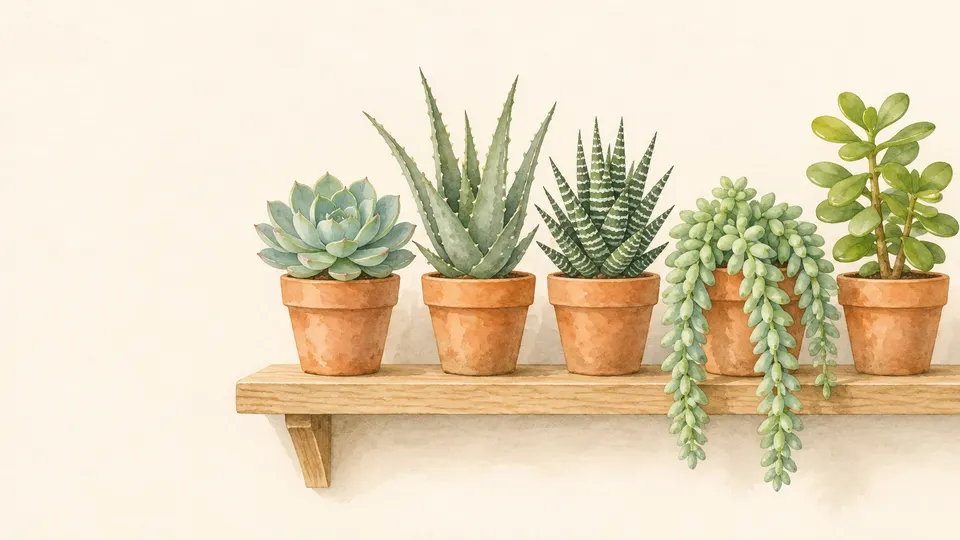
Common types of succulents fall into six growth forms: rosettes (echeveria, hens and chicks, living stones), upright plants (aloe, haworthia, snake plant), rounded or tree-like plants (jade), trailing plants (string of pearls, burro's tail), types grown for flowers (kalanchoe, Christmas cactus), and cacti. Light needs differ by type, from full sun for echeveria to lower light for snake plant.
On this page
- What Counts as a Succulent?
- Which Succulents Grow as Rosettes?
- Which Succulents Grow Upright?
- Which Succulents Look Like Trees, Trail, or Flower?
- Are Christmas Cacti Real Cacti?
- How Much Light Does Each Type of Succulent Need?
- Which Types of Succulents Are Safe for Cats and Dogs?
- Frequently Asked Questions
- Our Take
- Sources
Key Takeaways
- "Succulent" describes water-storing plants from several families, including the stonecrop, spurge, and cactus families; all cacti are succulents, but not all succulents are cacti.
- Iowa State Extension groups popular succulents into rosette, upright, rounded, trailing, flowering, and cactus forms.
- Several names have changed: zebra plant is now Haworthiopsis attenuata, string of pearls is Curio rowleyanus, and snake plant is Dracaena trifasciata.
- Light needs vary by type: echeveria, aloe, and burro's tail want a sunny window, while snake plant and haworthia cope with lower light.
- The ASPCA lists echeveria, haworthia, burro's tail, and Christmas cactus as non-toxic, and jade, aloe, kalanchoe, and snake plant as toxic; string of pearls and Sempervivum are not listed.
What Counts as a Succulent?
A succulent is any plant with thick, fleshy leaves or stems adapted to store water [4]. That makes "succulent" a description, not a single plant group. Iowa State Extension notes that succulents come from several plant families, including the stonecrop (Crassulaceae), spurge (Euphorbiaceae), and cactus (Cactaceae) families, and that all cacti are succulents but not all succulents are cacti [2].
The easiest way to sort the common types is by shape. Iowa State's list of popular species groups them by overall growth habit or use: rosette forms, upright forms, rounded forms, trailing forms, plants grown mainly for flowers, and cacti [1]. This guide follows those groups.
Types of Succulents at a Glance
| Type | Botanical name | Growth form | Family | Easiest propagation |
|---|---|---|---|---|
| Echeveria | Echeveria | Rosette | Crassulaceae | Stem cuttings |
| Hens and chicks | Sempervivum | Rosette | Crassulaceae | Offsets |
| Ghost plant | Graptopetalum | Rosette | Crassulaceae | Leaf or stem cuttings |
| Living stones | Lithops | Rosette | Aizoaceae | Offsets |
| Zebra plant | Haworthiopsis (listed as Haworthia) | Upright | Asphodelaceae | Offsets |
| Ox tongue | Gasteria | Upright | Asphodelaceae | Offsets |
| Aloe | Aloe vera | Upright | Asphodelaceae | Offsets |
| Snake plant | Dracaena trifasciata | Upright | Asparagaceae | Offsets |
| Century plant | Agave americana | Upright | Asparagaceae | Offsets |
| Jade plant | Crassula ovata | Rounded | Crassulaceae | Leaf or stem cuttings |
| String of pearls | Curio rowleyanus | Trailing | Asteraceae | Stem cuttings |
| Burro's tail | Sedum morganianum | Trailing | Crassulaceae | Stem or leaf cuttings |
| Kalanchoe | Kalanchoe blossfeldiana | Grown for flowers | Crassulaceae | Stem or leaf cuttings |
| Christmas cactus | Schlumbergera | Grown for flowers | Cactaceae | Stem cuttings |
Groups, families, and propagation methods come from Iowa State's species list [1]. Iowa State still uses some older names there; the current names in the table follow NC State Extension, which lists Crassula argentea as a former name of jade plant [13], Senecio rowleyanus as a former name of string of pearls [14], and Sansevieria trifasciata as a former name of snake plant [12].
Which Succulents Grow as Rosettes?
Rosette succulents hold their leaves in a ring around a short central stem. Iowa State lists living stones, stonecrop, hens and chicks, moonstones, ghost plant, echeveria, pig's ear, and aeonium in this group, from smallest to largest [1].
Echeveria. Thick, fleshy leaves form a tight rosette that stays close to the ground at first; as lower leaves wither and drop, the stem shows [6]. NC State says echeveria does not mind full sun and that leaf color improves with sunlight [6]. Iowa State lists stem cuttings as its best propagation method [1], and its propagation guide adds that rosettes with few offsets can be "beheaded": cut off with an inch or two of stem, callused, and rooted [3].
Hens and chicks (Sempervivum). Small, low rosettes surrounded by offsets, or "chicks," which are simple to separate [7]. NC State says they prefer cool nights and cold-dormant seasons, are less heat tolerant than other succulents, and that many varieties are frost hardy [7]. Each rosette is monocarpic: it dies after it flowers, while its offsets live on [7].
Ghost plant (Graptopetalum). A rosette former in the stonecrop family that Iowa State lists as easiest to grow from leaf or stem cuttings [1].
Living stones (Lithops). Each plant is just two thick leaves split by a fissure, 0.5 to 1 inch tall, with a new pair of leaves each year [8]. NC State ties watering to the plant's growth cycle, with no water during its summer dormancy [8], so living stones need their own seasonal watering schedule, not a standard succulent routine.
Which Succulents Grow Upright?
Upright succulents send stiff leaves or stems up from the base. Most upright types on Iowa State's list are propagated by offsets, or "pups" [1], a method Iowa State recommends for Agave, Aloe, Gasteria, Haworthia, and Sansevieria (Dracaena) [3].
Aloe vera. Can grow over 2 feet tall, with soft leaves that break easily [11]. Penn State recommends placing it near a sunny window for full sun to bright indirect light and rotating the pot [11].
Snake plant (Dracaena trifasciata). Iowa State Extension treats snake plant as a succulent and pictures it as one that prefers bright light indoors [2]. NC State says it tolerates very low light, and in winter needs water only every one to two months [12]. That interval is a starting point; adjust for light, pot, and season, and check that the soil is dry first. See our snake plant care guide for details.
Ox tongue (Gasteria) and century plant (Agave americana). Both are upright, offset-forming succulents on Iowa State's list; within each group the list runs from smallest to largest, and century plant comes last among the upright forms [1].
Haworthia or Haworthiopsis?
The plant sold as "zebra plant" is usually labeled Haworthia, but its name has changed. NC State Extension explains that the genus Haworthia was split in 2013 and 2014, with several species moved to Haworthiopsis and Tulista, and that many familiar cultivated species now sit in those genera [9]. Zebra plant is now Haworthiopsis attenuata, previously Haworthia attenuata [10].
| Feature | Haworthia | Haworthiopsis |
|---|---|---|
| Leaf tips | Translucent "windows" | Opaque |
| Leaf surface | Varies by species | White raised bumps in spots or bands underneath |
| Example | Cathedral window haworthia (H. cymbiformis) | Zebra plant (H. attenuata) |
Leaf features are from NC State Extension [9] [10]. NC State gives similar light advice for both: somewhat tolerant of low light, with the best leaf color in brighter light, full sun or bright indirect light for Haworthia [9] and bright indirect sunlight for zebra plant [10].
Which Succulents Look Like Trees, Trail, or Flower?
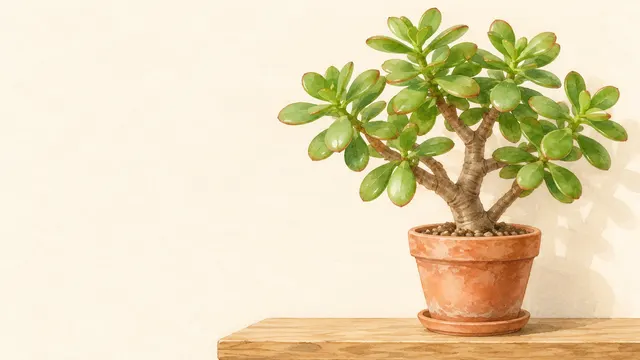
Jade plant (Crassula ovata). Iowa State puts jade in the rounded group [1]; NC State notes that as it matures it takes the form of a miniature tree, and that it does not usually bloom indoors [13]. NC State suggests a sunny spot that also gets some afternoon shade [13]. Our jade plant care guide covers pruning and propagation.
String of pearls (Curio rowleyanus). A trailing vine with pea-shaped leaves, popular in hanging baskets [14]. NC State calls it very particular: it does not tolerate overwatering, underwatering, or inadequate light, and older plants tend to die back after several years, so it suggests restarting from stem cuttings [14].
Burro's tail (Sedum morganianum). Stems grow upright at first, then hang down to four feet long, packed with plump blue-green leaves [15]. UW-Madison Extension recommends bright light to full sun, noting that too little light spaces the leaves out and too much bleaches them yellowish [15].
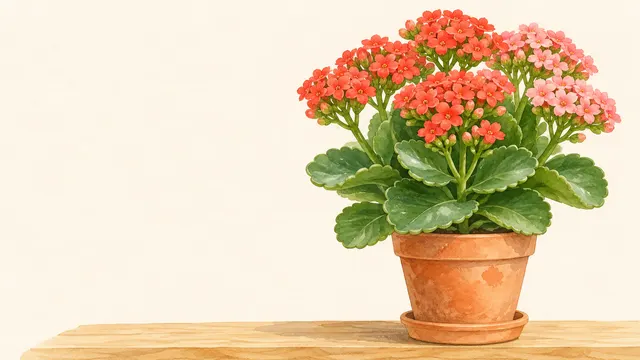
Kalanchoe (Kalanchoe blossfeldiana). Iowa State lists the florist kalanchoe among succulents grown mainly for flowers [1]. NC State says it prefers bright indirect sunlight or partial shade, with afternoon shade because prolonged direct sun can scorch the leaves [16]. See our kalanchoe care guide.
Are Christmas Cacti Real Cacti?
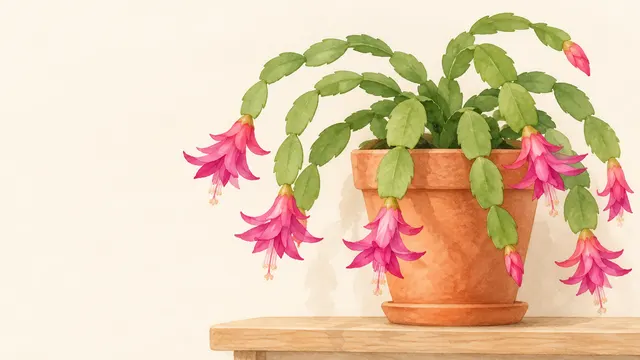
Yes, but they are not desert plants. Missouri Botanical Garden describes a second group of cacti and succulents from subtropical areas with less extreme light and more moisture, including the Christmas, Thanksgiving, Easter, and orchid cacti, which some call jungle cacti because they grow as understory plants in tropical forests [5]. Unlike most succulents, jungle cacti prefer medium light, higher humidity, and soil kept evenly moist, especially while flowering [5]. NC State adds that Schlumbergera thrives in bright, indirect sunlight but is intolerant of direct sun [17]. Our Christmas cactus care guide explains how to get it to rebloom.
Other cacti on Iowa State's list include pincushion cactus (Mammillaria), prickly pear (Opuntia), old man cactus, and barrel cactus, all propagated by offsets [1].
How Much Light Does Each Type of Succulent Need?
Light needs differ noticeably between types. As a baseline, Iowa State recommends 10 or more hours of bright, indirect light, with most succulents needing at least 6 to 8 hours [2], while Missouri Botanical Garden says cacti and succulents generally need at least 4 hours of bright, direct light, with jungle cacti as the exception [5]. Move any succulent into stronger sun gradually, because a sudden move from indirect light into full sun can damage it. [5]
The placements in the scale above come from each plant's extension profile: echeveria [6], aloe [11], burro's tail [15], jade [13], kalanchoe [16], living stones (4 to 5 hours of morning sun, partial shade in the afternoon) [8], string of pearls [14], Christmas cactus [17], snake plant [12], and haworthia [9].
Most of these types share the same basics: a sharp-draining mix, a pot with a drainage hole, and a soak-then-dry watering rhythm [2]. The easiest way to kill a succulent is watering too much. [4] For the full routine, see succulent care for beginners, the best soil for succulents, and how often to water succulents.
Which Types of Succulents Are Safe for Cats and Dogs?
It depends on the type, and some popular ones are not on the ASPCA's list at all. This table shows what the ASPCA's plant database says for each plant in this guide that it lists:
| Plant | ASPCA listing | Toxic principles and clinical signs (as listed) |
|---|---|---|
| Echeveria (entry: variegated wax plant, Echeveria sp.) | Non-toxic to dogs and cats [18] | None listed |
| Haworthia (entry: Haworthia species) | Non-toxic to dogs and cats [19] | Non-toxic |
| Burro's tail (Sedum morganianum) | Non-toxic to dogs, cats, and horses [20] | None listed |
| Christmas cactus (entry: Schlumbergera bridgesii) | Non-toxic to dogs, cats, and horses [21] | None listed |
| Jade plant (entry: Crassula argentea) | Toxic to dogs, cats, and horses [22] | Unknown; vomiting, depression, incoordination |
| Aloe (Aloe vera) | Toxic to dogs, cats, and horses [23] | Saponins, anthraquinones; vomiting (not horses), lethargy, diarrhea. The gel is considered edible. |
| Kalanchoe (Kalanchoe spp.) | Toxic to dogs and cats [24] | Bufodienolides; vomiting, diarrhea, abnormal heart rhythm (rare) |
| Snake plant (entry: Sansevieria trifasciata) | Toxic to dogs and cats [25] | Saponins; nausea, vomiting, diarrhea |
Two popular types are not listed by name. The ASPCA has no entry for string of pearls (Curio rowleyanus, formerly Senecio rowleyanus); it does list ragwort (Senecio species) as toxic to dogs, cats, and horses [26]. Hens and chicks (Sempervivum) is not listed either: the ASPCA's "hens and chickens" entry is a different plant, Echeveria elegans, listed as non-toxic [27]. The ASPCA's haworthia entry also does not mention Haworthiopsis [19]. "Not listed" does not mean safe.
If you think your pet has eaten any part of a succulent, contact your veterinarian or the ASPCA Animal Poison Control Center right away.
Frequently Asked Questions
What are the main types of succulents?
Iowa State Extension groups popular indoor succulents into six types: rosette forms such as echeveria, upright forms such as aloe and snake plant, rounded forms such as jade, trailing forms such as string of pearls, succulents grown for flowers such as kalanchoe, and cacti.
Is a cactus a succulent?
Yes. Iowa State Extension says all cacti are succulents, but not all succulents are cacti. Christmas and Thanksgiving cacti are tropical jungle cacti that, per Missouri Botanical Garden, prefer medium light and more moisture than desert types.
Is haworthia the same as Haworthiopsis?
They are now separate genera. NC State Extension explains that Haworthia was split in 2013 and 2014, and zebra plant is now Haworthiopsis attenuata. Haworthia species have translucent leaf-tip windows; Haworthiopsis leaves are opaque with white raised bumps.
Which succulents do well in lower light?
Snake plant and haworthia cope best: NC State says snake plant tolerates very low light and haworthias are somewhat tolerant of low light. Both still prefer brighter light, and most succulents need at least 6 to 8 hours of bright, indirect light, according to Iowa State Extension.
Are hens and chicks toxic to cats?
The ASPCA does not list Sempervivum by name. Its "hens and chickens" entry is a different plant, Echeveria elegans, listed as non-toxic. Not being listed does not mean safe; if your pet eats any plant, contact your veterinarian or the ASPCA Animal Poison Control Center.
Our Take
We think grouping succulents by shape is more useful to a new grower than memorizing genera, because the shape hints at where the plant fits on a shelf or in a hanging basket. In our view, the light scale matters more than the shape, though: the extension profiles we cite range from "full sun is fine" for echeveria to "tolerates very low light" for snake plant, so we suggest picking a type for the window you have. We would also treat the two odd ones out, living stones and Christmas cactus, as their own care projects. This is our editorial opinion based on extension and botanical garden guidance, not a test we ran.
Sources
- Common and Popular Succulent Species. Iowa State University Extension and Outreach (Aaron Steil; last reviewed August 2023).
- Growing Succulents Indoors. Iowa State University Extension and Outreach (Aaron Steil; last reviewed December 2024).
- How to Propagate Succulents. Iowa State University Extension and Outreach (Aaron Steil; last reviewed August 2023).
- Growing Succulents: Beyond the Basics. University of Illinois Extension (Candice Anderson, December 15, 2017).
- Cacti and Succulents (fact sheet). Missouri Botanical Garden, Gardening Help.
- Echeveria. NC State Extension, Gardener Plant Toolbox.
- Sempervivum. NC State Extension, Gardener Plant Toolbox.
- Lithops. NC State Extension, Gardener Plant Toolbox.
- Haworthia. NC State Extension, Gardener Plant Toolbox.
- Haworthiopsis attenuata. NC State Extension, Gardener Plant Toolbox.
- Aloe, a Hardy Houseplant. Penn State Extension.
- Dracaena trifasciata. NC State Extension, Gardener Plant Toolbox.
- Crassula ovata. NC State Extension, Gardener Plant Toolbox.
- Curio rowleyanus. NC State Extension, Gardener Plant Toolbox.
- Burro's Tail, Sedum morganianum. University of Wisconsin-Madison Extension, Horticulture.
- Kalanchoe blossfeldiana. NC State Extension, Gardener Plant Toolbox.
- Schlumbergera. NC State Extension, Gardener Plant Toolbox.
- Variegated Wax Plant (Echeveria sp.). ASPCA Toxic and Non-Toxic Plants.
- Haworthia. ASPCA Toxic and Non-Toxic Plants.
- Burro's Tail. ASPCA Toxic and Non-Toxic Plants.
- Christmas Cactus. ASPCA Toxic and Non-Toxic Plants.
- Jade Plant. ASPCA Toxic and Non-Toxic Plants.
- Aloe. ASPCA Toxic and Non-Toxic Plants.
- Kalanchoe. ASPCA Toxic and Non-Toxic Plants.
- Snake Plant. ASPCA Toxic and Non-Toxic Plants.
- Ragwort. ASPCA Toxic and Non-Toxic Plants.
- Hens and Chickens. ASPCA Toxic and Non-Toxic Plants.
Plant care advice is general guidance: adjust for your light, season and pot, and check the soil before you water. Pet toxicity follows the ASPCA list only; if a pet may have eaten part of a plant, contact your veterinarian or the ASPCA Animal Poison Control Center right away.Spotted an error? Tell us.
Related Guides
Succulent Care for Beginners
Succulent care for beginners: bright light, a soak-and-dry watering rhythm, gritty soil in a pot with drainage, and how to read wrinkled or mushy leaves.
How Often to Water Succulents
How often to water succulents: check about every 2 to 3 weeks, water only when dry several inches down, water less in winter, and tell rot from thirst.
The Best Soil for Succulents (and How to Mix Your Own)
Succulent soil guide: why regular potting soil stays too wet, how organic and mineral parts compare, four DIY recipes, the right pot, and when to repot.
Jade Plant Care: Light, Water, Pruning, and Propagation
Jade plant care: 4+ hours of direct sun, deep watering once the soil dries, less water in winter, a heavy pot, spring pruning, easy cuttings, leaf drop fixes.
Kalanchoe Care: Light, Water, and Reblooming
Kalanchoe care for florist kalanchoe: bright light, soil that dries between waterings, and about 14 hours of nightly darkness for 6 weeks to bloom again.
Christmas Cactus Care: How to Get It to Bloom
Christmas cactus care for beginners: tell it from a Thanksgiving cactus, water when the soil is nearly dry, and use cool, fully dark fall nights to set buds.