Succulent Care for Beginners
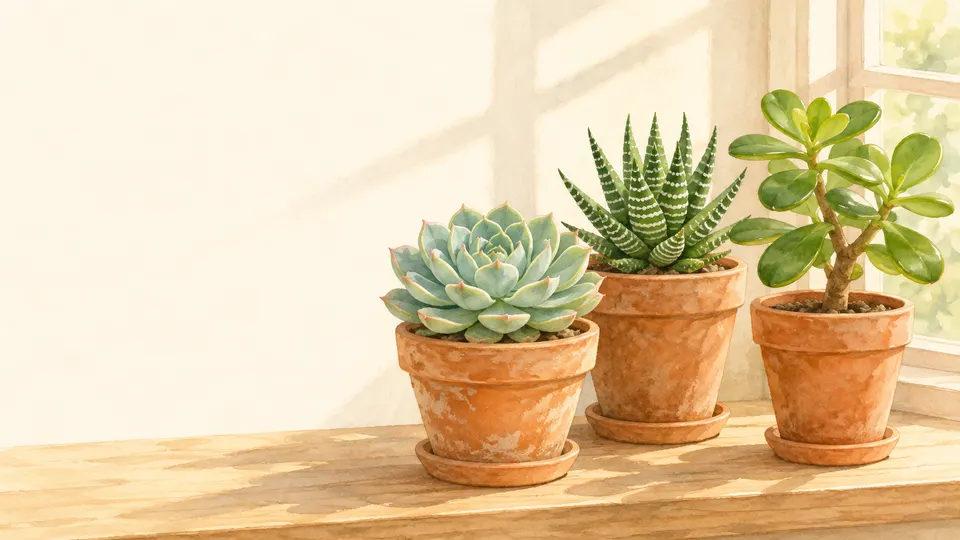
Quick Answer
Give succulents abundant bright light: ideally 10 or more hours of bright, indirect light, such as near a south- or west-facing window. Water thoroughly until it drains, then let the soil dry completely, often every 2 to 3 weeks and no more than monthly in winter. Use a gritty, fast-draining mix in a pot with a drainage hole. Watering too much is the easiest way to kill one.
On this page
Key Takeaways
- Light is often one of the most limiting factors indoors: aim for 10 or more hours of bright, indirect light, and move plants into stronger sun gradually.
- Use a wet-dry cycle: soak the whole root ball, drain it, then let the soil dry completely before watering again.
- Use a cactus and succulent mix, or one part organic material to two parts perlite, sand, pumice, or gravel, in a pot with a drainage hole.
- Yellow, mushy leaves mean too much water; wrinkled leaves with dry soil mean too little. Root rot can mimic thirst, so check the soil.
- Jade, aloe, and kalanchoe are listed by the ASPCA as toxic to cats and dogs; echeveria, haworthia, and burro's tail are listed as non-toxic.
What Makes Succulents Different?
Succulents store water in thick, fleshy leaves or stems, which is why they can go weeks between waterings [1] [3] [2]. They come from many plant families, including the stonecrop, spurge, and cactus families. All cacti are succulents, but not all succulents are cacti [1].
The easiest way to kill a succulent is to water it too much. [4] Good care starts with bright light, a fast-draining mix, and a soak-then-dry watering rhythm [1].
Succulent Care at a Glance
| Need | What works | Source |
|---|---|---|
| Light | Abundant bright light: ideally 10 or more hours of bright, indirect light, at least 6 to 8 for most | Iowa State |
| Water | Soak the whole root ball, let it drain, then let the soil dry completely; Iowa State suggests starting at every 2 to 3 weeks | Iowa State |
| Soil | About one-third organic material and two-thirds mineral material, or a cactus and succulent mix | Iowa State |
| Pot | Drainage hole required; small, snug, porous pots dry fastest | Iowa State |
| Temperature | 55 to 75°F, with cooler nights | Iowa State |
| Humidity | Low household humidity is fine | Iowa State, MBG |
| Fertilizer | Light: one-half to one-quarter strength in spring and summer only | Iowa State |
The table summarizes Iowa State Extension's guidance [1] [2], with Missouri Botanical Garden on humidity [3].
Not every plant called a cactus follows these rules. Christmas and Thanksgiving cacti are tropical "jungle cacti" that want more moisture and less direct sun [3]; see our Christmas cactus care guide for those.
How Much Light Do Succulents Need Indoors?
Iowa State Extension calls light often one of the most limiting factors indoors and recommends 10 or more hours of bright, indirect light, with most succulents needing at least 6 to 8 hours [1]. Missouri Botanical Garden says cacti and succulents generally need at least 4 hours of bright, direct light a day [3]. University of Illinois Extension recommends a south- or west-facing window [4]. These numbers measure different things: Iowa State's hours are bright, indirect light, while Missouri Botanical Garden's 4 hours are direct sun. A south- or west-facing window gives the most light indoors [4]; in a west window, watch for scorch from hot afternoon sun, which Iowa State says most succulents appreciate protection from [2].
Introduce direct sun gradually: a plant moved suddenly from lower light into strong sun can scorch, leaving brown, tan, or bleached patches that will not recover [2] [3].
Signs of too little light are tall, lanky, pale new growth, and rosettes that open up and flatten their leaves to catch more light [2]. If a window is not bright enough, use a high-output full-spectrum fluorescent or LED grow light. Iowa State suggests placing plants within 12 inches of the light and running it 12 to 16 hours a day on a timer [2]. Rotating the pot helps prevent lopsided growth [1].
How Do You Water Succulents?
Use a wet-dry cycle. Water thoroughly until the whole root ball is wet and water drains out, then let the soil dry completely before watering again [1]. Never leave water standing in a saucer, sleeve, or outer pot for more than a few hours [1].
How often depends on light, soil, pot, temperature, and humidity. Iowa State suggests starting at about every 2 to 3 weeks [1]. Missouri Botanical Garden recommends checking moisture every 2 to 3 weeks, watering more often during active growth (March to October in the Midwest), and watering no more than once a month in winter, when growth slows and overwatering leads to root rot [3]. For a full schedule by season, see how often to water succulents.
How to check: push a finger or a chopstick several inches into the soil. If the chopstick comes out darker with moisture, wait a few days [1] [2]. You can also learn the weight of the pot when it is dry [3].
Watering too little causes problems too. Iowa State notes that succulents still need regular water, and that growth can speed up considerably with a consistent wet-dry cycle [1].
What Soil and Pot Should You Use?
Regular potting soil holds too much water for succulents and risks root rot [1]. Use a sharp-draining mix instead:
- Buy it: a commercial cactus and succulent mix is a good choice for beginners [1].
- Mix it: combine one part organic material (potting soil, pine bark, compost, or coir) with two parts mineral material (perlite, coarse sand, pumice, or fine gravel) [1].
Pots. Every container needs a drainage hole. Iowa State warns that a layer of gravel at the bottom is not a substitute; plants in such pots often stay too wet [1]. If you love a pot without a hole, plant the succulent in a slightly smaller pot that drains and set it inside, emptying any water that collects [1]. Clay and terracotta are ideal because they dry faster, and small, shallow, snug pots dry out more quickly than oversized ones [1]. For mix recipes in detail, see the best soil for succulents.
Temperature, Humidity, Feeding, and Repotting
Temperature. Typical home conditions suit most succulents. Iowa State gives 55 to 75°F as ideal, with some tolerating 45 to 85°F, and notes that cooler nights and warmer days work well [1]. Some succulents do better with a cool, bright rest period in winter [3].
Humidity. The low humidity in most homes, especially in winter, is fine and helps the soil dry [1] [3].
Feeding. Most succulents need little. Use an all-purpose fertilizer at one-half to one-quarter of the label rate, every 3 to 4 waterings in spring and summer, or a succulent fertilizer as directed. Do not feed in winter [1].
Air flow. Good air circulation helps the soil dry and can reduce the risk of pests such as mealybugs and spider mites [1].
Summer outdoors. Succulents can go outside for summer. Iowa State recommends part sun so intense light does not damage leaves and stems [1], and Missouri Botanical Garden advises moving plants to filtered light first to prevent sunscald [3]. Bring them in before temperatures drop below freezing [4].
When Should You Repot a Succulent?
Not often. Succulents do well in snug containers because the soil dries faster, but over time the soil breaks down and holds more water, and larger plants can become top-heavy [1]. When you repot, choose a container just big enough for the roots, with a drainage hole, and avoid oversized pots, which stay wet longer [1]. Missouri Botanical Garden suggests repotting when growth begins in spring, into a pot only about 1 inch larger in diameter [3].
Handle plants gently, and use thick gloves or a folded band of paper for spiny ones [1]. Repotting is also a good time to propagate: most succulents grow easily from offsets, stem cuttings, or leaf cuttings [1]. Missouri Botanical Garden suggests letting offsets and cuttings dry for about two days so the cut end calluses, then potting them in a sandy mix [3]. Snake plants can also be grown from leaf sections [3]; see how to propagate a snake plant.
Common Succulent Problems
| Symptom | Likely cause | What to do |
|---|---|---|
| Yellow, soft, mushy leaves and stems; damp soil; fungus gnats | Overwatering [2] | Stop watering, let the soil dry thoroughly, and repot into sharp-draining mix if needed |
| Leaves shrivel, wrinkle, yellow, or brown, then drop; soil bone dry | Underwatering [2] | Water thoroughly when the soil is dry; do not wait too long |
| Dropping or shriveling leaves with wet soil | Root rot from waterlogged soil [2] | Let the soil dry; if rot is advanced, propagate healthy pieces |
| Tall, pale, stretched growth; flattened rosettes | Too little light [2] | Move to brighter light or add a grow light |
| Brown or tan patches on leaves or stems | Sun scald after a sudden move into bright sun [2] | Change light gradually; damaged areas will not recover |
| White cottony masses, sticky honeydew | Mealybugs [2] | Isolate the plant, remove the masses, and treat with a product labeled for the pest |
| One or two dry lower leaves on a healthy plant | Normal aging [2] | Simply remove them |
Iowa State explains that root rot kills roots, so the plant shrivels and drops leaves as if it were dry, and adding more water makes it worse [2]. Always check the soil before you water a shriveling succulent.
Are Succulents Safe for Cats and Dogs?
It depends on the plant. The ASPCA lists some common succulents as non-toxic and others as toxic to cats and dogs:
| Succulent | ASPCA listing |
|---|---|
| Echeveria (ASPCA entry: variegated wax plant, Echeveria sp.) | Non-toxic [5] |
| Haworthia | Non-toxic [6] |
| Burro's tail (Sedum morganianum) | Non-toxic [7] |
| Jade plant | Toxic [8] |
| Aloe (ASPCA entry: Aloe vera) | Toxic [9] |
| Kalanchoe | Toxic [10] |
If you think your pet has eaten part of any plant and seems unwell, contact your veterinarian or the ASPCA Animal Poison Control Center right away. For more on individual plants, see our guides to jade plant care and kalanchoe care.
Frequently Asked Questions
How often should I water succulents?
Iowa State Extension suggests starting at about every 2 to 3 weeks and adjusting for light, soil, pot, and temperature. Missouri Botanical Garden recommends no more than once a month in winter. Always let the soil dry completely between waterings.
Can succulents grow in low light?
Some tolerate lower light, but most struggle. Iowa State Extension says most succulents need at least 6 to 8 hours of bright, indirect light, ideally 10 or more. In low light they grow tall, pale, and stretched. A grow light within 12 inches, on for 12 to 16 hours a day, can fill the gap.
Why are my succulent's leaves wrinkled?
Often the plant is too dry: Iowa State Extension says wrinkled or drying lower leaves mean conditions are too dry. But root rot from overwatering can also cause shriveling, because damaged roots cannot take up water. Check the soil: if it is wet, do not water more.
Do succulents need special soil?
They need sharp-draining soil. Iowa State Extension recommends a commercial cactus and succulent mix, or one part organic material to two parts mineral material such as perlite, coarse sand, pumice, or fine gravel.
Do succulent pots need drainage holes?
Yes. Iowa State Extension notes that a gravel layer in the bottom is not a substitute for a drainage hole. If a decorative pot has no hole, set a smaller pot that drains inside it and empty any water that collects.
Our Take
We think most beginners lose succulents to kindness, not neglect. All four care guides we cite warn against overwatering, and Iowa State points out that a rotting succulent can shrivel just like a thirsty one, which tempts owners to water even more. In our view, the most useful habit is to check the soil several inches down before every watering, and to treat light as the first fix when a plant looks stretched or pale. This is our editorial opinion based on extension and botanical garden guidance, not a test we ran.
Sources
- Growing Succulents Indoors. Iowa State University Extension and Outreach (Aaron Steil; last reviewed December 2024).
- Common Problems and Issues of Succulents. Iowa State University Extension and Outreach (Aaron Steil; last reviewed August 2023).
- Cacti and Succulents (fact sheet). Missouri Botanical Garden, Gardening Help.
- Growing Succulents: Beyond the Basics. University of Illinois Extension (Candice Anderson, December 15, 2017).
- Variegated Wax Plant (Echeveria sp.). ASPCA Toxic and Non-Toxic Plants.
- Haworthia. ASPCA Toxic and Non-Toxic Plants.
- Burro's Tail. ASPCA Toxic and Non-Toxic Plants.
- Jade Plant. ASPCA Toxic and Non-Toxic Plants.
- Aloe. ASPCA Toxic and Non-Toxic Plants.
- Kalanchoe. ASPCA Toxic and Non-Toxic Plants.
Plant care advice is general guidance: adjust for your light, season and pot, and check the soil before you water. Pet toxicity follows the ASPCA list only; if a pet may have eaten part of a plant, contact your veterinarian or the ASPCA Animal Poison Control Center right away.Spotted an error? Tell us.
Related Guides
How Often to Water Succulents
How often to water succulents: check about every 2 to 3 weeks, water only when dry several inches down, water less in winter, and tell rot from thirst.
The Best Soil for Succulents (and How to Mix Your Own)
Succulent soil guide: why regular potting soil stays too wet, how organic and mineral parts compare, four DIY recipes, the right pot, and when to repot.
Jade Plant Care: Light, Water, Pruning, and Propagation
Jade plant care: 4+ hours of direct sun, deep watering once the soil dries, less water in winter, a heavy pot, spring pruning, easy cuttings, leaf drop fixes.
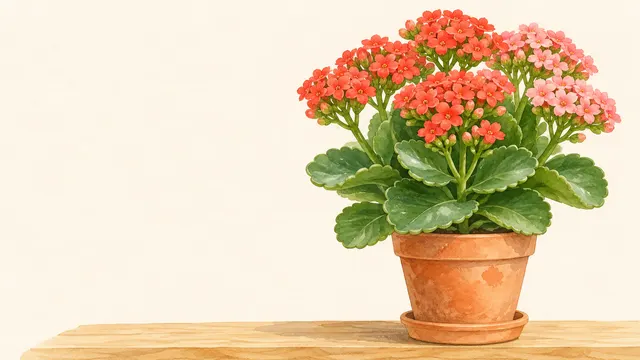
Kalanchoe Care: Light, Water, and Reblooming
Kalanchoe care for florist kalanchoe: bright light, soil that dries between waterings, and about 14 hours of nightly darkness for 6 weeks to bloom again.
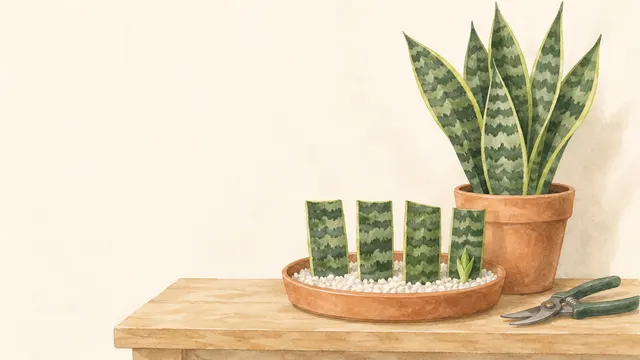
How to Propagate a Snake Plant
How to propagate a snake plant by division, offsets, or leaf cuttings, step by step, and why leaf cuttings from variegated plants usually grow back all green.
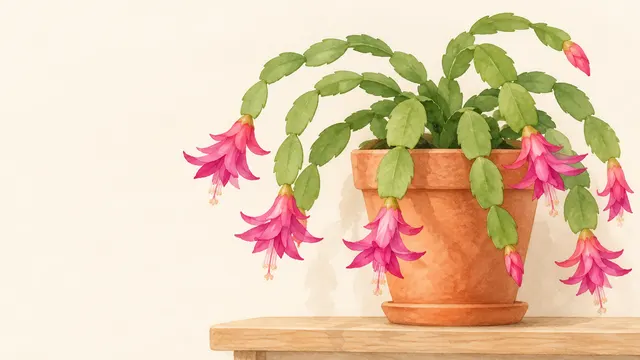
Christmas Cactus Care: How to Get It to Bloom
Christmas cactus care for beginners: tell it from a Thanksgiving cactus, water when the soil is nearly dry, and use cool, fully dark fall nights to set buds.