How to Propagate a Snake Plant
Quick Answer
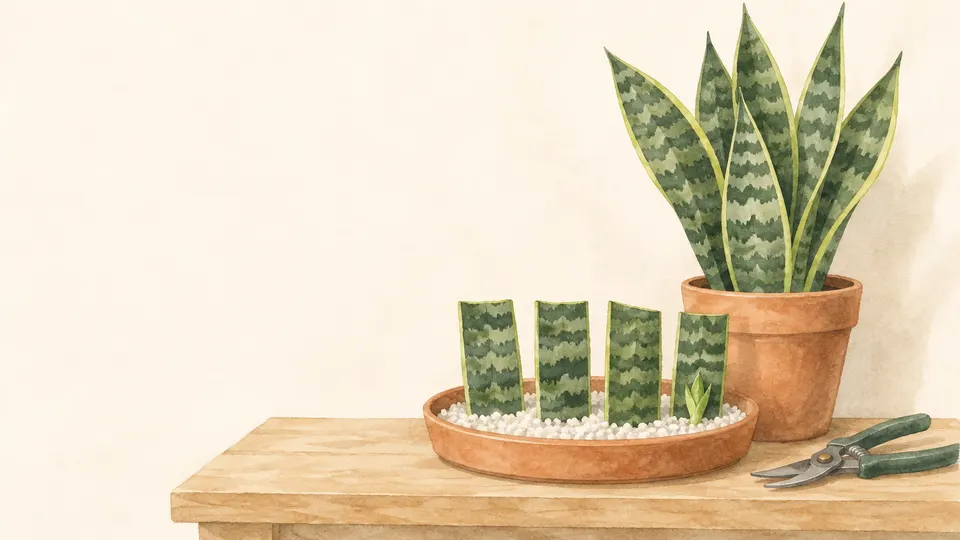
The easiest way to propagate a snake plant is division: unpot it and split the clump so each piece has leaves and roots. For all-green plants, you can also slice a leaf into 2 to 5 inch sections, let them callus for a day or two, and plant them bottom end down in moist perlite or a well-drained mix. New plantlets appear in about two months. Variegated types should be divided to keep their edges.
On this page
Key Takeaways
- Division is the easiest method, according to Penn State, and gives you rooted plants right away.
- Leaf cuttings from variegated snake plants like 'Laurentii' usually lose their yellow edges, so divide those instead.
- For leaf cuttings, mark which end is the bottom; roots form only there, and upside-down cuttings will not root.
- Let leaf sections callus for a day or two, then plant them in moist perlite or mix; plantlets appear in about two months.
- Spring is the best time. Wear gloves, since the sap can irritate skin.
Which Propagation Method Should You Use?
Snake plants (Dracaena trifasciata, formerly Sansevieria trifasciata) can be propagated three ways: by dividing the clump, by potting up offsets, or by rooting sections of a leaf [3] [4]. Penn State Extension says division is the easiest [4].
If your plant has yellow edges, divide it. Leaf cuttings from variegated snake plants, such as 'Laurentii' with its yellow edges, usually lose that pattern. Iowa State Extension explains that the variegation in these cultivars comes from a chimera, so they do not come true from leaf cuttings; propagate them by division instead [1]. The RHS adds that cuttings from variegated cultivars tend to revert to green [3].
| Method | Best for | Keeps yellow edges? | Time to a new plant |
|---|---|---|---|
| Division | Large, crowded plants | Yes | Immediate; the new piece already has roots |
| Offsets (pups) | Plants with young rosettes around the edge | Yes, by our reasoning (offsets are rooted divisions) | Rooted right away; establishes in a few weeks |
| Leaf cuttings in soil or perlite | All-green plants; making many plants | Usually not | Roots and shoots in several weeks; plantlets in about two months |
| Leaf cuttings in water | Experimenting only; less reliable for succulents | Usually not | No snake plant timing given by our sources |
Sources for the table: RHS, Penn State, and Iowa State Extension [3] [4] [1] [2].
When to do it. The RHS recommends spring, about March to May, when snake plants start growing again after winter [3]. Iowa State says early spring is ideal for cuttings, though most houseplants can be propagated any time of year [1]. Wear gloves, because the sap can irritate skin [3].
How Do You Divide a Snake Plant?
Division gives you rooted plants right away and keeps the leaf pattern [1] [3]. It also fits naturally with repotting, which a crowded snake plant eventually needs [4].
- Unpot the plant. Slide the whole root ball out of the container [3].
- Split the clump. Pull or cut it into pieces, making sure each piece has one or more leaves attached to roots. The root ball can often be pried apart by hand, but a sharp knife or pruners help with tough sections [3].
- Discard damaged parts. Replant only healthy sections [3].
- Repot each piece. Use fresh, fast-draining cactus mix in a snug pot with drainage holes [4] [3]. Water lightly; the new piece should establish in a few weeks [2].
- Support tall pieces. A stake and string can hold a wobbly division upright until it roots in [3].
Offsets work the same way. Established plants produce young rosettes, or pups, around the outside of the clump. Pull away well-rooted offsets and pot them individually, or plant several together for a fuller pot [3]. Iowa State's advice for succulent offsets is to keep both leaves and roots attached to each piece [2]. Offsets are rooted pieces of the same clump, not leaf cuttings, so they should keep the leaf pattern just as divisions do; our sources name division specifically for variegated plants [1].
How Do You Propagate a Snake Plant from a Leaf Cutting?
Leaf cuttings let you turn one leaf into several new plants, and Iowa State lists snake plant among the best houseplants for leaf section cuttings [1]. The one rule you cannot break: keep track of which end was down. Roots and shoots form only on the bottom end, and a cutting planted upside down will not root. [2] [5]
- Cut a healthy leaf. Remove a mature leaf at its base with clean, sharp pruners or scissors [3] [2].
- Slice it into sections. Sources suggest sections from about 2 inches to 5 inches long: the RHS uses about 2 inches, Iowa State's houseplant guide uses 3 to 4 inches, and its succulent guide 3 to 5 inches [3] [1] [2].
- Mark the top. Cut the bottom straight across and the top at an angle, or cut a notch in the top, so you always know which end goes down [2] [1].
- Let the cut ends callus. Leave the sections in a dry place for a day or two [3] [2].
- Plant bottom end down. Insert the bottom 1 to 2 inches, or about half the section, into moist perlite, a perlite and peat mix, or a well-drained mix, in a container at least 2 inches deep with good drainage [1] [2] [3]. Iowa State's leaf-section method dips the bottom end in rooting hormone [1]; its succulent guide notes that most succulents root quickly and easily without it [2].
- Keep it warm and bright. Iowa State recommends 65 to 75°F air, 4 to 6 hours of bright, indirect light, and higher humidity, such as a loosely closed clear bag or dome [1]. The RHS suggests a propagator with bottom heat of about 65°F, or a clear bag in a warm room [3].
- Wait. Roots and shoots develop over several weeks, and Iowa State says new plantlets should appear at the base in about two months [2] [1].
When the new plant has enough roots and shoots, Iowa State suggests moving it to a pot of regular potting mix and keeping it in bright, indirect light; Penn State's general advice for snake plants is a cactus mix or a mix with perlite [4]. The original leaf section can be removed once it browns or the new plant is established, though Iowa State says that is optional [1].
Should You Root Snake Plant Cuttings in Water?
We do not recommend it as a first choice. None of the sources we used gives a water method for snake plant, and Iowa State notes that most succulents do not root well in a glass of water [2]. Iowa State's leaf-section guide uses moist perlite or another rooting medium instead [1].
If you experiment with water anyway, Iowa State's general advice for rooting houseplant cuttings in water applies [1]:
- Change the water once or twice a week.
- Never let the water level drop and expose the developing roots to air.
- Expect coarser roots that adjust less easily to soil; the young plant may wilt or show tip die-back after potting.
- Pot the cutting up when the roots are about 1 inch long, and give it steady care while it adjusts.
What If Your Cuttings Rot or Stall?
Start by checking the light. Iowa State explains that too little light slows root formation, and cuttings may rot or dry out before new roots form, while too much light can burn them, especially under a plastic bag or dome [1]. Aim for 4 to 6 hours of bright, indirect light and air around 65 to 75°F [1].
If a section turns soft at the base, suspect too much water: the RHS says overwatering and standing water are usually the main problem for snake plants, potentially leading to root rot [3]. Iowa State adds that cuttings kept in too little light may also rot before roots form [1]. Check that the container drains well, moisten the mix only when it is dry, and leave the bag slightly open for air exchange [1]. Remember that leaf cuttings are slow: plantlets can take about two months to appear [1].
Caring for New Snake Plants
Treat new divisions and rooted cuttings like any snake plant, with a little extra care at first. Keep them in bright, indirect light. Iowa State advises keeping a newly potted cutting well watered while it establishes; after that, water when the mix dries and never leave it sitting wet [1] [3] [4]. Iowa State suggests starting regular fertilizing once a new plant from a cutting is established [1]. For light, watering, and pot advice, see our full snake plant care guide.
If you grow other succulents too, compare these steps with our succulent care guide. For a plant you can root in water or soil, see our guide to propagating pothos.
Pets. The ASPCA lists the snake plant as toxic to cats and dogs, so keep cuttings, divisions, and trimmed leaves out of reach [6]. If you think your pet has eaten part of one, contact your veterinarian or the ASPCA Animal Poison Control Center right away.
Frequently Asked Questions
How long does it take to propagate a snake plant?
A division is already rooted; Iowa State Extension says a lightly watered division establishes in a few weeks. Leaf cuttings take longer: roots and shoots develop over several weeks, with new plantlets appearing at the base in about two months.
Why did my variegated snake plant cutting grow all green?
The yellow edges on cultivars like 'Laurentii' come from a chimera, which Iowa State Extension says does not come true from leaf cuttings. The RHS notes cuttings from variegated cultivars tend to revert to green. Divide variegated plants instead.
Can I root snake plant cuttings in water?
Our sources do not give a water method for snake plant, and Iowa State Extension notes that most succulents do not root well in a glass of water. Its snake plant method uses moist perlite instead. If you experiment with water, change it once or twice a week, keep the roots covered, and pot the cutting when roots are about 1 inch long.
Do I need rooting hormone for snake plant cuttings?
It is optional. Iowa State Extension's leaf section method includes dipping the bottom end in rooting hormone, while its succulent propagation guide describes snake plant sections without mentioning it.
Our Take
We think most people should start with division, even though leaf cuttings may seem like the classic method. Penn State calls it the easiest method, it produces rooted plants immediately, and division (or offsets, which are small divisions) is the way to keep the yellow edges on variegated types. In our view, leaf cuttings are best saved for all-green plants, or for when you want a batch of new plants and do not mind waiting a couple of months. This is our editorial opinion based on extension and RHS guidance, not a test we ran.
Sources
- How to Propagate Houseplants by Leaf Section Cuttings. Iowa State University Extension and Outreach (Aaron Steil; last reviewed January 2025).
- How to Propagate Succulents. Iowa State University Extension and Outreach (Aaron Steil; last reviewed August 2023).
- How to grow sansevierias. Royal Horticultural Society.
- Snake Plant: A Forgiving, Low-maintenance Houseplant. Penn State Extension (updated September 20, 2023).
- A Houseplant Anyone Can Grow: Mother-In-Laws Tongue. University of Illinois Extension (Rhonda Ferree).
- Snake Plant. ASPCA Toxic and Non-Toxic Plants.
Plant care advice is general guidance: adjust for your light, season and pot, and check the soil before you water. Pet toxicity follows the ASPCA list only; if a pet may have eaten part of a plant, contact your veterinarian or the ASPCA Animal Poison Control Center right away.Spotted an error? Tell us.
Related Guides
Snake Plant Care: Light, Water, and Common Mistakes
Snake plant care for beginners: bright indirect light, water only when the soil is dry (about every 2 to 6 weeks, less in winter), a snug pot, and rot traps.
How to Propagate Pothos (Water vs Soil)
How to propagate pothos from stem cuttings: where to cut around the nodes, rooting in water vs a moist mix, how long roots take, and when to pot water cuttings.
Succulent Care for Beginners
Succulent care for beginners: bright light, a soak-and-dry watering rhythm, gritty soil in a pot with drainage, and how to read wrinkled or mushy leaves.
ZZ Plant Care: Light, Water, Soil, and Yellow Leaves
ZZ plant care: bright indirect light (low light tolerated), water 1 to 2 times a month only once the mix dries, a coarse mix, and how to fix yellow leaves.
Christmas Cactus Care: How to Get It to Bloom
Christmas cactus care for beginners: tell it from a Thanksgiving cactus, water when the soil is nearly dry, and use cool, fully dark fall nights to set buds.
Jade Plant Care: Light, Water, Pruning, and Propagation
Jade plant care: 4+ hours of direct sun, deep watering once the soil dries, less water in winter, a heavy pot, spring pruning, easy cuttings, leaf drop fixes.