ZZ Plant Care: Light, Water, Soil, and Yellow Leaves
Quick Answer
Give a ZZ plant bright, indirect light; it survives low light but grows more slowly, and direct sun can scald the leaves. Water only after the potting mix has dried; Clemson suggests 1 to 2 times a month, but check the soil first. Use a coarse, well-draining mix and keep it above 60°F. UConn lists yellow leaves and rotting rhizomes as signs of overwatering.
On this page
Key Takeaways
- ZZ plant (Zamioculcas zamiifolia) grows from thick rhizomes that store water, so it handles dry soil well.
- Bright, indirect light is best. It survives low and fluorescent light but grows slowly, and direct sun can scald the leaves.
- Water only when the mix has dried: Clemson suggests 1 to 2 times a month, and NC State suggests about once a month in winter. Check the soil first.
- UConn names overwatering as just about the only thing that kills a ZZ plant; the signs are yellow leaves and rotting rhizomes.
- The ASPCA's dog and cat plant lists do not include ZZ plant, which does not mean it is safe for pets.
What Is a ZZ Plant?
The ZZ plant, Zamioculcas zamiifolia, is an evergreen aroid (family Araceae) that grows from thick underground rhizomes [2]. It is also called Zanzibar gem, Zuzu plant, emerald palm, and eternity plant [2] [3]. NC State describes it as native to tropical Africa [2].
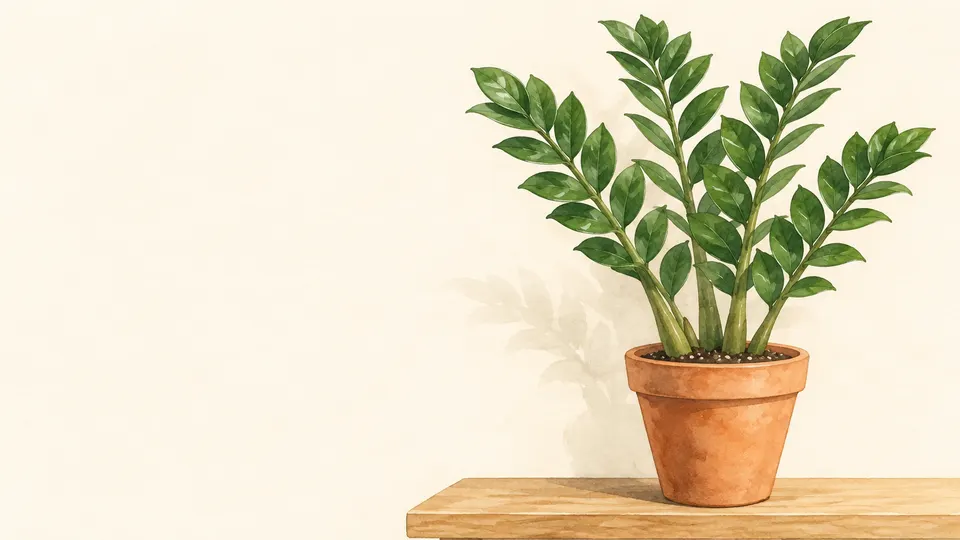
Each glossy leaf is a compound leaf, usually with 6 to 8 pairs of leaflets along a central stalk, and the slightly swollen base of the leaf rises straight from the rhizome [4] [5]. Clemson notes that these bulbous rhizomes store water and are drought resistant [1]. Iowa State calls the ZZ plant nearly indestructible because it tolerates low light, dry soil, and low humidity [4].
It grows slowly, eventually reaching 2 to 4 feet tall and wide [2]. Flowers are rare: NC State says it rarely flowers. The RHS says one or two green and white, arum-like flowers may appear among the leaf bases in summer, and UConn mentions small brownish to yellow flowers in late summer [2] [5] [3].
| Type | What it looks like |
|---|---|
| Species (Z. zamiifolia) | Glossy green leaflets on upright, arching stalks |
| 'Chameleon' | New leaves emerge golden yellow, then turn dark green |
| 'Lucky' | Wide green leaves with rounded tips |
| Raven 'Dowon' | Lime green new growth that ages to purple black |
Source for the table: NC State Extension [2].
How Much Light Does a ZZ Plant Need?
Bright, indirect light is best, but a ZZ plant copes with low light. Clemson says it can survive in low light, and that bright, indirect light helps speed up its very slow growth [1]. According to Iowa State, it does exceptionally well in low light [4], and NC State and UConn note that it can grow in rooms lit only by fluorescent light [2] [3]. UConn adds that a windowless office works if the plant gets fluorescent light for several hours each day [3].
Keep a ZZ plant out of direct sun. Place it anywhere except full sunlight, as Clemson advises [1]. NC State warns that direct sun can scald and brown the leaves [2]. UConn says the plant will not tolerate direct sunlight, except perhaps an east window in winter, and lists the signs of too much light: whitened, scalded leaves that may curl, yellow, and then brown, and stems that bend away from the light [3]. If you see those signs, UConn suggests moving the plant to a spot with more indirect light [3].
Low light has a cost, though. UConn notes that growth is much slower in the dimmer conditions of many homes [3]. If you want a second plant for a dim corner, our snake plant care guide covers another low-light option.
How Often Should You Water a ZZ Plant?
Water a ZZ plant only after the potting mix has dried. Clemson suggests watering 1 to 2 times a month, only after the potting medium has completely dried [1]. NC State gives a seasonal version: twice monthly in summer, but only if the soil has dried out completely, and once a month in winter when the plant is not actively growing [2].
The sources differ slightly on how dry is dry enough. Clemson and NC State say to wait until the mix has completely dried [1] [2], while UConn says to let it dry slightly between waterings and, when in doubt, err on the dry side [3]. Our suggestion, not a source's: feel the mix and water only when it is dry well below the surface.
Treat those intervals as a starting point, not a schedule. In our view, a plant in brighter light, a warmer room, or a smaller pot will likely dry out faster than one in a dim, cool spot, so check the soil before every watering. For the same habit applied to drought-tolerant plants in general, see our guide on how often to water succulents.
How to water [1]:
- Check that the potting mix has dried.
- Water the soil, then let the container drain fully before you set it back in a decorative pot or saucer.
- Never let the plant sit in water.
What Soil, Pot, and Room Conditions Suit a ZZ Plant?
Use a coarse, well-draining mix. Clemson suggests 50% peat moss or coir-based potting soil, 25% perlite, and 25% sand [1]. NC State says to use well-drained potting soil and notes that the plant can be treated much like a cactus or other succulent [2]. For more on gritty mixes, see our guide to the best soil for succulents.
Clemson doesn't name a pot type, but it advises fully draining the container and never letting the plant sit in water [1], so we suggest a pot with drainage holes. ZZ plants spread slowly sideways, adding stems as they age, and UConn notes that the strong stems can push out and eventually crack the sides of a pot when a plant is left in it too long [3]. If the pot starts to bulge or crack, the plant has been in it too long. [3]
Temperature. The sources give slightly different floors. Clemson says ZZ plants are sensitive to cold and should be kept above 60°F [1], while UConn gives a range of 55 to 80°F and notes that plants grow faster when warmer [3]. Our suggestion: keeping it between 60 and 80°F fits both sources. If you put it outdoors in summer, NC State says to bring it inside once temperatures fall below 60°F [2].
Humidity. Ordinary indoor air is fine. Clemson says ZZ plants are adapted to arid conditions and thrive at regular indoor humidity [1], and Iowa State notes they tolerate low humidity [4].
Fertilizer. ZZ plants need very little feeding. Clemson's guidance is to fertilize only once or twice during the growing season with a balanced fertilizer [1]. UConn suggests a balanced houseplant fertilizer at half strength once or twice in the growing season, or full strength once every six months [3], and NC State suggests a balanced liquid houseplant fertilizer once or twice a year [2].
How Do You Propagate a ZZ Plant?
NC State and Iowa State list two methods: division and leaf cuttings [2] [4]. Division means separating a crowded plant into smaller clumps. We suggest dividing when you already have the plant out of its pot.
Leaf cuttings take patience. UConn describes the steps [3]:
- Remove whole leaves from a stem.
- Leave them out for a few hours so the cut end calluses over.
- Push the stem end partway into moist soilless potting mix.
- Keep the mix moist and the cutting in indirect light.
Be patient. Under greenhouse conditions, small rhizomes start to form at the base of the leaves in about a month, but in a typical home it may take up to 9 months [3]. For another propagation project, see our guide to propagating pothos.
Why Are ZZ Plant Leaves Turning Yellow?
Overwatering is the first thing to rule out. UConn says overwatering is just about the only factor that leads to the death of this tough houseplant, and that its signs are yellow leaves and rotting rhizomes [3]. Clemson also warns that overwatering can lead to root rot [1]. Yellowing has other possible causes too, so check the conditions below.
| Possible cause | What the sources describe | What to do |
|---|---|---|
| Overwatering | Yellow leaves and rotting rhizomes [3]; root rot [1] | Let the mix dry before watering; drain fully; never leave water in the saucer |
| Too much direct sun | Leaves scald or whiten, may curl, yellow, then brown [3] [2] | Move it to bright, indirect light |
| Cold | ZZ plants are sensitive to cold [1]; UC IPM lists low temperatures among general causes of yellowing and dropping leaves [6] | Keep it above 60°F and away from cold spots |
| Too little light | UC IPM lists inadequate light among causes of yellowing and dropping leaves on houseplants [6]; UConn notes growth is much slower in low light [3] | Move it closer to bright, indirect light |
| Scale insects | NC State says to watch for scale [2]; UC IPM says soft scales leave sticky honeydew and can discolor leaves [6] | Check leaf bases and leaflet folds; scrape scales off or use a product labeled for use on this plant, following the label |
If you suspect rot, look at what is below the soil. UC IPM notes that healthy roots should be white, while brownish to blackish roots, especially at the tips, often indicate root rot [6]. Otherwise, ZZ plants have few problems: Clemson reports no serious insect or disease problems, and UConn says the plant has very few disease or insect issues [1] [3].
Is a ZZ Plant Toxic to Cats and Dogs?
The ASPCA's plant lists for dogs and cats do not include the ZZ plant (Zamioculcas zamiifolia) [7] [8]. A plant missing from the ASPCA lists is not the same as a plant the ASPCA has found safe. Keep a ZZ plant where pets cannot chew on it.
If you think your pet has eaten part of a ZZ plant, contact your veterinarian or the ASPCA Animal Poison Control Center right away. Our guides to peace lily care and spider plant care each note how the ASPCA lists those plants.
Frequently Asked Questions
How often should I water a ZZ plant?
Only after the potting mix has dried. Clemson Extension suggests about 1 to 2 times a month, and NC State suggests twice a month in summer and once a month in winter. Check the soil first rather than following a calendar.
Can a ZZ plant live in a room with no windows?
It can if it gets fluorescent light for several hours a day. UConn says a windowless office works under those conditions, and NC State notes it can grow under fluorescent light alone. Growth will be slow.
Why are my ZZ plant's leaves turning yellow?
Check watering first. UConn says the signs of overwatering are yellow leaves and rotting rhizomes. Too much direct sun can also make leaves yellow and then brown, and UC IPM lists low temperatures and too little light among general causes of yellowing houseplant leaves.
Can a ZZ plant break its pot?
Yes. UConn notes that the strong stems can push out and eventually crack the sides of a pot when a plant is left in it too long. A bulging or cracked pot is a sign the plant has been in that pot too long; we suggest repotting or dividing it.
How long does a ZZ leaf cutting take to form a rhizome?
Be patient. UConn says small rhizomes form at the base of the leaf in about a month under greenhouse conditions, but in a typical home it may take up to 9 months.
Our Take
We think the ZZ plant's reputation for being hard to kill is fair, with one big exception: too much water. UConn calls overwatering just about the only factor that kills it, and Clemson and NC State both say to wait until the mix has completely dried. In our view, the most useful habit is to treat "1 to 2 times a month" as a reminder to check the soil, not a reminder to water. This is our editorial opinion based on extension guidance, not a test we ran.
Sources
- ZZ Plant. Clemson Cooperative Extension, Home & Garden Information Center (Jackie Jordan, published June 8, 2026).
- Zamioculcas zamiifolia (ZZ Plant). NC State Extension Gardener Plant Toolbox.
- ZZ Plant. UConn Home and Garden Education Center (2019).
- Easy, Low-Maintenance Houseplants. Iowa State University Extension and Outreach (Aaron Steil; last reviewed January 2025).
- Zamioculcas zamiifolia (plant profile). Royal Horticultural Society.
- Houseplant Problems. UC Statewide IPM Program, University of California Agriculture and Natural Resources.
- Toxic and Non-Toxic Plant List: Dogs. ASPCA Animal Poison Control.
- Toxic and Non-Toxic Plant List: Cats. ASPCA Animal Poison Control.
Plant care advice is general guidance: adjust for your light, season and pot, and check the soil before you water. Pet toxicity follows the ASPCA list only; if a pet may have eaten part of a plant, contact your veterinarian or the ASPCA Animal Poison Control Center right away.Spotted an error? Tell us.
Related Guides
Snake Plant Care: Light, Water, and Common Mistakes
Snake plant care for beginners: bright indirect light, water only when the soil is dry (about every 2 to 6 weeks, less in winter), a snug pot, and rot traps.
The Best Soil for Succulents (and How to Mix Your Own)
Succulent soil guide: why regular potting soil stays too wet, how organic and mineral parts compare, four DIY recipes, the right pot, and when to repot.
How Often to Water Succulents
How often to water succulents: check about every 2 to 3 weeks, water only when dry several inches down, water less in winter, and tell rot from thirst.
Peace Lily Care: Watering, Light, and Getting Blooms
Peace lily care for beginners: bright indirect light, moist but not soggy soil, why it droops, how to get blooms, and what brown tips and yellow leaves mean.
How to Propagate Pothos (Water vs Soil)
How to propagate pothos from stem cuttings: where to cut around the nodes, rooting in water vs a moist mix, how long roots take, and when to pot water cuttings.
Spider Plant Care: Light, Water, and Baby Plants
Spider plant care made simple: bright, indirect light, water when the soil starts to dry, what causes brown leaf tips, and how to root the baby plantlets.