How to Propagate Pothos (Water vs Soil)
Quick Answer
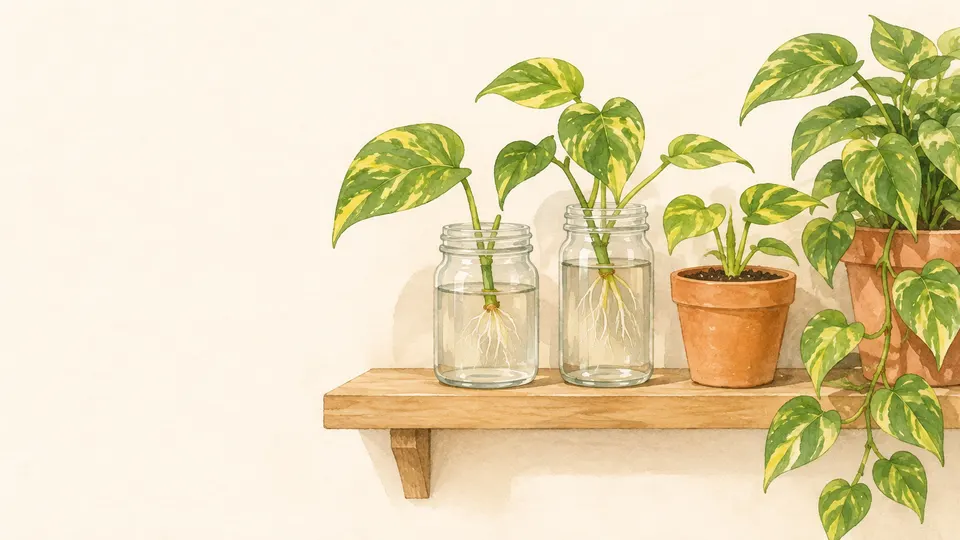
Cut a 3 to 6 inch piece of vine with at least two nodes, strip the lower leaves, and put one or two nodes in water or moist perlite or mix. Water roots can start to show within about ten days, per Nevada Extension; Iowa State gives 3 to 6 weeks as a general figure for houseplant cuttings. Iowa State says water roots are coarser and adapt less easily to soil, so we suggest potting early.
On this page
- Water or Soil: Which Is Better for Pothos Cuttings?
- How Do You Take a Pothos Cutting?
- How Do You Root the Cuttings?
- How Long Does It Take, and When Do You Move a Water Cutting to Soil?
- Why Is My Pothos Cutting Rotting or Not Rooting?
- Caring for a Newly Rooted Pothos
- Frequently Asked Questions
- Our Take
- Sources
Key Takeaways
- Pothos roots readily from stem cuttings in either water or a moist rooting medium such as perlite.
- Each cutting should have at least one node, where leaves and aerial roots grow, under the water or medium.
- Iowa State suggests 3 to 6 inch cuttings with at least two nodes, and no leaves below the surface.
- Water roots are coarser and adapt less easily to soil (Iowa State); Iowa State says to transplant water cuttings at about 1 inch of root.
- The ASPCA lists golden pothos as toxic to cats and dogs; keep cuttings out of reach.
Water or Soil: Which Is Better for Pothos Cuttings?
Both work. Pothos (Epipremnum aureum) is one of the easiest and most forgiving houseplants to grow, and Iowa State Extension says it roots quickly from stem cuttings and lists it among the houseplants best propagated that way [2] [1]. NC State Extension notes that the vines root easily in water, and a University of Nevada Extension fact sheet rates pothos cuttings "very easy" in water or in a rooting medium [3] [5].
By "soil" we mean a moist rooting medium such as perlite or a perlite and peat mix; plain potting soil should only be part of a mix [1].
The difference comes after rooting. Roots grown in water are coarser and not well adapted to potting soil, so a water cutting may wilt, drop or brown leaves, or show tip die-back once it is potted [1]. University of Illinois Extension goes further and does not recommend rooting houseplants in water, because water roots are often weak and adapt less easily to potting mix than roots formed in a rooting medium [4].
| Rooting in water | Rooting in a moist medium (perlite, mix) | |
|---|---|---|
| How it works | Stem in a jar of water, node submerged | Node buried in moist perlite, a perlite and peat mix, or similar |
| First roots / rooting time (sources not comparable) | Nevada Extension (1998): roots begin to appear within ten days | Iowa State: most houseplant stem cuttings form roots in 3 to 6 weeks (all houseplants, not pothos only) |
| Root quality | Coarser, weaker roots that adapt less easily to soil | Roots form in a medium, so there is no jar to soil switch |
| Upkeep | Change the water 1 to 2 times a week; keep roots covered | Keep the medium evenly moist, not soggy; raise humidity with a loose bag or dome |
| Watch for | Wilting or shock after potting | Rot in low light, or drying out before roots form |
| Move to soil | When roots are about 1 inch long | When roots are about 1 inch long or more |
Sources for the table: Iowa State, Illinois, and Nevada Extension [1] [4] [5]. No source we used times water and medium rooting side by side for pothos, so do not read these as a speed comparison.
If you want to watch roots form, water is fine as long as you pot the cutting up early; for the smoothest start in a pot, a moist medium avoids the switch. That is our reading, not a test we ran.
Snake plants are a different case: our snake plant propagation guide recommends rooting their leaf sections in perlite or mix rather than water. NC State and Nevada describe pothos cuttings rooting in water, and Iowa State gives a general water-rooting method for houseplant cuttings, though Illinois Extension recommends against rooting houseplants in water [3] [5] [1] [4].
How Do You Take a Pothos Cutting?
Everything depends on the node. New roots on a stem cutting form from buds on the lower part of the stem [1], and on pothos the nodes are easy to spot: white aerial roots form at the leaf nodes [2], and NC State describes the stems as having adventitious roots that the vine uses to climb [3]. Iowa State's method puts at least one node into the rooting medium on every cutting [1]. Before you cut, check that each piece will have at least one node to go below the waterline or soil line.
- Pick a healthy vine. Leggy stems are good candidates; NC State suggests pruning stems back to keep the plant bushy [3]. Water the parent plant the day before so the cuttings start fully hydrated [1].
- Use clean, sharp tools. Illinois Extension recommends sterilizing pruners or a knife before and between cuts by dipping them in denatured alcohol [4].
- Cut 3 to 6 inches with at least two nodes, Iowa State's guideline for houseplant stem cuttings [1]. Nevada Extension's general method cuts a 3 to 4 inch tip just below a node [5]. You can use the stem tip or a section from farther down the vine; keep segments the right way up, because they will not root upside down, and angle the bottom cut so you remember which end is down [1].
- Strip the lower leaves. Remove the leaves so one or two nodes can go into the water or medium, and make sure no leaves sit below the surface [1].
- Rooting hormone is optional. Iowa State says to treat the cut end with rooting hormone "if desired" [1], and Illinois notes that many houseplants root so easily that hormones are not important [4].
- Root it right away. If you must wait, wrap the cut ends in a moist paper towel and keep them somewhere cool and dim [1].
Timing. Early spring is ideal, but most houseplants can be propagated at any time of year [1]. Nevada Extension suggests propagating while the plant is actively growing [5].
How Do You Root the Cuttings?
In water
Set the cutting in a clean jar so the bare nodes sit under water and the leaves stay above it. Iowa State gives two rules: change the water often, one to two times a week, and never let the water level drop and expose the developing roots to air. [1] Nevada Extension similarly says to keep the water clean and fresh, changing it every few days [5]. Give the jar 4 to 6 hours a day of bright, indirect light for root and shoot growth [1].
In perlite or a rooting mix
Perlite is a great rooting medium because it holds a good balance of water and air; mixes such as perlite with peat moss also work [1]. Our succulent soil guide explains more about how perlite behaves in a potting mix. Use a clean container with drainage that is at least 2 inches deep, and moisten the medium first [1].
Make a hole with a pencil or chopstick, insert the cutting so at least one node is buried, water, and let it drain for a few minutes [1]. Then cover the pot loosely with a clear bag or dome, held off the leaves and not sealed tight, since high humidity is essential for rooting [1]. Keep the medium evenly moist but not soggy [4].
Warmth helps. Iowa State says cuttings root faster in warm air and rooting media: air at 65 to 75°F is ideal, and a heat mat can bring the medium to 75 to 80°F [1].
How Long Does It Take, and When Do You Move a Water Cutting to Soil?
Nevada Extension says roots on water cuttings begin to appear within ten days, and an NC State photo shows pothos cuttings rooting in water after 2 weeks [5] [3]. For cuttings in a rooting medium, most houseplant stem cuttings form roots in 3 to 6 weeks [1]. These figures come from different sources: Nevada's is for water cuttings and says when roots begin to appear, while Iowa State's is a general figure for houseplant stem cuttings in a rooting medium. They do not show that one method is faster. They are starting points; light, warmth, and the season all change the pace.
When to pot a water cutting. Iowa State says to transplant water cuttings when the roots are about 1 inch long [1]. Nevada Extension says to pot them when a good-sized root system develops [5], and Illinois, in its general tips for cuttings, advises not waiting too long to transplant into individual pots [4]. Because water roots adjust poorly to soil, we lean toward Iowa State's earlier 1 inch mark rather than letting roots grow long in the jar. That compromise is our judgment, not a rule from the sources.
To pot up, use regular potting soil, keep the new plant well watered and in bright, indirect light, and expect it to be established within a few weeks [1]. Some wilting at this stage is possible: potted water cuttings may show stress, and consistent care helps them recover [1]. Nevada notes that cuttings may go into shock when moved from water into soil [5].
Why Is My Pothos Cutting Rotting or Not Rooting?
Too little light slows root formation, and cuttings may rot or dry out before new roots form, while too much light can burn foliage, especially under a bag or dome [1].
| Problem | Possible cause (source) | What to try |
|---|---|---|
| No roots after several weeks | Too little light slows rooting; cuttings root faster in warm air and media (Iowa State); no node below the surface | Move to 4 to 6 hours of bright, indirect light; keep air at 65 to 75°F; make sure a node is submerged or buried |
| Stem turns soft or rots in a medium | Too little light, so it rots before rooting (Iowa State); soggy medium (our inference; Illinois advises evenly moist, not soggy) | Improve light; let the bag vent; moisten the medium only when it is dry |
| Water cutting with exposed or drying roots | Water level dropped (Iowa State) | Top up and change the water 1 to 2 times a week |
| Cutting wilts before rooting | Water loss: without roots, cuttings can take up only limited water (Iowa State) | Raise humidity with a loose bag; trim back very large leaves; start from a well-watered parent |
| Leaves scorch under the bag | Too much light (Iowa State) | Move to bright, indirect light |
| Wilting or tip die-back after potting | Coarse water roots adjusting to soil (Iowa State); transplant shock (Nevada) | Keep it well watered and in bright, indirect light while it establishes |
Sources for the table: Iowa State, Illinois, and Nevada Extension [1] [4] [5].
If a water cutting turns mushy, we suggest trimming back to firm tissue with a node and starting again in fresh water; our sources do not cover this case.
Caring for a Newly Rooted Pothos
Once the young plant is established, move it to its permanent spot and begin regular fertilizing [1]. NC State says pothos prefers bright, indirect light but survives long periods in low light, and recommends letting the well-drained potting medium dry out between waterings [3]; Iowa State says to let the soil dry moderately [2]. We suggest checking the soil with a finger before you water, since drying time varies with season, light, and pot size.
Watch for two warning signs NC State lists: overwatering can cause root rot and blackened leaf margins, and low light can cause loss of variegation [3]. NC State also suggests fertilizing every other month, except in winter when the plant is dormant [3].
If you enjoy multiplying plants, spider plants make plantlets that can be removed and potted [2]; see the propagation section of our spider plant care guide. Our rubber plant guide covers a different technique, air layering.
Pets. The ASPCA lists golden pothos (Epipremnum aureum) as toxic to dogs and cats. It names insoluble calcium oxalates as the toxic principle, with clinical signs of oral irritation, intense burning and irritation of the mouth, tongue and lips, excessive drooling, vomiting, and difficulty swallowing [6]. Keep jars of cuttings and trimmed vines out of reach. If you think your pet has chewed on a pothos, contact your veterinarian or the ASPCA Animal Poison Control Center right away.
Frequently Asked Questions
Can you propagate pothos without a node?
Plan on a node for every cutting. Iowa State Extension explains that new roots on stem cuttings form from buds on the lower part of the stem, and its method puts at least one node into the rooting medium. On pothos, the nodes are where the small aerial roots grow.
How long does pothos take to root in water?
A University of Nevada Extension fact sheet says roots begin to appear within ten days, and an NC State photo shows pothos cuttings rooting in water after 2 weeks. Warmth and bright, indirect light help; Iowa State recommends air at 65 to 75°F.
Can pothos live in water permanently?
Our sources do not cover growing pothos long term in water. They treat water as a rooting step: Iowa State says to transplant water cuttings to potting soil when roots are about 1 inch long. It also notes that water roots are coarser and not well adapted to soil.
Do I need rooting hormone for pothos cuttings?
No. Iowa State Extension lists rooting hormone as optional, and University of Illinois Extension notes that many houseplants root so easily on their own that rooting hormones are not important.
Why are my pothos cuttings not rooting?
Check that a node is under the water or medium, then check light and warmth. Iowa State says too little light slows root formation and can let cuttings rot or dry out first. It recommends 4 to 6 hours of bright, indirect light, and says cuttings root faster in warm air and media, with 65 to 75°F air as ideal.
Our Take
We think the water vs soil question matters less than two habits: making sure each cutting has a node to root from, and potting water cuttings early. Iowa State and Illinois Extension both describe water roots as coarser or weaker than roots grown in a medium, and Illinois does not recommend water rooting at all. In our view, water is still a reasonable choice for pothos if you enjoy watching roots form, as long as you move the cutting to soil around the 1 inch mark. This is our editorial opinion based on extension guidance, not a test we ran.
Sources
- How to Propagate Houseplants by Stem Tip Cuttings. Iowa State University Extension and Outreach (Aaron Steil; last reviewed January 2025).
- Easy, Low-Maintenance Houseplants. Iowa State University Extension and Outreach (Aaron Steil; last reviewed January 2025).
- Epipremnum aureum. NC State Extension Gardener Plant Toolbox.
- Houseplants: Propagation. University of Illinois Extension.
- Propagating Houseplants (FS-98-92). University of Nevada Cooperative Extension (Aggie Roberts and M. L. Robinson, 1998).
- Golden Pothos. ASPCA Toxic and Non-Toxic Plants.
Plant care advice is general guidance: adjust for your light, season and pot, and check the soil before you water. Pet toxicity follows the ASPCA list only; if a pet may have eaten part of a plant, contact your veterinarian or the ASPCA Animal Poison Control Center right away.Spotted an error? Tell us.
Related Guides
How to Propagate a Snake Plant
How to propagate a snake plant by division, offsets, or leaf cuttings, step by step, and why leaf cuttings from variegated plants usually grow back all green.
Spider Plant Care: Light, Water, and Baby Plants
Spider plant care made simple: bright, indirect light, water when the soil starts to dry, what causes brown leaf tips, and how to root the baby plantlets.
Rubber Plant Care: Light, Water, Leaf Drop, and Pruning
Rubber plant care: bright light, water when the soil feels slightly dry, steady warmth away from drafts, plus leaf drop causes, pruning, air layering, and pets.
Money Tree Care: Light, Water, Humidity, and Leaf Problems
Money tree (Pachira aquatica) care: bright light without harsh sun, evenly moist but never soggy mix, 65 to 75°F warmth, humidity, and causes of leaf drop.
ZZ Plant Care: Light, Water, Soil, and Yellow Leaves
ZZ plant care: bright indirect light (low light tolerated), water 1 to 2 times a month only once the mix dries, a coarse mix, and how to fix yellow leaves.
Peace Lily Care: Watering, Light, and Getting Blooms
Peace lily care for beginners: bright indirect light, moist but not soggy soil, why it droops, how to get blooms, and what brown tips and yellow leaves mean.