Rubber Plant Care: Light, Water, Leaf Drop, and Pruning
Quick Answer
Give a rubber plant (Ficus elastica) bright light, such as an east window, and keep it between about 60 and 80°F, away from cold drafts. Water thoroughly, then let the soil dry slightly to the touch, and water less from fall to late winter. Use a well-drained mix in a pot with drainage holes. Too little light, cold drafts, dry air, and overwatering can all cause leaf drop.
On this page
- What Is a Rubber Plant?
- How Much Light and Warmth Does a Rubber Plant Need?
- How Should You Water, Pot, and Feed a Rubber Plant?
- Why Is My Rubber Plant Dropping Leaves?
- How Do You Prune and Propagate a Rubber Plant?
- How Do You Clean Leaves and Handle Pests?
- Is a Rubber Plant Toxic to Cats and Dogs?
- Frequently Asked Questions
- Our Take
- Sources
Key Takeaways
- Rubber plants prefer bright light and adapt to low light, but too little light is one cause of leaf loss.
- Water thoroughly, then let the soil dry slightly to the touch; water less from fall to late winter and never on a fixed schedule.
- Clemson Extension gives ideal temperatures of 60 to 65°F at night and 75 to 80°F by day; avoid cold drafts and temperatures below 55°F.
- Prune in spring for a bushier plant, and expect the cuts to drip milky sap that may irritate skin.
- The ASPCA does not list Ficus elastica by species, but it lists weeping fig (Ficus benjamina) as toxic to dogs and cats.
What Is a Rubber Plant?
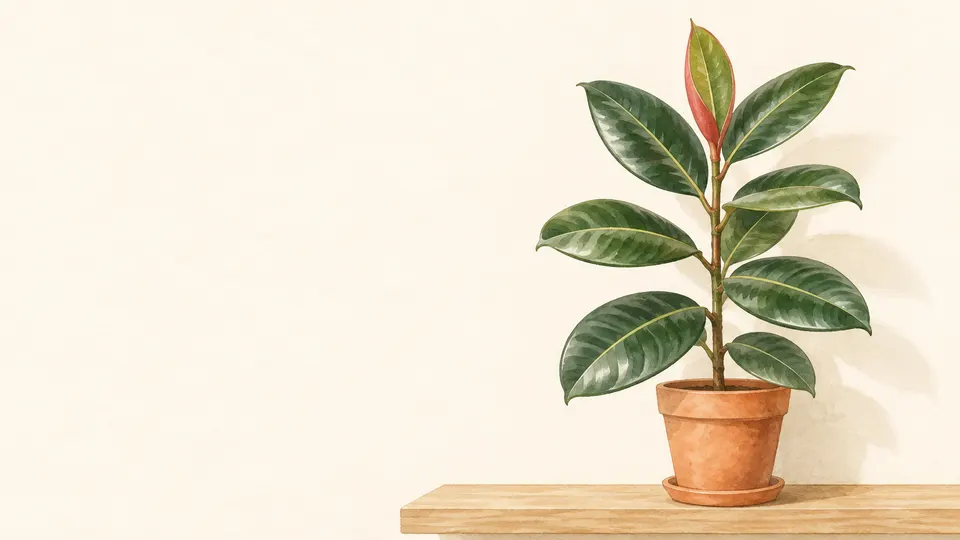
The rubber plant, Ficus elastica, is a broadleaf evergreen tree in the mulberry family that is widely grown as a houseplant [2]. In the wild it can reach 100 feet, but indoors it is usually kept to about 2 to 10 feet with training or support [2]. Clemson Extension calls it easy to grow and a good plant for beginners, and notes it can grow 6 to 10 feet or more indoors if it has the space [1]. The RHS also lists it under names such as India rubber plant and India rubber fig [3].
The leaves are large, stiff, and glossy, up to about 17 inches long [2]. The species name refers to its milky sap, which was once used to make rubber [2]. Indoors it rarely flowers [2]. It shares the genus Ficus with the fiddle-leaf fig, another species grown for its big leaves.
| Cultivar | What it looks like |
|---|---|
| 'Robusta' | Deep green, waxy leaves; up to 8 feet tall |
| 'Decora' | Large, very thick, dark green leaves |
| 'Burgundy' | Dark green leaves with hints of burgundy |
| 'Tineke' | Green leaves variegated with cream or pale yellow |
| 'Tricolor' | Leaves marked with cream, pink, and green |
Source for the table: NC State Extension [2].
How Much Light and Warmth Does a Rubber Plant Need?
Give it bright light. Clemson Extension says rubber plants prefer bright light but adapt to low light, and grow best with morning light from an east window [1]. NC State recommends bright indirect light or partial shade indoors, with protection from afternoon sun [2]. The RHS plant profile lists full sun or partial shade as suitable positions [3]. Because the sources differ on direct sun, a bright window with gentle morning sun and some shade from hot afternoon sun is a reasonable middle ground.
Low light has a cost. Clemson lists too little light among the causes of leaf loss [1], so check the light first if a plant in a dim corner starts shedding leaves.
Keep it warm and steady. Clemson gives ideal temperatures of 60 to 65°F at night and 75 to 80°F during the day, and advises avoiding temperatures below 55°F, sudden drops, and cold drafts [1]. NC State adds that the rubber plant prefers to stay in one location and does not do well with drafts or cold [2].
Humidity is flexible. Clemson says rubber plants prefer humid conditions but tolerate the dry air common in homes [1]. Dry air is still on Clemson's list of leaf loss causes [1], so we suggest keeping it away from heat vents in winter.
How Should You Water, Pot, and Feed a Rubber Plant?
Water thoroughly, then let the soil dry slightly to the touch before watering again [1]. NC State says to water regularly but avoid overwatering, and to cut back when the plant is dormant, from fall to late winter [2].
There is no fixed schedule. The University of Maryland Extension advises watering when a plant needs it rather than on a schedule, since potting mix, humidity, and temperature all change how fast a pot dries [4]. We would add season, light, and pot size to that list. Check the soil with your finger before every watering. An Illinois Extension educator suggests feeling about 1 to 2 inches into the mix, or lifting the pot to judge its weight [5].
How to water [1]:
- Use a pot with drainage holes and a well-drained houseplant mix.
- Water thoroughly until water runs out the bottom [4].
- Empty any water left in the saucer.
- Wait until the soil feels slightly dry before the next watering.
Both too much and too little water cause trouble. Clemson lists over- and underwatering among the main problems, notes that leaves may yellow if the soil stays too wet, and says root rot usually comes from a slow-draining mix or overly frequent watering [1].
Soil, repotting, and feeding
- Soil. Use a well-drained houseplant mix [1]. NC State suggests a soil-based potting mix [2].
- Repotting. Repot in late winter or early spring if needed [1]. An Illinois Extension educator notes that ficus can tolerate being somewhat root-bound but do need repotting on occasion, and that a top dressing of fresh mix is an option for a very big pot [5].
- Fertilizer. Clemson suggests a water-soluble houseplant fertilizer during active growth in spring and summer, and notes that plants in lower light need less [1]. Follow the label rate.
Why Is My Rubber Plant Dropping Leaves?
Leaf drop has several possible causes, and losing a few old leaves is normal. NC State says it is normal for some bottom leaves to turn yellow and drop, and that overwatering, temperature drops, or cold drafts can cause leaf loss [2]. Clemson adds too little light and dry air [1].
| What you see | Possible cause | What to try |
|---|---|---|
| A few lower leaves yellow and fall | Normal aging [2] | Nothing, if new leaves keep coming |
| Yellow leaves, soil stays wet | Too much water or a slow-draining mix [1] [4] | Let the soil dry slightly; check the drainage holes |
| Leaves drop after a cold snap or near a door | Temperature drop or cold draft [2] [1] | Move it away from drafts; keep it above 55°F |
| Leaves drop in a dim spot | Too little light [1] | Move it closer to a bright window |
| Leaves drop in dry winter air | Dry air [1] | Keep it away from heat vents |
| Sticky leaves, white cottony or shell-like bumps, or fine speckling | Mealybugs, scale, or spider mites [2] [8] | See the pest section below |
We suggest changing one thing at a time. NC State notes that rubber plants prefer to stay in one place [2], so once you find a good spot, leave the plant there. For other low-maintenance foliage plants, see our ZZ plant care guide and snake plant care guide.
How Do You Prune and Propagate a Rubber Plant?
Indoor rubber plants may become tall and lanky. Clemson suggests supporting them with a stake or pruning them in spring to rejuvenate them [1]. NC State explains the choice: prune the main branches for a bushier plant, or leave them unpruned for a tall, narrow, tree-like form [2].
Expect the cut to drip sap. NC State says cut leaves will drip sap [2], and an Illinois Extension educator describes the rubber plant as producing a lot of milky, latex sap that can drip onto the floor from a snapped leaf [5]. Clemson notes the sticky white sap may irritate skin [1], so gloves and a drop cloth under the plant are sensible precautions.
Propagation
Clemson lists stem or tip cuttings and air layering as ways to start new plants [1]. If you take a cutting, include a leaf bud: an Illinois Extension educator notes that a single leaf stuck in soil can root but cannot grow into a new plant without bud tissue [5].
Air layering roots a stem while it is still attached to the parent plant, and Iowa State Extension describes it for the rubber tree [6] [7]:
- Pick a point on a stem about 12 to 18 inches from the shoot tip and remove the leaves there.
- Make two cuts around the stem about 1 inch apart, connect them, and remove the ring of bark. Scrape the exposed wood.
- Dust on a little rooting hormone (optional; rooting is slower without it).
- Pack 1 or 2 handfuls of moist sphagnum moss around the wound, wrap it in clear plastic, and tie it above and below.
- Keep the moss moist. Roots should appear in several weeks, though some species take several months.
- When roots are several inches long, cut the stem below the bottom tie and pot it in well-drained potting mix.
Iowa State says early spring is the ideal time to layer, though most houseplants can be layered at any time of year, and that most plants form new branches from buds just below the cut on the parent plant [7]. For a different plant and method, see our pothos propagation guide.
How Do You Clean Leaves and Handle Pests?
Wash dusty leaves with water to keep them attractive and help the plant stay healthy [1]. NC State suggests a damp, soft cloth or sponge [2]. An Illinois Extension educator says plain water is all you need and advise against adding oils, which they say can clog the leaf pores [5].
Look at the leaves while you clean them. NC State lists mealybugs, scales, and spider mites as possible problems, and Clemson notes that mealybugs may infest rubber plants [2] [1]. UC IPM describes the signs: mealybugs look like white, cottony insects, often where leafstalks join stems; scales are small brown or grayish bumps that leave sticky honeydew; and spider mites cause fine light speckling on leaves [8].
UC IPM suggests washing or scraping off mealybugs and scales, washing leaves with water to remove some mites, and pruning out infested parts [8]. If you use a product, choose one labeled for indoor use on your plant and for that pest, and follow the label directions [8].
Is a Rubber Plant Toxic to Cats and Dogs?
When we checked on November 11, 2026, the ASPCA's toxic and non-toxic plant lists did not include the rubber plant, Ficus elastica, by species [11]. Do not read that as safe. The ASPCA's Fig page lists weeping fig (Ficus benjamina) as toxic to dogs, cats, and horses [10], and its separate Weeping Fig page gives the scientific name only as "Ficus sp." [9]. Its entry called "Indian Rubber Plant" refers to Ficus benjamina, not Ficus elastica [11].
For those weeping fig entries, the ASPCA lists the toxic principles as proteolytic enzyme (ficin) and psoralen (ficusin), and its Fig page lists the clinical signs as gastrointestinal and dermal irritation [10] [9]. Separately, Clemson Extension notes that the rubber plant's sticky white sap may irritate skin or the stomach if eaten, and advises keeping the plant away from pets and small children who might eat plants [1].
If you think your pet has eaten part of a rubber plant, contact your veterinarian or the ASPCA Animal Poison Control Center right away.
Frequently Asked Questions
How often should I water a rubber plant?
Water when the soil feels slightly dry to the touch, not on a set schedule. Clemson Extension says to water thoroughly and let the soil dry slightly between waterings, and NC State advises watering less from fall to late winter. University of Maryland Extension notes that potting mix, humidity, and temperature all affect how often a plant needs water.
Why is my rubber plant losing its leaves?
Several things can cause it. NC State lists overwatering, temperature drops, and cold drafts, and Clemson adds too little light and dry air. Pests such as mealybugs, scale, and spider mites are also possible. Losing a few lower leaves that yellow first is normal, according to NC State.
Can a rubber plant grow in low light?
It can adapt to low light, according to Clemson Extension, but it prefers bright light and grows best with morning sun from an east window. Clemson also lists too little light as a cause of leaf loss, so a brighter spot is better.
How do I make my rubber plant bushier?
Prune the main stems. NC State says pruning the main branches encourages a bushier habit, and Clemson suggests pruning in spring. Iowa State Extension notes that after air layering, most plants form new branches from buds just below the cut. Expect the cuts to drip milky sap.
Is a rubber plant safe for cats and dogs?
We cannot call it safe. The ASPCA does not list Ficus elastica by species, but it lists weeping fig (Ficus benjamina) as toxic to dogs and cats, and Clemson Extension notes the sap may irritate skin or the stomach if eaten. If your pet eats any, contact your veterinarian or the ASPCA Animal Poison Control Center right away.
Our Take
In our editorial view, the most useful thing to know about a rubber plant is that leaf drop is a signal, not a verdict. NC State and Clemson list several causes, from overwatering and cold drafts to low light and dry air, and NC State notes that losing a few lower leaves is normal. We think the best response is to change one condition at a time and then leave the plant in place, since NC State says it prefers to stay in one location. This is our opinion based on extension guidance, not a test we ran.
Sources
- Rubber Plant (HGIC 1510). Clemson Cooperative Extension, Home & Garden Information Center (Karen Russ and Robert F. Polomski; revised by Barbara H. Smith, December 15, 2015).
- Ficus elastica (Rubber Plant). NC State Extension Gardener Plant Toolbox.
- Ficus elastica (plant profile). Royal Horticultural Society.
- Watering Indoor Plants. University of Maryland Extension (updated March 10, 2023).
- Ep. 238 Exploring Ficus: More than the houseplant in the corner (Good Growing podcast transcript). University of Illinois Extension (Chris Enroth and Ken Johnson, January 23, 2026).
- How can I propagate a rubber tree?. Iowa State University Extension and Outreach, Yard and Garden (updated March 4, 2022).
- How to Propagate Houseplants by Air Layering and Simple Layering. Iowa State University Extension and Outreach, Horticulture and Home Pest News (January 2023).
- Houseplant Problems. UC Statewide IPM Program, University of California Agriculture and Natural Resources.
- Weeping Fig. ASPCA Toxic and Non-Toxic Plants.
- Fig. ASPCA Toxic and Non-Toxic Plants.
- Indian Rubber Plant. ASPCA Toxic and Non-Toxic Plants.
Plant care advice is general guidance: adjust for your light, season and pot, and check the soil before you water. Pet toxicity follows the ASPCA list only; if a pet may have eaten part of a plant, contact your veterinarian or the ASPCA Animal Poison Control Center right away.Spotted an error? Tell us.
Related Guides
Fiddle Leaf Fig Care: Light, Water, and Leaf Drop
Fiddle leaf fig care from extension sources: bright indirect light, watering after a 2-inch soil check, drainage, and what can cause leaf drop and brown spots.
Money Tree Care: Light, Water, Humidity, and Leaf Problems
Money tree (Pachira aquatica) care: bright light without harsh sun, evenly moist but never soggy mix, 65 to 75°F warmth, humidity, and causes of leaf drop.
ZZ Plant Care: Light, Water, Soil, and Yellow Leaves
ZZ plant care: bright indirect light (low light tolerated), water 1 to 2 times a month only once the mix dries, a coarse mix, and how to fix yellow leaves.
Snake Plant Care: Light, Water, and Common Mistakes
Snake plant care for beginners: bright indirect light, water only when the soil is dry (about every 2 to 6 weeks, less in winter), a snug pot, and rot traps.
How to Propagate Pothos (Water vs Soil)
How to propagate pothos from stem cuttings: where to cut around the nodes, rooting in water vs a moist mix, how long roots take, and when to pot water cuttings.

Bird of Paradise Care Indoors: Light, Water, and Blooms
Bird of paradise care indoors: give it your sunniest window, water deeply then let it dry slightly, keep humidity up, and learn why young plants rarely bloom.