Bird of Paradise Care Indoors: Light, Water, and Blooms
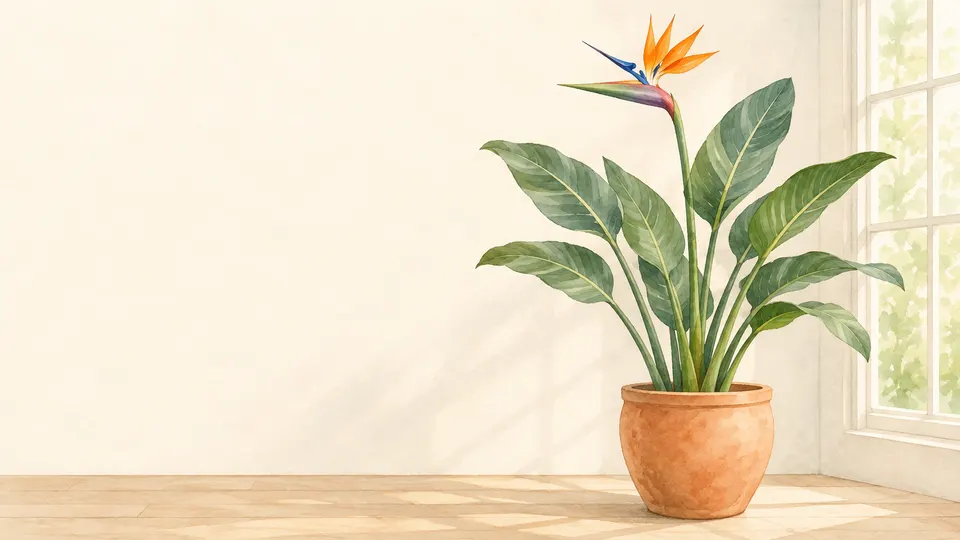
Quick Answer
Give a bird of paradise (Strelitzia reginae) full sun or your brightest window. Water thoroughly, then let the mix dry slightly, watering less in fall and winter. Keep it around 65 to 70°F by day and above about 50°F at night, with humidity near 60 percent. Plants usually need to be 5 to 10 years old to flower.
On this page
- Which Bird of Paradise Do You Have?
- How Much Light Does a Bird of Paradise Need Indoors?
- What Temperature and Humidity Does a Bird of Paradise Need?
- How Often Should You Water a Bird of Paradise?
- Why Won't My Bird of Paradise Flower?
- How Much Should You Feed a Bird of Paradise?
- Repotting, Problems, and Pet Safety
- Frequently Asked Questions
- Our Take
- Sources
Key Takeaways
- Two species are sold as bird of paradise: Strelitzia reginae (orange flowers, about 3 to 4 feet per NC State to 5 feet or more per the RHS) and the far larger Strelitzia nicolai.
- S. reginae wants full sun or your sunniest window; UW-Madison names insufficient light as a common reason mature plants bloom poorly.
- Water deeply, then let the mix dry slightly, less often in winter. No source gives a fixed schedule, so we suggest checking the soil first.
- The RHS says plants usually need to be 5 to 10 years old to flower.
- The ASPCA lists Strelitzia reginae as toxic to cats and dogs. Its dog and cat plant lists do not name S. nicolai, so do not assume the giant bird of paradise is safe.
Which Bird of Paradise Do You Have?
Two Strelitzia species are sold as "bird of paradise." Strelitzia reginae has orange and blue flowers shaped like a bird's head. NC State Extension lists it at about 3 to 4 feet tall and wide, and the RHS says it can reach at least 5 feet tall over time [4] [3]. The RHS calls it the most popular houseplant species [3].
The white or giant bird of paradise (Strelitzia nicolai) has banana-like leaves up to 6.5 feet long, white and blue flowers, and can grow 20 to 30 feet tall in its native habitat [5]. The giant species do not bloom until quite mature, according to UW-Madison Extension, though the leaves alone make a good indoor foliage specimen [1]. The RHS says it is too big for most homes in the long term [3].
This guide covers S. reginae and notes where NC State gives different advice for S. nicolai. For a big floor plant grown mainly for its leaves, our fiddle leaf fig care guide and rubber plant care guide cover two other common options.
Care at a glance
| Need | What works | Source |
|---|---|---|
| Light | Full sun or the brightest window you have, such as a south-facing one; as much light as possible in winter | Clemson, UW-Madison, RHS |
| Water | Wet the mix thoroughly, then let it dry slightly; water less in fall and winter | Clemson, RHS |
| Humidity | Around 60 percent; mist or use a tray of damp gravel in dry winter air | Clemson, RHS |
| Temperature | 65 to 70°F by day, 50 to 55°F at night; never below about 50 to 54°F | Clemson, RHS |
| Potting mix | Any well-draining soil or soilless mix; RHS suggests a loam-based mix with added grit | UW-Madison, RHS |
| Fertilizer | Every 2 weeks in spring and summer (RHS); Clemson says weekly in summer; sources differ on winter | RHS, Clemson, UW-Madison |
| Repotting | Keep it slightly pot-bound; repot in spring when roots fill the pot | UW-Madison, RHS |
| Pets | ASPCA lists S. reginae as toxic to cats and dogs | ASPCA |
Sources for the table: [2] [1] [3] [6].
How Much Light Does a Bird of Paradise Need Indoors?
A lot. Clemson Extension says bird of paradise prefers full sun but will tolerate lower light, such as a south-facing window [2]. The RHS says strelitzias need lots of bright light and recommends a spot beside a large sunny window [3]. Put it in the sunniest spot you have, especially in winter. To bloom, the plant needs nearly full sun in summer and as much light as possible in winter, according to UW-Madison Extension [1].
The RHS also suggests turning the pot a quarter turn at each watering and a little shade during flowering, since strong sun can bleach the colors [3].
NC State Extension says the giant S. nicolai prefers bright, indirect light instead [5].
Summer outdoors
The plant can spend summer outside, but move it out gradually: a plant not acclimated to outdoor light can get sunburned [1]. Pick a sheltered spot; the RHS says wind can shred the leaves and snap the stems [3]. Clemson says to move it indoors when temperatures begin to drop below 60°F, and the RHS says before nights dip anywhere near 54°F [2] [3].
What Temperature and Humidity Does a Bird of Paradise Need?
Clemson gives 65 to 70°F during the day and 50 to 55°F at night, while NC State lists 55 to 65°F at night [2] [4]. Temperatures should never go below 50 to 54°F (10 to 12°C), per the RHS [3]. For S. nicolai, NC State gives 65 to 85°F, says it will not tolerate temperatures below 50°F, and advises avoiding cold drafts and sudden temperature changes [5].
Clemson says the plant prefers around 60 percent relative humidity, which may require daily misting during dry winter months [2]. The RHS suggests misting the leaves regularly or standing the pot on a tray of damp gravel [3], and NC State suggests a pebble tray or a humidifier for S. nicolai [5]. Our orchid care guide explains how to set up a pebble tray so the pot sits above the water line.
How Often Should You Water a Bird of Paradise?
Clemson Extension advises wetting the potting mix thoroughly and allowing it to dry slightly before watering again [2]. No source gives a fixed number of days, and how fast the pot dries depends on the season, the light, the pot size, and the mix. We suggest checking the soil with your finger before watering.
- Spring and summer: the RHS calls for regular and plentiful watering, keeping the mix moist but not saturated. Because the large leaves lose a lot of water, it may need water daily in warm weather [3].
- Fall: reduce watering gradually [3].
- Winter: from the end of November, the RHS says to let the mix get fairly dry between waterings [3]. Clemson says watering will be less frequent in the colder months, and UW-Madison says to let the pot dry out between waterings when the plant is indoors [2] [1].
Too much or too little water is one of the main problems Clemson names for this plant [2]. Root rot usually comes from a mix that does not drain quickly or from watering too often [2] [4]. Our suggestion: use a pot with a drainage hole and empty the saucer after watering. For S. nicolai, NC State says to water when the top layer of soil feels dry, and notes the plant becomes more drought tolerant once established [5].
Why Won't My Bird of Paradise Flower?
Insufficient light is one of the most common reasons mature plants do not bloom well, says UW-Madison Extension [1]. A small, young plant with no flowers is expected; the RHS says flowering usually waits until the plant is 5 to 10 years old. [3]
- Age and size. Seed-grown plants take years. Clemson gives 4 to 10 years or more, UW-Madison 4 to 7 years, and the RHS 5 years or more [2] [1] [3].
- Light. Move it to the sunniest window, and give it as much light as possible in winter [1].
- Too much fertilizer. Overfertilizing leads to lots of leaves with little or no flowering, Clemson warns [2].
- Too much root room. Both UW-Madison and the RHS say the plant tends to bloom more when slightly pot-bound [1] [3].
- Recent division or planting depth. Dividing a plant that has been blooming may stop it from blooming for a few years [1]. UW-Madison also advises against planting too deeply, since exposing the top of the roots may encourage flowering [1].
When it does flower, the RHS says blooms appear in winter and spring and each one lasts up to a month, and UW-Madison adds autumn [3] [1]. Cut off the whole flower stalk once the flower fades [3].
How Much Should You Feed a Bird of Paradise?
Feed in the growing season, but sources differ on timing:
| Source | Spring | Summer | Fall | Winter |
|---|---|---|---|---|
| UW-Madison | Not specified | Every 2 weeks | Not specified | Monthly |
| Clemson | Every 2 weeks | Weekly | None | None |
| RHS | Every 2 weeks | Every 2 weeks | Not specified | Not specified |
Sources for the table: [1] [2] [3].
Our suggestion, not a source's: a liquid houseplant fertilizer every 2 weeks in spring and summer, then little or none in fall and winter. Given Clemson's warning about overfeeding, err on the side of less if the plant is growing lots of leaves and no flowers.
Repotting, Problems, and Pet Safety
When to repot
A newly bought plant usually will not need repotting for a year or two, and the RHS says to repot once the roots have filled the pot [3]. UW-Madison advises not rushing once a plant is about 3 feet tall, and repotting when the roots have cracked the pot [1].
- When: early spring, or in spring after flowering [1] [3].
- Pot: only slightly larger than the old one [3].
- Mix: any well-draining soil or soilless potting mix; the RHS suggests a loam-based mix with grit added for drainage [1] [3].
- Depth: do not plant too deeply [1].
- In between: replace the top layer of soil each year. The RHS suggests removing about 2 inches each spring and replacing it with fresh mix [1] [3].
To make new plants, Clemson Extension calls division the easiest method. In early spring, before new growth begins, take the plant out of the pot and cut through the rhizome with a sharp knife so each piece has a fan of leaves with roots attached. Pot each division in a small pot, water it, and keep it warm in bright, indirect light for about eight weeks; flowering should follow in 2 to 3 years [2].
Common problems
Diseases are very rarely a problem in the home, according to Clemson [2].
| Symptom | Cause named by the source | What to do |
|---|---|---|
| Brown leaf tips and edges, slow growth, no flowers | Growing conditions not right [3] | Raise humidity, and water and feed regularly in the growing season |
| Leaves torn or shredded | Wind [3] [5] | Keep it in a sheltered spot; remove badly torn leaves at the base |
| Yellow or brown spots on leaves | Leaf spot [4] | Remove affected leaves at the base (the RHS advises removing browning leaves) [3] |
| Root rot | Overwatering or a mix that drains poorly [4] [2] | We suggest watering less often and repotting into a fast-draining mix |
| Mealybugs, scale insects, or spider mites on the leaves | Sap-sucking pests [3] [1] [4] | Wipe leaves with a soft cloth; use a houseplant insecticide labeled for the pest, following the label |
| Whiteflies or aphids on the plant | Insect pests [2] | Use a product labeled for the pest and the plant, following the label |
Are split leaves normal?
The sources we used do not describe indoor leaf splitting on S. reginae. They do describe tearing from wind: the RHS says leaves in a windy spot soon become shredded and tatty, and NC State says S. nicolai leaves can rip along their veins in wind [3] [5]. Both advise removing torn leaves; the RHS says to cut them at the base [3] [5].
When you clean the leaves, UW-Madison recommends a soft cloth and no leaf-shine products, which could damage the natural matte finish [1]. Our money tree care guide covers another large indoor plant.
Is bird of paradise toxic to cats and dogs?
Yes, for Strelitzia reginae. The ASPCA lists Bird of Paradise Flower (Strelitzia reginae) as toxic to dogs, cats, and horses. It lists the toxic principle as GI irritants and the clinical signs as mild nausea, vomiting, and drowsiness, caused mainly by fruit and seeds [6].
Neither the ASPCA dog plant list nor its cat plant list names Strelitzia nicolai [7] [8], so do not assume the giant bird of paradise is safe. The ASPCA also says Strelitzia reginae should not be confused with Caesalpinia gilliesii (also called Poinciana gilliesii), a different plant that shares the name "bird of paradise" and that the ASPCA describes as more toxic [6].
Keep the plant, and especially any fruit or seeds, away from pets. If you think your pet has eaten part of a bird of paradise, contact your veterinarian or the ASPCA Animal Poison Control Center right away. The ASPCA lists the center's number as (888) 426-4435 and notes that a consultation fee may apply [6].
Frequently Asked Questions
How much sun does a bird of paradise need indoors?
Clemson Extension says Strelitzia reginae prefers full sun but tolerates a south-facing window. NC State says the giant Strelitzia nicolai prefers bright, indirect light.
How often should I water a bird of paradise?
Water thoroughly, then let the mix dry slightly; water more in spring and summer and less in winter. No source gives a fixed schedule, so we suggest checking the soil with your finger before watering.
Why is my bird of paradise not blooming?
Start with age and light. The RHS says plants usually need to be 5 to 10 years old to flower, and UW-Madison names insufficient light as a common reason mature plants bloom poorly. Overfeeding can also delay flowers.
Is bird of paradise toxic to cats and dogs?
The ASPCA lists Bird of Paradise Flower (Strelitzia reginae) as toxic to cats and dogs, with GI irritants as the toxic principle and mild nausea, vomiting, and drowsiness as clinical signs, caused mainly by fruit and seeds. Its dog and cat plant lists do not name Strelitzia nicolai, so do not assume it is safe. If your pet eats part of the plant, contact your veterinarian or the ASPCA Animal Poison Control Center right away.
Why are my bird of paradise leaves torn or shredded?
Our sources link torn leaves to wind: the RHS says leaves in a windy spot become shredded, and NC State says Strelitzia nicolai leaves can rip along their veins. Keep the plant sheltered and remove torn leaves.
Our Take
We think the key question before buying a bird of paradise is which one you are getting. The orange-flowered Strelitzia reginae and the giant Strelitzia nicolai share a name but not a growth habit, and our sources give them different light advice. If you want flowers, we would buy the biggest S. reginae you can afford and give it your sunniest window, since the RHS says flowering usually waits until the plant is 5 to 10 years old. If you mainly want big leaves and have the ceiling height, S. nicolai may suit you better. This is our editorial opinion based on extension and RHS guidance, not a test we ran.
Sources
- Bird of Paradise, Strelitzia reginae. University of Wisconsin-Madison Extension (Susan Mahr; revised September 2026).
- Bird of Paradise (HGIC 1562). Clemson Cooperative Extension Home & Garden Information Center (Chuck Burgess; published 2004).
- How to grow strelitzia. Royal Horticultural Society (RHS) Growing Guide.
- Strelitzia reginae (Bird of Paradise). NC State Extension Gardener Plant Toolbox.
- Strelitzia nicolai (White Bird of Paradise). NC State Extension Gardener Plant Toolbox.
- Bird of Paradise Flower. ASPCA Toxic and Non-Toxic Plants.
- Toxic and Non-Toxic Plant List: Dogs. ASPCA Animal Poison Control.
- Toxic and Non-Toxic Plant List: Cats. ASPCA Animal Poison Control.
Plant care advice is general guidance: adjust for your light, season and pot, and check the soil before you water. Pet toxicity follows the ASPCA list only; if a pet may have eaten part of a plant, contact your veterinarian or the ASPCA Animal Poison Control Center right away.Spotted an error? Tell us.
Related Guides
Fiddle Leaf Fig Care: Light, Water, and Leaf Drop
Fiddle leaf fig care from extension sources: bright indirect light, watering after a 2-inch soil check, drainage, and what can cause leaf drop and brown spots.
Rubber Plant Care: Light, Water, Leaf Drop, and Pruning
Rubber plant care: bright light, water when the soil feels slightly dry, steady warmth away from drafts, plus leaf drop causes, pruning, air layering, and pets.
Money Tree Care: Light, Water, Humidity, and Leaf Problems
Money tree (Pachira aquatica) care: bright light without harsh sun, evenly moist but never soggy mix, 65 to 75°F warmth, humidity, and causes of leaf drop.
Peace Lily Care: Watering, Light, and Getting Blooms
Peace lily care for beginners: bright indirect light, moist but not soggy soil, why it droops, how to get blooms, and what brown tips and yellow leaves mean.
Snake Plant Care: Light, Water, and Common Mistakes
Snake plant care for beginners: bright indirect light, water only when the soil is dry (about every 2 to 6 weeks, less in winter), a snug pot, and rot traps.
Orchid Care: How to Keep a Phalaenopsis Blooming
Moth orchid care for beginners: bright indirect light, a weekly soak in bark, the right temperatures, and how cool fall nights and spike pruning bring rebloom.