Orchid Care: How to Keep a Phalaenopsis Blooming
Quick Answer
Grow a moth orchid (Phalaenopsis) in bright, indirect light, such as an east window, in a bark-based orchid mix. Soak it with room-temperature water about once a week and let it drain completely. Keep days around 70 to 80°F and nights 60 to 70°F. To get it to bloom again, keep the light bright and give it a few weeks of 55 to 60°F nights in fall.
On this page
- What Kind of Orchid Do You Have?
- How Much Light Does a Moth Orchid Need?
- How Often Should You Water an Orchid?
- What Temperature and Humidity Do Orchids Like?
- How Do You Get an Orchid to Bloom Again?
- What Potting Mix and Fertilizer Do Orchids Need?
- Common Orchid Problems and Pet Safety
- Frequently Asked Questions
- Our Take
- Sources
Key Takeaways
- Moth orchids grow on trees in the wild, so they need airy bark, filtered light, and roots that get both water and air.
- Water a mature plant in bark about once a week: soak it, drain it completely, and never let it sit in water. Skip the ice cubes.
- Leaf color shows the light: dark green means too little, light or olive green is right, and yellow-green with red edges is too much.
- Rebloom depends most on enough light; many moth orchids also need a few weeks of cool fall nights around 55 to 60°F.
- The ASPCA lists the Phalaenopsis orchid as non-toxic to cats and dogs.
What Kind of Orchid Do You Have?
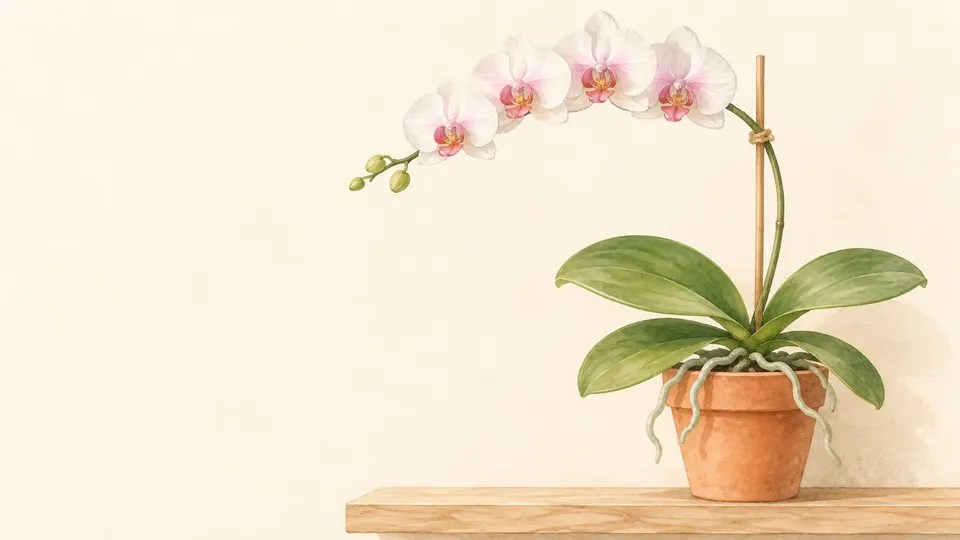
The orchid sold in grocery stores and garden centers is usually a moth orchid (Phalaenopsis), the most popular and widely available orchid sold as a houseplant [1]. It has a few broad, leathery leaves in a flat rosette, silvery or green roots that climb out of the pot, and arching sprays of flat, moth-shaped flowers [6] [1]. Iowa State University Extension calls moth orchids one of the easiest orchids to grow indoors [2]. If your plant has thick, swollen stems (pseudobulbs) at the base, it is a different kind of orchid; moth orchids have none [3].
In nature, moth orchids are epiphytes. They cling to tree trunks and branches in the tropics instead of growing in soil [3] [4]. Almost every care rule follows from that: airy bark instead of soil, filtered light instead of full sun, and roots that need both water and air.
One quirk worth knowing: some stores sell white moth orchids dyed blue or pink. If a dyed plant reblooms, the new flowers will be white [1].
| Need | What works | Source |
|---|---|---|
| Light | Bright, indirect light; an east window is ideal | Iowa State, NC State |
| Day temperature | 70 to 80°F | Iowa State, MBG |
| Night temperature | 60 to 70°F; avoid below 55°F | Iowa State |
| Water | About once a week in bark; less often in sphagnum moss | MBG, NC State |
| Humidity | 40 to 60% or higher | Iowa State, MBG |
| Potting mix | Bark-based orchid mix, never regular potting soil | MBG, RHS |
| Fertilizer | Orchid fertilizer at label strength or weaker during growth; sources differ on how often | RHS, MBG, UMD |
| Repotting | About every two years, when the bark breaks down | MBG, RHS |
How Much Light Does a Moth Orchid Need?
Give it bright, indirect light. Iowa State recommends an east- or north-facing window, or a south window shaded with a sheer curtain, and warns that direct sun can harm the leaves [2]. NC State names an east windowsill as the best spot in the house [1].
The leaves tell you whether the light is right [3] [4]:
- Dark green, stiff leaves: not enough light.
- Light green or olive green leaves: about right.
- Yellow-green leaves with pink or red edges: too much light.
Light also drives flowering. The University of Maryland Extension says the most common reason a moth orchid will not rebloom is low light [3]. In winter, when the sun is weaker, UMD notes the plant can even move to a south window [3]. If your windows are dim, Iowa State suggests a fluorescent fixture 6 to 8 inches above the plant for 12 to 16 hours a day [2].
How Often Should You Water an Orchid?
For a mature plant in bark, a thorough watering about once a week is usually enough [4] [1]. Plants in sphagnum moss need water less often, when the top of the moss feels dry, because moss holds water longer than bark [4] [2]. Heat, bright light, and active growth all increase how often a plant needs water, so check the roots and potting mix rather than following the calendar alone [4] [2].
Here is the soak method recommended by UMD Extension and Missouri Botanical Garden [3] [4]:
- Water in the morning, so the leaves dry before night [4].
- Set the pot in a sink and run lukewarm water through the bark. UMD suggests 3 or 4 drenches over about 10 minutes so the bark can absorb it [3].
- Let it drain completely. Never leave the pot sitting in water [4].
- Check the crown. If water pools where the leaves meet, wick it out with a paper towel to prevent crown rot [4].
The roots show when you have watered enough. Dry roots look dull silver or white and turn pale green once they have absorbed water [3]. The RHS recommends a clear pot so you can see the roots and tell whether the mix is still moist [6], and NC State notes that the roots can photosynthesize [1].
| Potting mix | When to water | Watch out for |
|---|---|---|
| Bark | About once a week; let it dry slightly between waterings | Bark that breaks down and stays soggy |
| Sphagnum moss | When the top of the moss feels dry | Moss stays wet longer and can be hard to rewet |
Sources for the table: Missouri Botanical Garden, Iowa State, and NC State [4] [2] [1].
Skip the ice cubes. Missouri Botanical Garden says the ice cube method sold with some orchids is not a good practice: cold water harms tropical orchid roots, and a few ice cubes do not provide enough moisture [5]. Use room-temperature water instead.
Moth orchids have no water-storing pseudobulbs, so they should never dry out completely [4] [3]. But too much water is just as dangerous: soggy roots rot, and Iowa State warns that watering too often can kill the plant [4] [2].
What Temperature and Humidity Do Orchids Like?
Moth orchids are warm growers. Iowa State recommends 70 to 80°F during the day and 60 to 70°F at night, and advises against exposing plants to temperatures below 55°F [2]. The drop between day and night matters, and Missouri Botanical Garden lists 95°F and 50°F as the outer limits [4]. For everyday care, treat 55°F as the floor; 50°F is a limit, not a target.
Keep the plant away from heaters, radiators, and drafts. Missouri Botanical Garden notes that rapid temperature changes and drafts cause bud drop, and spots near a window can be hotter or colder than the rest of the room [4] [6].
For humidity, Iowa State recommends 40 to 60%, while Missouri Botanical Garden suggests 50% or higher [2] [4]. Winter air in most homes is drier than that. A room humidifier or a pebble tray helps, as long as the bottom of the pot sits above the water line [2]. UMD notes that misting usually does not add enough moisture [3].
How Do You Get an Orchid to Bloom Again?
A healthy moth orchid can bloom once a year, and its flowers can last for months [1] [4]. Getting it to rebloom depends on enough light, a cool fall cue for many plants, and what you do with the old flower spike.
1. Keep the light up. The most common reason a moth orchid will not rebloom is low light, so move a plant that is not flowering to a brighter window [3].
2. Give it a cool fall. Iowa State says night temperatures of 55 to 60°F in fall help start flower development [2]. Missouri Botanical Garden says several weeks of nights around 55°F in autumn start flower spikes [4]. The RHS suggests moving a plant that has not flowered for a while to a spot about 8°F cooler for a month or so [6]. NC State says the large white spring-flowering types need a chill of about 55°F for a week, while modern dwarf hybrids do not need one [1].
3. Decide what to do with the old spike. Sources differ, so here are the options side by side:
| Option | How | What sources say |
|---|---|---|
| Wait | Leave a green spike alone and watch it | New flowering branches can form on old spikes [3] |
| Cut above a node | Cut just above a node below the spent flowers (the RHS says the second node) | A side shoot with new flowers often, but not always, forms [6] [1] |
| Cut at the base | Remove the whole spike near the base | Encourages reblooming within a year; MBG says cutting above a node stresses the plant [4] |
Once a spike has dried and turned brown, cut it off at the base [3].
Once a new spike appears, stake it loosely as it grows, and avoid turning the plant so the spike does not twist toward the light [3] [4]. For other houseplants that flower indoors, see our guides to Christmas cactus care and peace lily care.
What Potting Mix and Fertilizer Do Orchids Need?
Potting mix. Use a commercial bark-based orchid mix labeled for Phalaenopsis. Never use regular potting soil, which leads to root rot [4] [6].
Repotting. Repot about every two years, or sooner if the bark has broken down so it looks like mulch, drains poorly, or holds too much water [4] [3]. Remove dead roots (brown, wiry, and dry) and keep the firm, plump, whitish ones [4]. Choose a pot that just fits the roots; too much extra mix stays wet and can rot them [6]. For timing, MBG recommends spring or summer after blooming, and the RHS says any time the roots are active with green tips [4] [6].
Aerial roots. Roots growing over the pot rim are normal. UMD advises leaving them alone [3].
Fertilizer. Feed lightly while the plant is growing, using an orchid fertilizer at the strength the label recommends or weaker [6] [4]. Sources differ on how often: the RHS feeds at most waterings but uses plain water every fourth time to flush out salts [6], while UMD fertilizes only every third or fourth watering [3]. Both agree on feeding sparingly, or not at all, in winter. [6] [3] UMD warns that overfeeding produces lush leaves at the expense of flowers [3].
Common Orchid Problems and Pet Safety
| Symptom | Likely cause | What to do |
|---|---|---|
| Lowest leaf turns yellow and drops | Normal aging; older leaves at the base die as new ones grow [4] | Remove it at the base once it is fully yellow [3] |
| Yellow-green leaves with red edges | Too much light [3] | Move to bright, indirect light |
| Wrinkled, limp leaves | Too little water or low humidity, or roots damaged by rot [3] [1] | Check the roots; repot if they are brown and mushy |
| Buds fall before opening | Changes in temperature, humidity, moisture, or location [1] | Keep conditions steady while in bud |
| No new flowers | Low light, or no cool fall nights [3] [2] | Brighter spot plus cooler fall nights |
| Scale insects or mealybugs on the plant | Sap-feeding pests [1] | Treat with a product labeled for the pest |
Yellow leaves have several possible causes, so we cover them in detail in orchid yellow leaves: causes and fixes.
Is a moth orchid safe for cats and dogs?
The ASPCA lists the Phalaenopsis orchid (moth orchid) as non-toxic to cats and dogs [7]. If your pet eats part of any plant and seems unwell, contact your veterinarian or the ASPCA Animal Poison Control Center right away.
Frequently Asked Questions
How often should I water my orchid?
About once a week for a mature moth orchid in bark, according to Missouri Botanical Garden and NC State Extension. Plants in sphagnum moss need water less often, when the top of the moss feels dry. Heat and bright light increase water needs, so check the roots: silvery means dry, green means recently watered.
Should I water my orchid with ice cubes?
No. Missouri Botanical Garden says it is not a good practice because cold water harms tropical orchid roots and a few ice cubes do not provide enough moisture. Use room-temperature water and let it drain through the pot.
Where do I cut an orchid stem after the flowers fall?
Sources differ. The RHS suggests cutting just above the second node below the spent flowers so a new side shoot can bloom. Missouri Botanical Garden prefers cutting the spike near the base, which encourages a new spike within a year. Cut off a spike that has dried and turned brown.
Why won't my orchid rebloom?
The most common reason is too little light, according to the University of Maryland Extension. Many moth orchids also need several weeks of cooler fall nights, around 55 to 60°F, to start a new flower spike.
Is it normal for orchid roots to grow out of the pot?
Yes. Moth orchids are epiphytes that send out aerial roots, and the University of Maryland Extension advises leaving them alone rather than cutting them off.
Our Take
We think the single most useful habit for a new orchid owner is looking at the roots before watering. The sources we reviewed agree that moth orchids should never dry out completely and should never sit in soggy mix, and the roots show which side of that line you are on: silvery means dry, green means watered. In our view, that makes a clear pot and a weekly look more reliable than any fixed schedule, and it rules out the ice cube shortcut. This is our editorial opinion based on extension and botanical garden guidance, not a test we ran.
Sources
- Phalaenopsis (Moth Orchid). NC State Extension Gardener Plant Toolbox.
- What is the proper care for a moth orchid?. Iowa State University Extension and Outreach (last updated January 21, 2025).
- Care of Phalaenopsis Orchids (Moth Orchids). University of Maryland Extension (updated March 13, 2023).
- Phalaenopsis (Visual Guide). Missouri Botanical Garden.
- Should I water my orchid plant with ice cubes?. Missouri Botanical Garden, Gardening Help FAQs.
- How to grow Phalaenopsis (moth orchids). Royal Horticultural Society.
- Phalaenopsis Orchid. ASPCA Toxic and Non-Toxic Plants.
Plant care advice is general guidance: adjust for your light, season and pot, and check the soil before you water. Pet toxicity follows the ASPCA list only; if a pet may have eaten part of a plant, contact your veterinarian or the ASPCA Animal Poison Control Center right away.Spotted an error? Tell us.
Related Guides
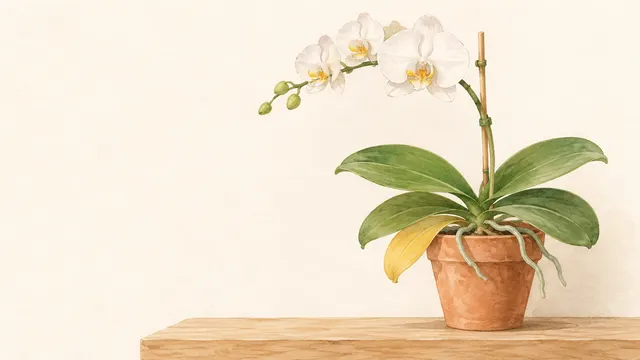
Orchid Yellow Leaves: Causes and Fixes
Why orchid leaves turn yellow: normal aging, root rot, too much light, pests, disease, cold, or ethylene gas. Use the table and flowchart to find the cause.
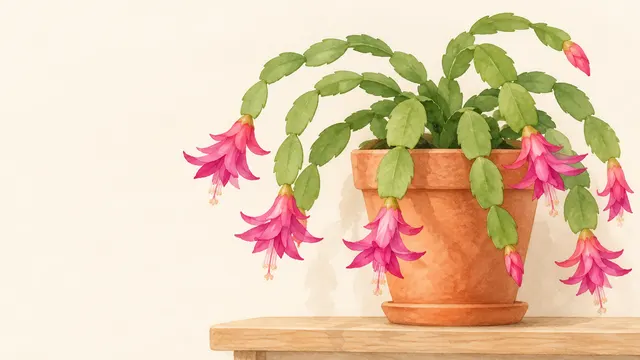
Christmas Cactus Care: How to Get It to Bloom
Christmas cactus care for beginners: tell it from a Thanksgiving cactus, water when the soil is nearly dry, and use cool, fully dark fall nights to set buds.
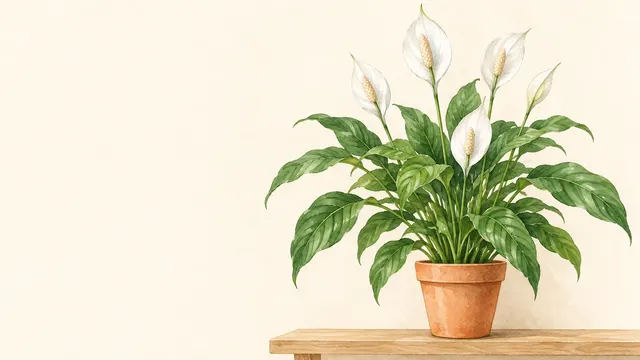
Peace Lily Care: Watering, Light, and Getting Blooms
Peace lily care for beginners: bright indirect light, moist but not soggy soil, why it droops, how to get blooms, and what brown tips and yellow leaves mean.
Spider Plant Care: Light, Water, and Baby Plants
Spider plant care made simple: bright, indirect light, water when the soil starts to dry, what causes brown leaf tips, and how to root the baby plantlets.

Kalanchoe Care: Light, Water, and Reblooming
Kalanchoe care for florist kalanchoe: bright light, soil that dries between waterings, and about 14 hours of nightly darkness for 6 weeks to bloom again.
Succulent Care for Beginners
Succulent care for beginners: bright light, a soak-and-dry watering rhythm, gritty soil in a pot with drainage, and how to read wrinkled or mushy leaves.