Orchid Yellow Leaves: Causes and Fixes
Quick Answer
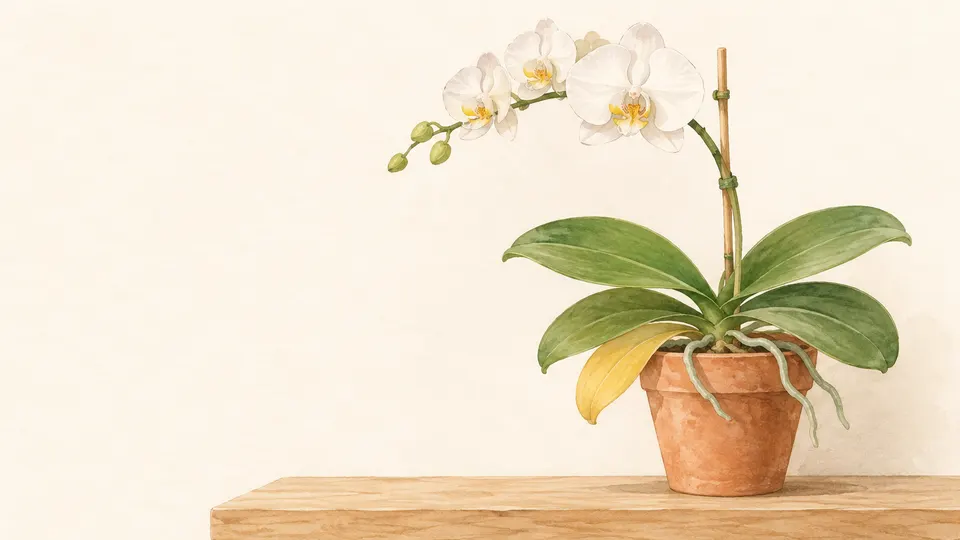
If only the lowest leaf of a moth orchid turns yellow slowly, it is normal aging; you can cut it off at the base once it fades. If several leaves or the newest leaves yellow, check the roots first: brown, mushy roots mean overwatering and root rot. Other causes include underwatering (firm white roots, wrinkled leaves), too much direct light, scale and other pests, leaf spot diseases, cold, and ethylene gas.
On this page
- Is a Yellow Orchid Leaf Ever Normal?
- What Causes Yellow Leaves on an Orchid?
- Overwatering and Root Rot
- Too Much Light or Sunburn
- Pests and Diseases That Turn Leaves Yellow
- Other Causes: Gas, Cold, Fertilizer, and Crowded Roots
- Should You Cut Off Yellow Orchid Leaves?
- Frequently Asked Questions
- Our Take
- Sources
Key Takeaways
- One slowly yellowing bottom leaf is normal: moth orchids shed their oldest leaves as new ones grow at the top.
- Several yellow leaves, or yellow new leaves, point to a problem. Check the roots first.
- Dark, soft roots mean root rot from overwatering: trim them and repot in fresh orchid bark. Firm white roots with wrinkled leaves mean the plant is too dry.
- Yellow-green leaves with red edges mean too much light; scorched blotches after a move mean sunburn.
- Bacterial brown spot is the most serious Phalaenopsis disease: act fast and keep water out of the crown.
Is a Yellow Orchid Leaf Ever Normal?
Yes, if it is the lowest leaf and it yellows slowly. A moth orchid (Phalaenopsis) grows upward from a single crown (the center of the plant, where new leaves appear), adding one or two new leaves at the top each year while the oldest leaves at the base die off [2] [1]. So one bottom leaf turning yellow gradually, while the rest of the plant stays firm and green, is normal aging. This guide covers moth orchids, the orchid widely sold in big box stores [4].
The pattern tells you whether to worry:
- Probably normal: only the oldest, lowest leaf is yellow; it yellows gradually; new leaves look healthy; roots are firm.
- Probably a problem: several leaves yellow at once, the newest leaves yellow, the yellowing comes with soft, wrinkled, spotted, or blotched tissue, or the roots are dark and mushy.
The quickest way to tell aging from trouble is to check where the yellow starts and how fast it spreads. Then check the roots, because root problems cause many of the other patterns below.
What Causes Yellow Leaves on an Orchid?
Use this table to match what you see with the most likely cause. The sections below explain each one.
| What you see | Most likely cause |
|---|---|
| Lowest leaf slowly turns yellow, rest of plant healthy | Normal aging [2] |
| Yellow, limp, or shriveled leaves; brown, mushy roots | Overwatering and root rot [1] [6] |
| Shriveled or yellow-green leaves; roots firm and white | Underwatering [1] [6] |
| Yellow-green leaves with red edges | Too much light [4] [1] |
| Scorched blotches or overall yellowing after a move into direct sun | Sunburn [1] |
| Yellow patches with small bumps or sticky residue | Scale or other sap-sucking pests [1] |
| Yellow spots on the undersides that spread | Fungal leaf spot [1] |
| Water-soaked spots that turn brown or black fast | Bacterial brown spot [1] |
| Older leaves yellow and drop near gas appliances or ripe apples, especially in a poorly ventilated room | Ethylene gas [1] |
| Yellow and green mottling with stunted growth | Virus [5] [1] |
Overwatering and Root Rot
Missouri Botanical Garden names overwatering and underwatering as the major causes of orchid death [1]. Constantly wet bark starves the roots of oxygen, the roots rot, and the leaves above them shrivel and decline [1]. UC IPM also lists root rot among the causes of light green to yellow houseplant leaves [6].
How to check: slide the plant out of its pot and look at the roots. Healthy roots are firm, plump, and whitish; dead roots are brown, wiry, and dry, and rotted roots are dark and soft [2] [5]. Underwatered plants can show similar shriveled leaves, but their roots stay firm and white [1]. If the roots are firm and white and the leaves are limp and wrinkled, the plant is too dry; UMD Extension notes that low humidity and too little water cause wrinkled leaves [4].
What to do if you find rot [2] [5] [8]:
- Remove the plant from its pot and rinse off the old bark or moss.
- Cut off soft, brown, or dead roots with a sterilized blade or pruner.
- Repot in fresh bark-based orchid mix, never regular potting soil.
- Choose a pot that just fits the remaining roots; extra mix stays wet and invites more rot.
- Water in the morning and keep water out of the crown.
If almost no firm roots remain, recovery is unlikely; UMD Extension advises discarding severely damaged plants [5].
To prevent it, water a mature plant in bark about once a week, let the pot drain completely, and never leave it standing in a saucer of water [2] [3]. Many store-bought moth orchids come potted in sphagnum moss, which stays wetter longer than bark [7]; water those only when the top of the moss feels dry [2]. Old bark that has broken down holds too much water, so repot about every two years [2] [4]. For the full watering routine, see our orchid care guide.
Too Much Light or Sunburn
Moth orchids are low-light orchids by orchid standards, but they still need bright, indirect light to grow and flower well [2] [7]. With too much light, the leaves turn yellowish green, often with pink or red edges [4] [1]. Sunburn is more sudden: a plant moved into direct sun can develop scorched blotches or overall yellowing [1].
Move the plant to bright, indirect light, such as an east window or a south window behind a sheer curtain [7]. Leaves that are healthy olive or light green tell you the light is correct [2] [4].
Pests and Diseases That Turn Leaves Yellow
Missouri Botanical Garden notes that orchids are fairly resistant to pests and diseases and that good growing conditions prevent most infestations [1]. Each time you check the roots, also check leaf undersides, leaf joints, and the base of the plant. Here is what each problem looks like:
| Problem | Signs | Response |
|---|---|---|
| Scale | Small bumps on leaves; yellow patches; sticky honeydew | Wipe them off with a swab; for more than a few, use a product labeled for orchids and follow the label [1] |
| Mealybugs | White, woolly insects in leaf joints and at the base | Remove and treat with a product labeled for orchids [1] |
| Spider mites | Tiny specks; fine webbing; speckled, then bronzed leaves | Raise humidity; if they persist, use a product labeled for orchids and follow the label [1] [6] |
| Fungal leaf spot | Yellow spots on the undersides that darken and enlarge; a leaf with Cercospora leaf spot cannot be reversed | Remove infected leaves as soon as you see them; keep foliage dry [1] [6] |
| Bacterial brown spot | Water-soaked spots that turn brown or black and spread quickly | Isolate the plant, cut off spotted leaves with a sterilized blade, and keep leaves dry; the plant cannot survive once spots reach the crown [1] [6] |
| Virus | Mottled green and yellow leaves, stunted growth | No cure; discard the plant [5] [1]. Virus symptoms can look like other problems, so rule out pests, light, and watering first [1] |
Missouri Botanical Garden calls bacterial brown spot the most common and severe disease of Phalaenopsis orchids [1]. Because it spreads by splashing water, avoid splashing the leaves and never let water sit in the crown. [1] [2] If you use any pest or disease product, check that the label allows use on orchids and follow the directions exactly [1].
Other Causes: Gas, Cold, Fertilizer, and Crowded Roots
Ethylene gas. Missouri Botanical Garden calls ethylene a bigger problem for orchids than pollutants such as ozone and sulfur dioxide. At high concentrations it makes older leaves turn yellow and drop, and indoors it can come from pilot lights, stoves, heaters, and ripe apples [1]. Keep orchids away from the fruit bowl and gas appliances, and ventilate the room.
Cold. Moth orchids are warm-growing. Missouri Botanical Garden's orchid problems sheet lists a 60°F minimum night temperature for warm growers such as Phalaenopsis, and Iowa State advises against exposing plants to temperatures below 55°F [1] [7]. UC IPM lists exposure to low temperatures among the causes of yellowing and dropping houseplant leaves, and chilling below 50°F among the causes of leaf spots and blotches [6]. Spots near a window can be colder than the rest of the room, and ice cube watering chills the roots [2] [3].
Fertilizer. Underfeeding, especially too little nitrogen, can turn older leaves yellow-green [6]. Overfeeding browns leaf tips, and salts that build up in the mix can burn the roots [1]. The usual rule is "weekly, weakly": half or quarter strength right after watering, with a plain-water flush to remove salts [1] [2].
Crowded or overpotted roots. A plant that has outgrown its pot begins to fail, and its older growth dies early. A pot that is too large is also a problem, because it holds extra water that leads to root rot [1].
Should You Cut Off Yellow Orchid Leaves?
For an old bottom leaf, removal is mostly cosmetic. UMD Extension advises cutting old yellowed leaves off at the base of the plant [4], and the RHS suggests removing old leaves as they start to fade, to keep the plant looking its best [8]. Use a sterilized blade or pruner, and sterilize tools between plants so you do not spread disease [2].
For a leaf with rot, leaf spot, or brown spot, remove it as soon as you notice it, and keep the plant apart from your other plants [6] [1].
Fixing the cause protects the new leaves that grow from the crown. For yellowing on other common houseplants, see our guides to peace lily care and Christmas cactus care.
Frequently Asked Questions
Should I cut off a yellow orchid leaf?
Yes, if it is an old lower leaf. UMD Extension advises cutting old yellowed leaves off at the base, and the RHS says old leaves can come off as they start to fade. Missouri Botanical Garden advises sterilizing tools between plants. Remove leaves with rot or leaf spot promptly.
Can a yellow orchid leaf turn green again?
Usually not. An old bottom leaf that is yellowing is dying back as the plant adds new leaves at the top, which Missouri Botanical Garden describes as normal for moth orchids. Missouri Botanical Garden also notes that a leaf infected with Cercospora leaf spot cannot be reversed. Whatever the cause, fix the problem so the new leaves growing from the crown stay healthy.
Why are my orchid leaves yellow and wrinkled?
Check the roots. Missouri Botanical Garden explains that overwatered and underwatered orchids both develop shriveled leaves; in overwatered plants the roots rot, while underwatered plants keep firm, white roots.
Can ripe apples make orchid leaves turn yellow?
They can contribute. Missouri Botanical Garden names ripe apples, along with stoves, heaters, and pilot lights, as indoor sources of ethylene gas, which at high concentrations makes older leaves turn yellow and drop. It recommends proper ventilation as the fix.
Our Take
We think yellow orchid leaves cause more panic than they deserve, because a common case, one old bottom leaf fading, is simply how a moth orchid grows. In our view, the habit that matters is checking the roots before changing anything else: the sources we reviewed tie root health to several of the serious causes, from overwatering and underwatering to crowded or overpotted plants. Fast-spreading, water-soaked spots are the exception that deserves immediate action. This is our editorial opinion based on botanical garden and extension guidance, not a test we ran.
Sources
- Orchids: Problems (fact sheet). Missouri Botanical Garden, Gardening Help.
- Phalaenopsis (Visual Guide). Missouri Botanical Garden.
- Should I water my orchid plant with ice cubes?. Missouri Botanical Garden, Gardening Help FAQs.
- Care of Phalaenopsis Orchids (Moth Orchids). University of Maryland Extension (updated March 13, 2023).
- Diagnose Indoor Plant Problems. University of Maryland Extension.
- Houseplant Problems. UC Statewide IPM Program, University of California Agriculture and Natural Resources.
- What is the proper care for a moth orchid?. Iowa State University Extension and Outreach (last updated January 21, 2025).
- How to grow Phalaenopsis (moth orchids). Royal Horticultural Society.
Plant care advice is general guidance: adjust for your light, season and pot, and check the soil before you water. Pet toxicity follows the ASPCA list only; if a pet may have eaten part of a plant, contact your veterinarian or the ASPCA Animal Poison Control Center right away.Spotted an error? Tell us.
Related Guides
Orchid Care: How to Keep a Phalaenopsis Blooming
Moth orchid care for beginners: bright indirect light, a weekly soak in bark, the right temperatures, and how cool fall nights and spike pruning bring rebloom.
Christmas Cactus Care: How to Get It to Bloom
Christmas cactus care for beginners: tell it from a Thanksgiving cactus, water when the soil is nearly dry, and use cool, fully dark fall nights to set buds.
Peace Lily Care: Watering, Light, and Getting Blooms
Peace lily care for beginners: bright indirect light, moist but not soggy soil, why it droops, how to get blooms, and what brown tips and yellow leaves mean.
Snake Plant Care: Light, Water, and Common Mistakes
Snake plant care for beginners: bright indirect light, water only when the soil is dry (about every 2 to 6 weeks, less in winter), a snug pot, and rot traps.
Succulent Care for Beginners
Succulent care for beginners: bright light, a soak-and-dry watering rhythm, gritty soil in a pot with drainage, and how to read wrinkled or mushy leaves.
Spider Plant Care: Light, Water, and Baby Plants
Spider plant care made simple: bright, indirect light, water when the soil starts to dry, what causes brown leaf tips, and how to root the baby plantlets.