Peace Lily Care: Watering, Light, and Getting Blooms
Quick Answer
Give a peace lily bright, indirect light, though it tolerates low light. Keep the soil moist but not soggy, letting it dry slightly between waterings but not to the point of wilting, and use room-temperature water. Keep it at 68 to 85°F by day and above 60°F. Feed very lightly. If it will not bloom, it is usually too young or needs more light. The ASPCA lists it as toxic to cats and dogs.
On this page
Key Takeaways
- Bright, indirect light gives the best growth and flowers; peace lilies tolerate low light but direct sun scorches the leaves.
- Keep the soil moist but not soggy, letting it dry slightly but not to wilting. Check the soil before watering a drooping plant, because overwatering can cause wilting too.
- Lack of flowers usually means the plant is under a year old or needs more light.
- Brown leaf tips often come from overfertilizing, dry soil, low humidity, or direct sun.
- The ASPCA lists peace lily as toxic to cats and dogs because of insoluble calcium oxalates.
What Is a Peace Lily?
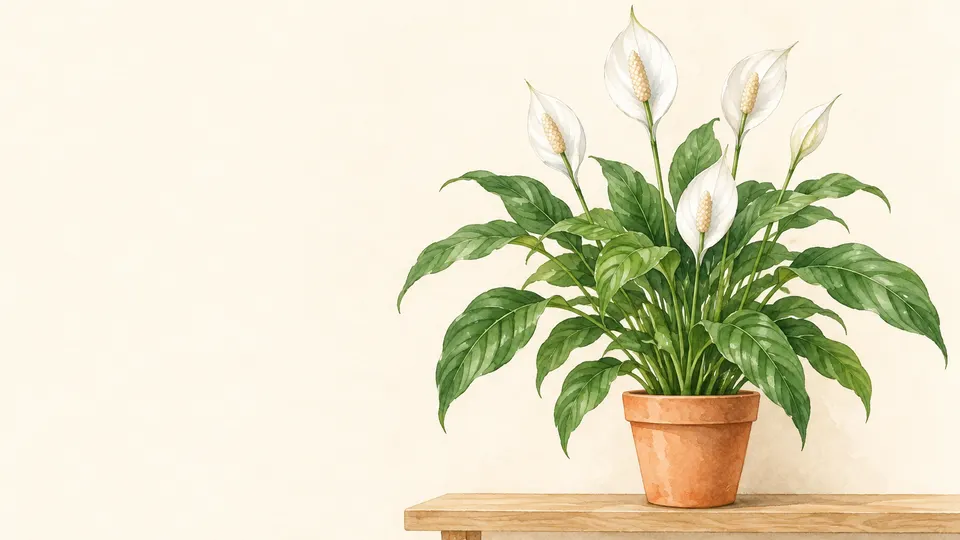
Peace lilies (Spathiphyllum) are leafy tropical perennials in the arum family, with glossy dark green leaves and white flowers held above the foliage [2] [4]. The "flower" is really a cigar-shaped spadix backed by a white, leaf-like spathe. As it ages, the spathe turns from white to green [4]. NC State notes the blooms turn pale green after about 10 days and stay attractive for at least another month [2].
Most indoor peace lilies grow 1 to 4 feet tall, and some cultivars reach 6 feet [1] [2]. In nature they grow on forest floors in tropical Central America and Southeast Asia [3].
| Need | What works | Source |
|---|---|---|
| Light | Bright, indirect light; tolerates low light; no direct sun | Clemson, MBG |
| Water | Moist but not soggy; let it dry slightly between waterings, but not to wilting | Clemson, NC State, MBG |
| Temperature | 68 to 85°F by day, about 10°F cooler at night, but not below 60°F | Clemson |
| Humidity | Tolerates below-average humidity; NC State lists low humidity as one cause of brown tips | Iowa State, NC State |
| Fertilizer | Very little: one-quarter strength every 6 to 8 weeks in spring and summer | Clemson |
| Pot | Slightly pot-bound; move up only 1 to 2 inches | Clemson |
| Pets | ASPCA lists it as toxic to cats and dogs | ASPCA |
Sources for the table: [1] [3] [2] [4] [7].
How Much Light Does a Peace Lily Need?
Peace lilies tolerate low light but grow best in bright, indirect light [1] [3]. Keep them out of direct sun, which scorches the leaves [1].
Clemson calls them one of the few foliage plants that will flower in low light [1]. Iowa State adds a caveat, though: they grow in low light but flower best in indirect sunlight [4]. If a mature plant has leaves but no flowers, more bright, indirect light is the first thing to try. For a foliage plant that Iowa State also lists among its easy, low-maintenance houseplants, see our ZZ plant care guide [4].
How Often Should You Water a Peace Lily?
Keep the soil moist but not soggy, and let it dry out slightly between waterings [1] [2], but water before the plant wilts [3]. UMD Extension's general finger test for houseplants is to push a finger about two inches into the soil and water if it feels dry [6]. Potting mix, humidity, and temperature all change how fast the soil dries, so check the soil rather than watering on a fixed schedule [6].
Peace lilies are known for telling you when they are thirsty. Their leaves wilt when the plant is dry and revive after watering [4]. But do not wait for the droop every time: Missouri Botanical Garden advises letting the soil dry between waterings without letting the plant wilt, and Clemson warns that letting the soil dry out too much makes the leaves and edges turn yellow [3] [1].
A wilting peace lily is not always a dry one. UMD Extension, using peace lily as its example, notes that plants can also wilt when overwatered [6]. Always check the soil before you water a drooping plant.
- Use room-temperature water. MBG suggests letting tap water sit so the chlorine can evaporate.
- Water until it drains from the bottom of the pot, or water from below by setting the pot in a saucer of water. NC State and MBG both say peace lilies do very well with bottom watering.
- Empty the saucer afterward. Clemson warns that a plant left sitting in excess water develops root rot.
Temperature, Soil, and Fertilizer
Temperature. Peace lilies like warmth: 68 to 85°F during the day and about 10°F cooler at night, while staying above 60°F [1]. Clemson advises avoiding temperatures below 60°F, which can cause cold damage, and NC State and MBG note that long periods below 40°F can damage leaves, stems, and roots [1] [2] [3]. Keep the plant away from heating and air-conditioning vents [1].
Soil and pot. Peace lilies grow well in almost any well-drained potting mix, and NC State suggests one high in organic matter [1] [2]. They like to be slightly pot-bound. Repot when roots grow out of the drainage holes, choosing a pot only 1 to 2 inches larger; a pot that is too large may keep the mix too wet, leading to root rot [1].
Repotting and dividing. Clemson says you can repot any time, though plants recover faster during the growing season, while NC State and MBG suggest February or March [1] [2] [3]. When you repot, you can divide a large plant; UF/IFAS recommends dividing peace lilies in spring [5].
Fertilizer. Peace lilies need very little. Clemson suggests a balanced liquid houseplant fertilizer at one-quarter strength every 6 to 8 weeks in spring and summer [1]. NC State adds flushing the soil with plain water between feedings, because too much fertilizer and salt buildup can burn leaf tips and roots [2].
Cleaning. The broad leaves collect dust. Wipe them regularly with a damp cloth, which also removes some pests that gather on the undersides [1] [2].
Why Isn't My Peace Lily Blooming?
Clemson gives two usual reasons: the plant is less than a year old, or it is not getting enough light [1]. Peace lilies have no specific bloom season and flower freely when conditions are right [2] [3], so a mature plant with no flowers is most often asking for more light.
Move it to a spot with bright, indirect light, while still keeping it out of direct sun [1] [4]. Go easy on fertilizer: Clemson recommends very little fertilizer, and overfeeding can burn the leaf tips and roots [1].
Brown Tips, Yellow Leaves, and Other Problems
| Symptom | Likely cause | What to do |
|---|---|---|
| Whole plant droops | Dry soil, or sometimes overwatering [4] [6] | Check the soil first; water only if it is dry |
| Yellow leaves and edges | Soil allowed to dry out too much [1]; houseplants kept too wet can also yellow [6] | Check the soil first: water if it is dry, let it dry slightly if it is soggy. For orchids, see why orchid leaves turn yellow |
| Yellow between green veins, stunted growth | Magnesium deficiency [1] | Check that your houseplant fertilizer lists magnesium (Mg), and follow the label |
| Brown leaf tips or edges | Overfertilizing, excessive drying, low humidity, or too much direct sun [1] [2] | Flush the soil, feed less, water more evenly, move out of direct sun, and keep it away from vents and dry drafts |
| Scorched patches | Direct sun [1] | Move to bright, indirect light |
| Rotting roots or stems | Root and stem diseases, usually from overwatering [1] | Let the soil dry slightly between waterings; never leave water in the saucer |
| Insects on leaves, or tiny flies near the soil | Mealybugs, spider mites, scale, or fungus gnats [1] [2] | Check leaves often; treat with a product labeled for the pest |
Clemson notes that root and stem diseases, usually from overwatering, are the most common peace lily problem [1]. Snake plant and spider plant, also on Iowa State's easy-houseplant list, are covered in our snake plant care and spider plant care guides [4].
Is a Peace Lily Toxic to Cats and Dogs?
Yes. The ASPCA lists the peace lily as toxic to cats and dogs. Its toxic principle is insoluble calcium oxalates, and the clinical signs listed include oral irritation, intense burning and irritation of the mouth, tongue, and lips, excessive drooling, vomiting, and difficulty swallowing [7]. Clemson also notes the calcium oxalate crystals can cause toxicity in children [1].
Keep peace lilies out of reach of pets and children. If you think your pet has eaten part of a peace lily, contact your veterinarian or the ASPCA Animal Poison Control Center right away.
Frequently Asked Questions
How often should I water a peace lily?
When the soil has dried slightly, before the plant wilts. Clemson Extension recommends keeping the soil moist but not soggy, and Missouri Botanical Garden advises not letting it wilt. UMD Extension's general houseplant check is a finger pushed about two inches into the soil, rather than a fixed schedule.
Why is my peace lily drooping?
It may be dry soil; Iowa State Extension notes the leaves wilt when dry and revive after watering. But UMD Extension warns that peace lilies can also wilt when overwatered, and Clemson names overwatering-related root and stem disease as the most common problem, so check the soil before you water.
Why won't my peace lily bloom?
Clemson Extension says lack of flowering usually happens when the plant is less than a year old or is growing in too little light. Move a mature plant to brighter, indirect light, but keep it out of direct sun.
Why are my peace lily's leaf tips turning brown?
Common causes are overfertilizing, letting the soil dry out too much, low humidity, and too much direct sun, according to Clemson and NC State Extension. Feed very lightly, flush the soil with plain water, and water more evenly.
Is a peace lily safe for cats?
No. The ASPCA lists peace lily as toxic to cats and dogs; its toxic principle is insoluble calcium oxalates, and the clinical signs listed include oral irritation, intense burning and irritation of the mouth, tongue, and lips, excessive drooling, vomiting, and difficulty swallowing. Contact your veterinarian or the ASPCA Animal Poison Control Center right away if your pet eats any.
Our Take
We think the peace lily's dramatic droop is both its best feature and its biggest trap. Iowa State notes it revives after watering when dry, but UMD notes it can also wilt when overwatered, and Clemson names overwatering-related root and stem disease as its most common problem. In our view, the safest habit is to check the soil every time it droops instead of reaching straight for the watering can. This is our editorial opinion based on extension and botanical garden guidance, not a test we ran.
Sources
- Peace Lily (HGIC 1512). Clemson Cooperative Extension, Home & Garden Information Center (revised by Barbara H. Smith, February 15, 2022).
- Spathiphyllum (Peace Lily). NC State Extension Gardener Plant Toolbox.
- Spathiphyllum (group), Plant Finder. Missouri Botanical Garden.
- Easy, Low-Maintenance Houseplants. Iowa State University Extension and Outreach (Aaron Steil; last reviewed January 2025).
- Peace Lily. UF/IFAS Gardening Solutions.
- Watering Indoor Plants. University of Maryland Extension (updated March 10, 2023).
- Peace Lily. ASPCA Toxic and Non-Toxic Plants.
Plant care advice is general guidance: adjust for your light, season and pot, and check the soil before you water. Pet toxicity follows the ASPCA list only; if a pet may have eaten part of a plant, contact your veterinarian or the ASPCA Animal Poison Control Center right away.Spotted an error? Tell us.
Related Guides
Orchid Yellow Leaves: Causes and Fixes
Why orchid leaves turn yellow: normal aging, root rot, too much light, pests, disease, cold, or ethylene gas. Use the table and flowchart to find the cause.

Snake Plant Care: Light, Water, and Common Mistakes
Snake plant care for beginners: bright indirect light, water only when the soil is dry (about every 2 to 6 weeks, less in winter), a snug pot, and rot traps.
Spider Plant Care: Light, Water, and Baby Plants
Spider plant care made simple: bright, indirect light, water when the soil starts to dry, what causes brown leaf tips, and how to root the baby plantlets.
Orchid Care: How to Keep a Phalaenopsis Blooming
Moth orchid care for beginners: bright indirect light, a weekly soak in bark, the right temperatures, and how cool fall nights and spike pruning bring rebloom.
ZZ Plant Care: Light, Water, Soil, and Yellow Leaves
ZZ plant care: bright indirect light (low light tolerated), water 1 to 2 times a month only once the mix dries, a coarse mix, and how to fix yellow leaves.
Prayer Plant Care: Light, Water, Humidity, and Brown Tips
Prayer plant care: bright indirect light, evenly moist soil, high humidity, and steady warmth, plus why leaves fold at night and what brown edges can mean.