Prayer Plant Care: Light, Water, Humidity, and Brown Tips
Quick Answer
Give a prayer plant bright, indirect light with no direct sun, and keep the soil evenly moist March through September, letting the top inch dry in winter. It needs high humidity, ideally well above 50%, and temperatures around 65 to 70°F, never below 55°F. Brown, curled edges probably point to uneven moisture or dry air. Leaves folding up at night are normal.
On this page
- Why Do Prayer Plant Leaves Fold Up at Night?
- Prayer Plant Care at a Glance
- How Much Light, Warmth, and Humidity Does a Prayer Plant Need?
- How Often Should You Water a Prayer Plant?
- Feeding and Repotting a Prayer Plant
- Why Are Prayer Plant Leaves Turning Brown or Fading?
- How Do You Propagate a Prayer Plant?
- Frequently Asked Questions
- Our Take
- Sources
Key Takeaways
- Leaves rising into a "prayer" position at night and lying flat by day is the plant's normal sleep movement, not a sign of trouble.
- Bright, indirect light suits it best. Direct sun bleaches the leaf color, and low light also dulls it.
- Keep the soil evenly moist from March through September, let the top inch dry in winter, and never let water stand on the crown.
- High humidity matters. NC State suggests a pebble tray or humidified room; NYBG says a pebble tray may not be enough and suggests a humidifier and a hygrometer.
- The ASPCA lists "Prayer Plant" (scientific name shown as Calathea insignis) as non-toxic to dogs and cats.
Why Do Prayer Plant Leaves Fold Up at Night?
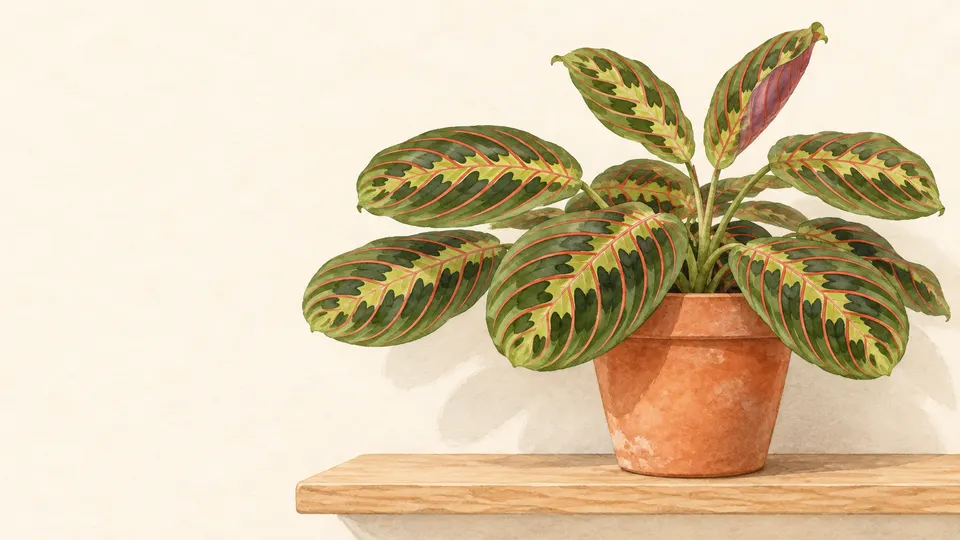
The folding is normal and is where the plant gets its name. NC State Extension describes leaves held parallel to the ground by day that move to an upright "prayer" position at night, and lists this as one of the quick ways to identify the plant [1]. The RHS and the New York Botanical Garden (NYBG) also tie the common name to the leaves folding or rising at night [3] [4]. University of Illinois Extension puts it simply: a prayer plant folds up its leaves in darkness [2].
NC State calls this "sleep movement" [1]. The extension and garden sources used here describe the movement but do not explain how the plant does it, so this guide does not either. Leaves that rise in the evening and lie flat again in the morning are the normal sleep movement NC State describes, not a problem to fix.
Prayer Plant Care at a Glance
The plant itself is Maranta leuconeura, an evergreen tropical perennial in the arrowroot family (Marantaceae) that NC State lists as native to Brazil, also sold as herringbone plant or rabbit tracks [1]. It stays low, about 6 inches to 1 foot tall, and spreads sideways from short, rhizomatous stems [1]. Cultivars on NC State's list include 'Fascinator Tricolor' with red veins, 'Lemon' or Lemon Lime, and 'Silver Band' [1]. According to NYBG, Maranta is closely related to Goeppertia, the genus NYBG's own guides list Calathea under [4].
Think of a rainforest floor: filtered light, warm air, and steady moisture. NYBG uses that same picture to explain why the plant needs protection from strong sun and generous humidity [4].
| Need | What works | Source |
|---|---|---|
| Light | Bright, indirect or diffused light; no direct sun. Tolerates low to medium light; colors fade in low light | NC State, Illinois, NYBG |
| Temperature | 65 to 70°F is ideal; always above 55°F; no cold drafts or sudden changes | NYBG, NC State |
| Water | Evenly moist March through September; drier in winter | NC State, Illinois, NYBG |
| Humidity | High; NYBG suggests keeping it well above 50% | NC State, NYBG |
| Potting mix | Regular potting mix that drains; NYBG suggests a soil-based mix with some peat and sharp sand | Illinois, NYBG, NC State |
| Fertilizer | NYBG: standard liquid fertilizer every 2 weeks, March through September | NYBG |
| Repotting | In spring, every 1 to 2 years, in a pot with a drainage hole | NYBG |
| Propagation | Division; Nevada Extension also lists stem cuttings | NC State, Nevada Extension |
| Pets | ASPCA lists "Prayer Plant" as non-toxic to dogs and cats (see below) | ASPCA |
Sources for the table: [1] [2] [4] [5] [7].
Pets. The ASPCA's "Prayer Plant" page lists the plant as non-toxic to dogs, cats, and horses. Its scientific name field reads Calathea insignis, family Marantaceae, with Maranta, peacock plant, rattle snake plant, red veined prayer, and zebra plant as additional common names [7]. The ASPCA's separate "Maranta" page also lists Calathea insignis as non-toxic to dogs, cats, and horses [8]. Neither page names Maranta leuconeura directly, so you can open both pages and check the listing yourself. If your pet eats any plant and seems unwell, contact your veterinarian or the ASPCA Animal Poison Control Center right away.
How Much Light, Warmth, and Humidity Does a Prayer Plant Need?
Light. Place a prayer plant in bright, indirect light [1]. Illinois Extension describes the same thing as diffused sun [2], and NYBG suggests a shady window or a spot shielded from the strongest light by a sheer curtain [4]. The plant is intolerant of direct sunlight, according to NC State, and too much sun bleaches the leaf color [1]. It tolerates low to medium light, but NC State also notes that both sides of the leaves lose color in low light [1]. Aim for bright light that never falls directly on the leaves.
Temperature. NYBG gives 65 to 70°F as ideal household temperatures, and says to avoid sudden changes and always keep the plant above 55°F [4]. NC State lists the plant as intolerant of low temperatures and cold drafts [1], so keep it away from drafty doors and cold winter windows.
Humidity. Both NC State and Illinois say the plant needs high humidity, and NC State lists it as intolerant of low humidity [1] [2]. The sources differ on how to provide it:
- NC State suggests a humidified room or a pot standing in a tray of wet pebbles [1].
- NYBG warns that a pebble tray or daily misting may not be enough, especially in a heated home in winter (NYBG cites New York winters), and points to a humidifier or a terrarium instead. It suggests keeping a simple hygrometer near the plant to confirm humidity stays well above 50%, and notes that above the low 60s °F the plant needs more humidity [4].
Our suggestion, not a source's: start with a pebble tray and a hygrometer, and add a humidifier if the reading stays low or the leaf edges keep browning. The pebble tray is the same setup described in our orchid care guide.
How Often Should You Water a Prayer Plant?
Keep the potting mix evenly moist through the growing season, then let it dry more in winter [1] [2]. NYBG defines the growing period as March through September and suggests letting the top inch of mix dry out before watering in winter [4]. None of these sources give a fixed number of days. Because no source gives a schedule, we suggest touching the soil before you water instead of following a calendar.
A few habits help the water go where it should:
- Use tepid water. NYBG recommends it for this plant [4].
- Empty the saucer. NYBG says to empty the run-off dish 15 minutes after watering [4].
- Keep water off the crown. Illinois Extension warns not to let water stand on the crowns because the stems rot easily [2].
- Use a pot that drains. NC State notes root rot may occur in poorly drained soil [1], and NYBG says the container must have a drainage hole [4].
Water quality. Two sources raise it. NYBG does not recommend hard water because it leaves mineral deposits on the leaves [4], and NC State says the leaves will burn with high fluorides [1]. If your tap water is hard or fluoridated, we suggest trying rainwater or distilled water. Our spider plant guide covers the same tap-water question for another plant with tip burn.
Feeding and Repotting a Prayer Plant
Fertilizer. NYBG recommends a standard liquid fertilizer every two weeks during the growing period, March through September [4]. NC State adds two cautions that pull in opposite directions: leaves lose color in low-fertility situations, and they burn with over-fertilization [1]. Follow the dose on the product label and do not add extra.
Repotting. NYBG suggests repotting in spring, every one or two years, into a soil-based mix with some added peat and sharp sand, kept loose in the pot [4]. Illinois Extension says regular potting mix works [2]. Whatever the mix, it has to drain, and the pot needs a drainage hole [4] [1]. NYBG repots in spring and Nevada Extension recommends propagating during active growth [5], so repotting is a convenient time to divide.
Why Are Prayer Plant Leaves Turning Brown or Fading?
Moisture is the key to success, in NYBG's words: if leaf tips and edges brown, curl, or leaves fall, the plant probably needs more consistently moist soil or higher humidity [4]. Check soil moisture and humidity first when edges turn brown. The table below covers browning and other common leaf symptoms.
| Symptom | Possible cause | What to do |
|---|---|---|
| Brown, curled leaf tips and edges, or falling leaves | Soil not consistently moist, or humidity too low [4] | Water more evenly in the growing season and raise humidity |
| Burned leaves | High fluorides or over-fertilization [1] | Try rainwater or distilled water (our suggestion); feed only at the label rate |
| Faded, bleached leaf color in a bright spot | Too much sun [1] [4] | Move it out of direct sun or behind a sheer curtain |
| Leaves losing color in a dim spot | Low light or low fertility [1] | Give brighter, indirect light; feed during the growing period |
| Mineral spots on the leaves | Hard water [4] | Switch to softer water |
| Rotting stems at the base | Water standing on the crowns [2]; root rot in poorly drained soil [1] | Water the soil, not the crown; repot into a mix that drains |
| Pale specks on leaves, sometimes fine webbing | Spider mites [1] [6] | Check leaf undersides with a hand lens; see pests below |
| White, cottony clusters along veins or leaf bases | Mealybugs [1] [6] | Scrape or wash them off; see pests below |
| Yellowing, dropping leaves | Low light, cold, overwatering, or poor drainage [6] | Check light and drafts; let the top of the mix dry as described above; confirm the drainage hole |
Our peace lily care guide walks through brown tips on another common shade-tolerant houseplant, with its own list of causes.
Spider mites and mealybugs
NC State says the prayer plant has no serious pest problems, but occasional spider mites and mealybugs can be an issue [1]. UC IPM describes spider mites as tiny pests, about 0.02 inch long, usually found on leaf undersides, where a 10X hand lens helps identify them. Their feeding leaves light-colored specks called stippling, sometimes with silk webbing, and severe infestations make leaves dry and fall [6]. Mealybugs are small, oval, whitish sap-sucking insects that leave a cottony, powdery, or waxy material on the plant, often along leaf veins or where leafstalks join stems [6].
UC IPM suggests periodically washing leaf surfaces with water to help prevent pests, and scraping or washing mealybugs off with a spray of water [6]. If you use a pesticide, choose one labeled for indoor use on your plant and against the pest you found, and follow the label directions [6].
For spider mites, UC IPM suggests washing leaf surfaces with water frequently, reducing dust, and removing infested parts; it also notes that low indoor humidity favors mites [6]. Isolate an infested plant so the pest does not spread [6].
How Do You Propagate a Prayer Plant?
NC State says to propagate the plant by rhizomatous division [1]. Nevada Extension's houseplant table lists prayer plant propagation by stem cuttings or division, and recommends propagating houseplants while they are actively growing [5].
Division. Nevada Extension gives these general steps for houseplants that grow from more than one crown [5]:
- Carefully remove the plant from its pot.
- Gently pull the clump apart into sections, pulling by hand as much as possible.
- Use a sharp knife only where thick roots will not pull apart, and try not to damage the root system.
- Pot each section right away.
Stem cuttings. Nevada Extension's general method for houseplant stem cuttings is to cut a 3 to 4 inch piece from the tip, cut below a node, strip the lower leaves so at least two nodes go into the potting mix, dip the end in rooting powder, and enclose the pot in a clear plastic bag in a warm, shady spot until new growth shows that roots are forming [5]. These steps are written for houseplants in general. NC State names only division for this plant [1], so we suggest starting with division. Division is also one of the methods in our guide to snake plant propagation.
Frequently Asked Questions
Why does my prayer plant close its leaves at night?
That is the movement the plant is named for. NC State Extension describes the leaves lying flat by day and moving to an upright "prayer" position at night, and calls it sleep movement. It is normal and does not need fixing.
How often should I water a prayer plant?
There is no fixed number of days. Keep the soil evenly moist from March through September, and in winter let the top inch dry before watering, as NYBG suggests. Check the soil with your finger first, use a pot with a drainage hole, and empty the saucer after watering.
Why are the edges of my prayer plant's leaves turning brown?
NYBG says browning or curling tips and edges probably mean the plant needs more consistently moist soil or higher humidity. NC State adds that leaves can burn from high fluorides in water or from over-fertilizing, so check your water and feeding too.
Is a prayer plant toxic to cats or dogs?
The ASPCA lists "Prayer Plant" as non-toxic to dogs and cats, though its page gives the scientific name as Calathea insignis. Its separate "Maranta" page is also non-toxic. If your pet eats any plant and seems unwell, contact your veterinarian or the ASPCA Animal Poison Control Center right away.
Can a prayer plant take direct sun?
No. NC State lists it as intolerant of direct sunlight and says too much sun bleaches the leaf color. Use bright, indirect light, such as a spot near a window behind a sheer curtain.
Our Take
We think the prayer plant is less fussy about any single setting than about steadiness. The sources we reviewed keep returning to consistency: evenly moist soil, no sudden temperature changes, no cold drafts, and humidity that stays high. In our view, the most useful tool for this plant is an inexpensive hygrometer, because dry indoor air is hard to judge by feel and NYBG's guidance gives a clear number to aim for. Start with a pebble tray, watch the reading, and add a humidifier if it stays low. This is our editorial opinion based on extension and botanical garden guidance, not a test we ran.
Sources
- Maranta leuconeura. NC State Extension Gardener Plant Toolbox.
- Prayer Plant. University of Illinois Extension.
- Maranta leuconeura (plant profile). Royal Horticultural Society (RHS).
- Prayer Plant (Maranta leuconeura). New York Botanical Garden, LuEsther T. Mertz Library Plant & Research Guides.
- Propagating Houseplants (FS-98-92). University of Nevada Cooperative Extension (Aggie Roberts, M. L. Robinson).
- Houseplant Problems. UC Statewide IPM Program, University of California Agriculture and Natural Resources.
- Prayer Plant. ASPCA Toxic and Non-Toxic Plants.
- Maranta. ASPCA Toxic and Non-Toxic Plants.
Plant care advice is general guidance: adjust for your light, season and pot, and check the soil before you water. Pet toxicity follows the ASPCA list only; if a pet may have eaten part of a plant, contact your veterinarian or the ASPCA Animal Poison Control Center right away.Spotted an error? Tell us.
Related Guides
Peace Lily Care: Watering, Light, and Getting Blooms
Peace lily care for beginners: bright indirect light, moist but not soggy soil, why it droops, how to get blooms, and what brown tips and yellow leaves mean.
Spider Plant Care: Light, Water, and Baby Plants
Spider plant care made simple: bright, indirect light, water when the soil starts to dry, what causes brown leaf tips, and how to root the baby plantlets.
Orchid Care: How to Keep a Phalaenopsis Blooming
Moth orchid care for beginners: bright indirect light, a weekly soak in bark, the right temperatures, and how cool fall nights and spike pruning bring rebloom.
How to Propagate a Snake Plant
How to propagate a snake plant by division, offsets, or leaf cuttings, step by step, and why leaf cuttings from variegated plants usually grow back all green.
How to Propagate Pothos (Water vs Soil)
How to propagate pothos from stem cuttings: where to cut around the nodes, rooting in water vs a moist mix, how long roots take, and when to pot water cuttings.

Money Tree Care: Light, Water, Humidity, and Leaf Problems
Money tree (Pachira aquatica) care: bright light without harsh sun, evenly moist but never soggy mix, 65 to 75°F warmth, humidity, and causes of leaf drop.