Money Tree Care: Light, Water, Humidity, and Leaf Problems
Quick Answer
Give a money tree (Pachira aquatica) bright light or partial shade, out of strong direct sun, which can scorch the leaves. Keep the well-drained mix evenly moist: check about two inches down and water when it feels dry, letting excess drain away, because standing water can cause root rot. It thrives at 65 to 75°F with humidity. Leaf drop can follow soil that is too dry, or for houseplants generally, too wet.
On this page
- What Is a Money Tree?
- How Much Light Does a Money Tree Need?
- How Often Should You Water a Money Tree?
- What Temperature and Humidity Does a Money Tree Like?
- Potting, Pruning, Propagation, and Feeding
- Why Are My Money Tree's Leaves Dropping or Turning Yellow?
- Is a Money Tree Toxic to Cats and Dogs?
- Frequently Asked Questions
- Our Take
- Sources
Key Takeaways
- The money tree is Pachira aquatica, also sold as money plant; to be sure, match the botanical name on the label.
- Bright light or partial shade suits it indoors; direct sunlight can scorch the leaves.
- Keep the mix evenly moist but well drained: check about two inches down before watering, and never leave the pot in water.
- NC State says it thrives at 65 to 75°F in humid air and should come indoors before 45°F; University of Maryland Extension advises protecting houseplants below 50°F.
- The ASPCA lists Pachira aquatica as non-toxic to dogs and cats.
What Is a Money Tree?
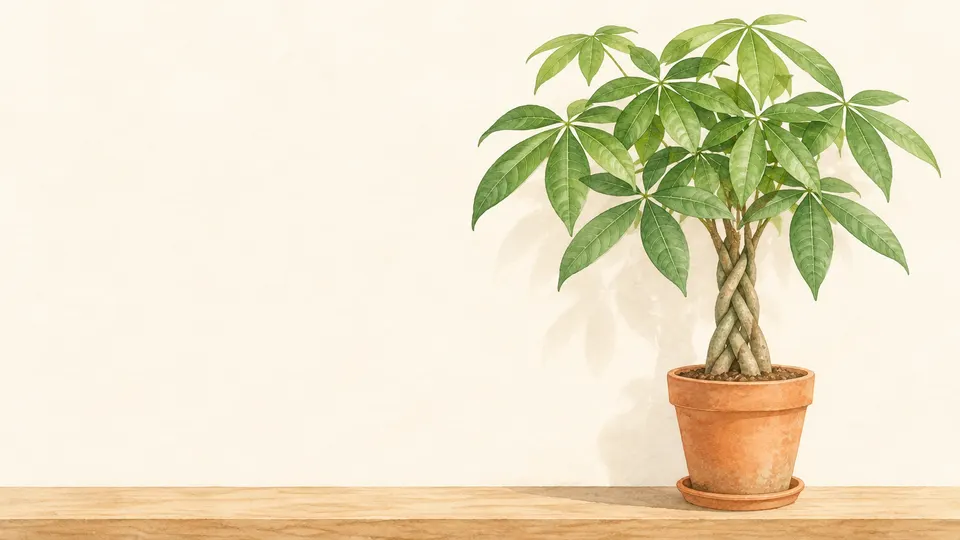
A money tree is Pachira aquatica, a tropical evergreen tree in the mallow family (Malvaceae) that is sold as a houseplant or bonsai [1] [2]. In the wild it grows in freshwater swamps, estuaries, and riverbanks from Mexico to northern South America, and it can reach 60 feet tall there [1] [2]. It also goes by Guiana chestnut, Malabar chestnut, and water chestnut, and it is sold under the names money tree and money plant [2].
To be sure you have the plant this guide covers, check that the label says Pachira aquatica.
Its trunks are flexible enough to braid [1], and it is often grown indoors in a braided trunk form, sometimes with several plants plaited together [2] [3].
| Feature | What sources describe |
|---|---|
| Leaves | Shiny, palmately compound, with 5 to 9 leaflets, each up to 5 to 10 inches long [2] |
| Size indoors | 6 to 8 feet, per NC State and Missouri Botanical Garden; the RHS says it is unlikely to exceed 1.5 m (about 5 feet) in a pot [1] [2] [3] |
| Flowers | Large and fragrant at night, but houseplants are unlikely to flower, and NC State says braided trees will not flower [1] |
| Growth rate | Listed as rapid, with medium maintenance [1] |
| Hardiness | USDA zones 10 to 12; an indoor plant in colder areas [1] [2] |
How Much Light Does a Money Tree Need?
Give a money tree bright light without long, hot direct sun. Houseplants perform best in bright light, according to Missouri Botanical Garden [2], and the RHS suggests bright light or partial shade indoors [3]. NC State says it prefers indirect sunlight or a mix of sun and shade, and its plant record lists partial shade, meaning direct sun for only part of the day, about 2 to 6 hours [1]. We read these together as: a few hours of direct sun is fine, but long or harsh direct sun risks scorch.
Direct sunlight can cause leaf scorch. [1] We suggest filtering strong sun. The tree tolerates close to full shade in Missouri Botanical Garden's outdoor growing notes, but its advice for houseplants is bright light [2].
If you move the plant outdoors for summer, or to a much brighter window, do it gradually. Bleached or whitened leaves can mean too much light or sunburn, and houseplants should be acclimated slowly to higher light, according to University of Maryland Extension (UMD) [5].
How Often Should You Water a Money Tree?
Water when the mix feels dry about two inches down, not on a fixed calendar. The money tree prefers a moist, well-drained potting mix, but standing water is not tolerated and can cause root rot [1]. For houseplants, Missouri Botanical Garden recommends moderate but even moisture and warns that plants drop leaves if the soil becomes dry [2].
So you are aiming between two failures: soggy roots and dry soil. UMD advises against watering houseplants on a schedule and suggests testing the soil with a finger to about two inches deep; if it is dry there, the plant probably needs water [4]. Lifting the pot also helps, because a pot with dry mix weighs much less [4].
How to water [4]:
- Check the mix with your finger, about two inches down.
- Water from the top until water drains freely from the bottom of the pot.
- Pour off any water left in the saucer. Never let the plant sit in water.
University of Maryland Extension names potting mix, humidity, and temperature among the factors that change how often houseplants need water [4]. We would add season, light, and pot size. Treat any schedule as a reminder to check the soil, not a reminder to water. Our sources give no fixed number of days for this plant, so we do not offer one.
For another common houseplant with its own watering routine, see our snake plant care guide.
What Temperature and Humidity Does a Money Tree Like?
The money tree thrives in a humid environment at 65 to 75°F [1]. Where winters are cold, bring it indoors before temperatures drop to 45°F [1]; the RHS rates it as a plant that must be kept under glass or indoors in winter [3]. For houseplants in general, UMD advises protecting plants from temperatures below 50°F and notes that cold injury symptoms can keep appearing for up to a week after exposure [5].
Humidity matters too: yellow leaves can occur if humidity is too low [1]. Keep the plant away from spots that are cold or very dry, and if you take it outside in summer, protect it from strong winds [1].
Potting, Pruning, Propagation, and Feeding
Potting mix. Use a moist, well-drained potting mix of peat moss, perlite, loam, or sand [1], or an open, free-draining compost [3]. Either way, water has to drain out of the bottom of the container; UMD recommends a well-drained potting mix labeled for houseplants in a pot that lets water drain [5]. If your finger cannot get two inches into the mix, University of Maryland Extension says it may need a more porous mix or the plant may be root bound [4].
Pruning. Cut back shoots as needed to control size, in spring [3]. If you see discolored areas on a stem (stem cankers), prune out the affected areas [5].
Propagation. NC State lists softwood cuttings, layering, and seed [1], and the RHS lists seed, semi-ripe cuttings, and air-layering [3]. For a step-by-step look at rooting stem cuttings of a common vining houseplant, see our pothos propagation guide.
Fertilizer. Inadequate nutrients in the soil are one cause of yellow leaves [1]. Our sources do not give a feeding schedule for money trees, so use a houseplant fertilizer as its label directs. If growth turns spindly, UMD points to low light or excess fertilizer and advises reducing fertilizer in winter [5].
Why Are My Money Tree's Leaves Dropping or Turning Yellow?
Start with the soil and the room, then check for pests. Here is what the sources link to each sign:
| Sign | Possible cause named by sources | What to do |
|---|---|---|
| Leaves dropping | Soil too dry [1] [2]; for houseplants generally, soil kept too wet [4] | Check the mix two inches down first: water if dry; if wet, hold off and check the roots |
| Yellow leaves | Humidity too low, or inadequate nutrients in the soil [1]; soil kept too wet [4]; root rot, high soluble salts, or pests such as spider mites and scale [5] | Rule out wet soil and pests before raising humidity or feeding |
| Wilting with dark, soft roots | Root rot; NC State links it to standing water [1] [5] | UMD: cut out rotten portions and replant healthy sections, and root cuttings in sterile mix |
| Bleached or whitened leaves | Too much light or sunburn [5] | Move out of strong direct sun; acclimate slowly |
| Leaf scorch | Direct sunlight [1]; over-fertilizing, high soluble salts, or lack of water [5] | Filter strong sun; if light is not the cause, check watering and flush the mix with water |
| Tiny dark flies near the pot | Fungus gnats [1] [5] | UMD: let the potting mix dry between waterings |
Healthy roots are light-colored and firm; diseased roots look dark and soft. [5] If the soil stays wet and the plant wilts, slide it out of its pot and look at the roots.
Pests and diseases. Watch for aphids, mealybugs, scale, and fungus gnats; potential diseases include anthracnose, powdery mildew, and root rot [1]. The RHS adds glasshouse red spider mite and a leaf spot [3]. Missouri Botanical Garden, by contrast, reports no serious insect or disease problems [2].
We read that as: trouble is possible rather than expected. To keep pests down, rinse plants regularly with water, dab individual mealybugs with a cotton swab dipped in alcohol, and otherwise use a registered houseplant spray [5]. If you use a spray, pick a product labeled for that pest on houseplants and follow the label.
For two other indoor trees, see our guides to rubber plant care and fiddle-leaf fig care.
Is a Money Tree Toxic to Cats and Dogs?
The ASPCA lists Money Tree (Pachira aquatica), with the additional common name Money Plant, as non-toxic to dogs, cats, and horses [6]. It lists the toxic principles as "None" and the clinical signs as "Nausea, vomiting and loose stool" [6]. The ASPCA entry is for Pachira aquatica; match that botanical name on your plant's label.
If your pet has chewed on a money tree and shows any signs of illness, contact your veterinarian or the ASPCA Animal Poison Control Center right away. Our guides to peace lily care and ZZ plant care each note how the ASPCA lists those plants.
Frequently Asked Questions
How often should I water a money tree?
There is no fixed interval. Check the potting mix with a finger about two inches down and water when it is dry there, as the University of Maryland Extension suggests for houseplants. NC State says the money tree prefers a moist, well-drained mix but does not tolerate standing water. University of Maryland Extension says differences in potting mix, humidity, and temperature influence how often houseplants need water.
Why is my money tree dropping leaves?
NC State and Missouri Botanical Garden both say leaf drop can occur when the soil becomes too dry. For houseplants in general, University of Maryland Extension notes that soil kept too wet can also cause leaf drop. Check the mix about two inches down before you water, and if the soil is wet and the plant wilts, check the roots for rot.
Why are my money tree's leaves turning yellow?
NC State lists low humidity and inadequate nutrients in the soil as causes of yellow leaves. For houseplants in general, University of Maryland Extension says soil kept too wet can turn leaves yellow, and it also links yellowing to root rot, high soluble salts, and pests such as spider mites and scale. Check the mix about two inches down, then check the roots and leaf undersides.
Can I prune a money tree?
Yes. The RHS advises cutting back shoots as needed to control size, in spring. Prune out any discolored, cankered areas on stems, as the University of Maryland Extension advises for houseplants.
Is a money tree safe for cats and dogs?
The ASPCA lists Money Tree (Pachira aquatica) as non-toxic to dogs, cats, and horses. It lists the toxic principles as none and the clinical signs as nausea, vomiting and loose stool. If your pet chews it and shows signs, contact your veterinarian or the ASPCA Animal Poison Control Center right away.
Our Take
We think the money tree is easiest to understand as a swamp tree living in a pot. NC State and Missouri Botanical Garden both describe it as native to freshwater swamps and riverbanks, which fits their advice to keep the mix moist, yet NC State also warns that standing water can rot the roots. In our view, the practical habit is to check the mix before every watering and empty the saucer afterward, rather than following a fixed schedule. This is our editorial opinion based on extension and botanical garden guidance, not a test we ran.
Sources
- Pachira aquatica. NC State Extension Gardener Plant Toolbox.
- Pachira aquatica (Plant Finder). Missouri Botanical Garden.
- Pachira aquatica. Royal Horticultural Society.
- Watering Indoor Plants. University of Maryland Extension (updated March 10, 2023).
- Diagnose Indoor Plant Problems. University of Maryland Extension.
- Money Tree. ASPCA Toxic and Non-Toxic Plants.
Plant care advice is general guidance: adjust for your light, season and pot, and check the soil before you water. Pet toxicity follows the ASPCA list only; if a pet may have eaten part of a plant, contact your veterinarian or the ASPCA Animal Poison Control Center right away.Spotted an error? Tell us.
Related Guides
Rubber Plant Care: Light, Water, Leaf Drop, and Pruning
Rubber plant care: bright light, water when the soil feels slightly dry, steady warmth away from drafts, plus leaf drop causes, pruning, air layering, and pets.
Fiddle Leaf Fig Care: Light, Water, and Leaf Drop
Fiddle leaf fig care from extension sources: bright indirect light, watering after a 2-inch soil check, drainage, and what can cause leaf drop and brown spots.
ZZ Plant Care: Light, Water, Soil, and Yellow Leaves
ZZ plant care: bright indirect light (low light tolerated), water 1 to 2 times a month only once the mix dries, a coarse mix, and how to fix yellow leaves.
Peace Lily Care: Watering, Light, and Getting Blooms
Peace lily care for beginners: bright indirect light, moist but not soggy soil, why it droops, how to get blooms, and what brown tips and yellow leaves mean.
Snake Plant Care: Light, Water, and Common Mistakes
Snake plant care for beginners: bright indirect light, water only when the soil is dry (about every 2 to 6 weeks, less in winter), a snug pot, and rot traps.
How to Propagate Pothos (Water vs Soil)
How to propagate pothos from stem cuttings: where to cut around the nodes, rooting in water vs a moist mix, how long roots take, and when to pot water cuttings.