Fiddle Leaf Fig Care: Light, Water, and Leaf Drop
Quick Answer
Give a fiddle leaf fig bright, indirect light with protection from afternoon sun, and keep that light steady; if it summers outdoors, move it gradually into shade first. Water only after checking the soil about 2 inches down, let the pot drain, and never leave it sitting in water. Use a pot with drainage holes, keep it above 55°F and away from heating or cooling vents, and wipe dust off the leaves.
On this page
- What Is a Fiddle Leaf Fig, and Is It Hard to Grow?
- How Much Light Does a Fiddle Leaf Fig Need?
- How Often Should You Water a Fiddle Leaf Fig?
- What Soil and Pot Does a Fiddle Leaf Fig Need?
- Why Is My Fiddle Leaf Fig Dropping Leaves or Getting Brown Spots?
- Temperature, Humidity, Feeding, Cleaning, and Pests
- Is a Fiddle Leaf Fig Toxic to Cats and Dogs?
- Frequently Asked Questions
- Our Take
- Sources
Key Takeaways
- NC State says the fiddle leaf fig (Ficus lyrata) prefers bright indirect light or partial shade, with protection from afternoon sun.
- Check the soil about 2 inches deep before watering; NC State notes leaf drop may occur from too much or too little water.
- A sharp change in light, such as moving in from full sun, can cause leaf drop, and Maryland Extension says lost leaves are not replaced.
- NC State links brown spots to temperature swings from heating or cooling vents; a Penn State article links them to root rot.
- The ASPCA does not list Ficus lyrata by species, but it lists weeping fig as toxic. Do not treat a fiddle leaf fig as pet safe.
What Is a Fiddle Leaf Fig, and Is It Hard to Grow?
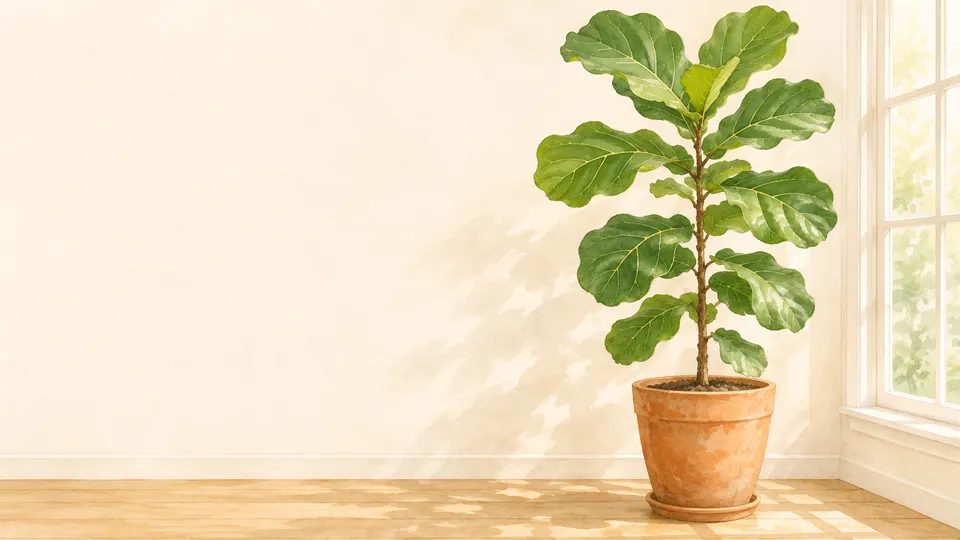
The fiddle leaf fig, Ficus lyrata (previously known as Ficus pandurata), is a tropical tree from western and central Africa that is grown as a houseplant [1] [6]. Indoors it grows about 2 to 10 feet tall, with broad, lyre-shaped leaves up to 18 inches long, and it rarely flowers or fruits as a houseplant [1]. Another common name is banjo fig [1].
Is it hard to grow? The extension sources we used describe it as manageable. NC State Extension calls it a relatively low-maintenance houseplant [1]. A Penn State Extension Master Gardener article calls fiddle leaf figs very easy to care for, with minimal care [2]. An Illinois Extension blog post describes it as rather easy to grow but finicky if it is in the wrong spot [3]. In our reading of these sources, most fiddle leaf fig care comes down to picking a good spot and then checking the soil before every watering.
| Variety | What NC State says about it |
|---|---|
| 'Bambino' | Dwarf variety, grows a few feet tall |
| 'Compacta' | Grows up to 5 feet tall, with smaller leaves |
| 'Little Sunshine' | Small plant with bright, violin-shaped green leaves |
| 'Variegata' | Green and cream leaves; uncommon |
Source for the table: NC State Extension [1]. Its relative, rubber plant (Ficus elastica) [5], is covered in our rubber plant care guide.
How Much Light Does a Fiddle Leaf Fig Need?
Give it bright light: the fiddle leaf fig prefers bright indirect light or partial shade and needs protection from the afternoon sun, according to NC State [1]. For its spot indoors, Illinois Extension recommends very bright indirect light [3]. The RHS, writing for UK conditions, suggests full or filtered light when it is grown under glass [6].
Too much direct sun has a cost. NC State notes that leaf scorch can occur if the plant gets too much direct sunlight [1]. A plant that has spent months indoors also needs time to adjust before it goes outside [2]. The Penn State Master Gardener article compares the leaves to skin that can sunburn and suggests starting in a shady spot, watching the plant for a few days, then moving it into filtered light, still out of direct sun [2].
For a lower-light corner, see our snake plant care guide.
Keep the Light Steady; Turning the Pot Is Fine
On Illinois Extension's Good Growing podcast, horticulture educator Ken Johnson suggests keeping a fiddle leaf fig's sun intensity consistent: move it outdoors into partial shade so the leaves do not burn, because a plant that has been in full sun can drop its leaves when it comes back in [4]. Maryland Extension adds that fiddle leaf figs will not replace leaves that are lost indoors, even when moved back outdoors [5]. Once you find a bright spot that works, leave the plant there rather than moving it around, apart from a gradual summer move outdoors. That last point is our own reading of these sources, not a rule any one of them states.
Turning the plant is the exception. The Penn State Master Gardener rotates each plant about a quarter turn while checking for pests [2].
How Often Should You Water a Fiddle Leaf Fig?
Water when the soil needs it, not on a fixed schedule. NC State notes that the fiddle leaf fig is sensitive to overwatering, and that leaf drop may occur from too much or too little water [1]. None of the sources we used gives a set number of days, so let the soil decide. We would expect drying time to vary with the season, light, pot size, and room warmth, so check rather than count days.
How to check and water:
- Push a finger about 2 inches into the soil to see whether it is wet or dry; the Penn State Master Gardener also uses a moisture meter [2].
- If it is dry at that depth, water [2] [4], and let the excess drain out of the pot.
- Do not leave the pot sitting in water in its saucer, which keeps the soil too moist [4].
Do not let the soil dry so far that it pulls away from the side of the pot. When that happens, water runs down the inside of the pot instead of soaking the roots, and the Penn State Master Gardener loosens the soil with a fork or chopstick before watering [2]. Plants summering outdoors will probably need water more often than they do inside [2].
What Soil and Pot Does a Fiddle Leaf Fig Need?
Drainage matters most: a pot with sufficient drainage is essential, according to Illinois Extension [3]. The preferred soil is moist, well drained, loamy, and acidic, per NC State [1]. The RHS suggests a peat-free, loam-based compost for plants grown under glass [6]. The Penn State Master Gardener uses a fast-draining potting soil in a plastic pot with four to six drainage holes [2].
| Topic | What the sources say |
|---|---|
| Pot | Sufficient drainage is essential [3]; plastic pot with several drainage holes [2] |
| Soil | Moist, well drained, loamy, acidic [1]; peat-free, loam-based compost under glass [6] |
| Repotting | Fiddle leaf figs love to be potbound [2]; ficus in general do need repotting on occasion [4] |
| Pruning | May be pruned as needed [1]; indoor ficus are kept at the desired height by pruning [5] |
| Propagation | Seed, leaf-bud cuttings, or semi-hardwood cuttings [6] |
The sources we used do not call for frequent repotting. The Penn State article says fiddle leaf figs love to be potbound [2]. On the Illinois podcast, speaking of ficus in general, Ken Johnson says ficus tolerate being root bound rather than liking it, so they do need repotting now and then; for a very large pot, he mentions top dressing as an alternative [4]. His co-host Chris Enroth advises against garden soil, which is too heavy [4].
Pruning and sap. NC State says the fiddle leaf fig may be pruned as needed [1]. Its stems carry a milky sap that can irritate the skin, so NC State recommends gloves when handling the plant, particularly when pruning or propagating [1]. The RHS also lists it as a skin allergen [6].
Why Is My Fiddle Leaf Fig Dropping Leaves or Getting Brown Spots?
Leaf drop and brown spots have more than one possible cause, and different sources name different ones. Check the watering and the plant's spot first, then work down the table.
| Symptom | Possible causes named by sources | What to try |
|---|---|---|
| Leaves dropping | Too much or too little water [1]; heavy-handed watering [4] | Check the soil 2 inches down before watering; empty the saucer |
| Leaves dropping after a move indoors | A plant grown in full sun outdoors can drop its leaves when brought in [4]; lost leaves are not replaced [5] | Keep light levels consistent; summer it in partial shade |
| Brown spots | Fluctuating room temperatures from heating or cooling vents [1]; root rot [2] | Move it away from vents; review your watering and drainage |
| Scorched leaves | Too much direct sunlight [1]; sunburn outdoors without time to adjust [2] | Protect from afternoon sun; move outdoors gradually |
| Insects on leaves or stems | Scale, aphids, mealybugs, thrips, or spider mites [1] | Inspect when you water; treat with a product labeled for the pest and plant |
Illinois Extension also advises avoiding a spot with hot or cold drafts [3]. If you are deciding between indoor trees, our money tree care guide covers another popular choice.
Temperature, Humidity, Feeding, Cleaning, and Pests
Temperature and humidity. The fiddle leaf fig performs best in medium relative humidity with a temperature above 55°F, according to NC State [1]. A container plant can move outside to a sheltered deck or patio in summer and should come back in as outdoor temperatures start to drop in fall [1]. Before you bring it back inside, check it closely for insects [2].
Feeding. The sources we used say little about feeding. The Penn State Master Gardener notes that fiddle leaf figs do not go dormant over winter and gives her plants a very mild liquid fertilizer with each watering [2]. That is one gardener's routine, so follow the label of whatever fertilizer you use.
Cleaning. The Penn State article suggests wiping the leaves, top and bottom, with a damp cloth or paper towel about every few months, since a layer of dust gets in the way of the leaves [2]. It is also a good moment to look under the leaves for pests.
Pests. NC State says the fiddle leaf fig has no serious insect pests or diseases, but recommends monitoring houseplants for scale, aphids, mealybugs, thrips, and spider mites [1]. The RHS lists glasshouse red spider mite, thrips, mealybugs, and scale insects for plants under glass [6], and Maryland Extension notes that all ficus are susceptible to scale [5]. If you find pests, use a product labeled for that pest and for houseplants, and follow the label directions. For other large statement plants, see our bird of paradise care guide.
Is a Fiddle Leaf Fig Toxic to Cats and Dogs?
The ASPCA's toxic and non-toxic plant list does not list the fiddle leaf fig (Ficus lyrata) by species [8] [9]. It does list weeping fig as toxic to dogs, cats, and horses. Weeping fig is the common name of Ficus benjamina [5]; the ASPCA's dog plant list names it as Ficus benjamina, and its weeping fig page gives the scientific name as Ficus sp. [8] [7]. The toxic principles that page lists are proteolytic enzyme (ficin) and psoralen (ficusin) [7].
A missing species entry does not mean the fiddle leaf fig is safe for pets. Keep it where pets cannot chew it. If you think your pet has eaten part of a fiddle leaf fig, contact your veterinarian or the ASPCA Animal Poison Control Center right away.
Frequently Asked Questions
Why is my fiddle leaf fig dropping leaves?
Check watering first: NC State says leaf drop may occur from too much or too little water. A sudden drop in light can also do it; on an Illinois Extension podcast, a horticulture educator notes that a plant grown in full sun can drop its leaves when brought indoors. Maryland Extension adds that fiddle leaf figs do not replace leaves lost indoors.
How often should I water a fiddle leaf fig?
There is no fixed schedule in the sources we used. Push a finger about 2 inches into the soil, as a Penn State Master Gardener article suggests, and water when it is dry. Let the pot drain and empty the saucer. Penn State notes plants summering outdoors will probably need water more often.
What causes brown spots on fiddle leaf fig leaves?
NC State says brown spots may occur when room temperatures fluctuate near heating or cooling vents, and a Penn State Master Gardener article links brown spots to root rot. NC State also notes leaf scorch from too much direct sun. Move the plant away from vents and review your watering and drainage.
Can a fiddle leaf fig go outside in summer?
Yes, in a container. NC State says it can move to a sheltered deck or patio in summer and come back in as fall temperatures drop. Start in shade and move it into filtered light gradually, as Penn State suggests, and check it for insects before bringing it in.
Is a fiddle leaf fig safe for cats and dogs?
Do not assume it is. The ASPCA does not list Ficus lyrata by species, but it lists weeping fig as toxic to dogs, cats, and horses. If your pet chews one, contact your veterinarian or the ASPCA Animal Poison Control Center right away.
Our Take
In our editorial view, the fiddle leaf fig is less about special skills and more about consistency. NC State calls it relatively low-maintenance, and a Penn State Master Gardener article calls it very easy to care for, yet the leaf-drop warnings we found point back to the same things: watering without checking the soil, and big changes in light. So we would choose the brightest spot that avoids afternoon sun, keep the plant there apart from a gradual summer move outdoors, and let a finger in the soil decide when to water. This is our opinion based on the extension sources cited here, not a test we ran.
Sources
- Ficus lyrata (Banjo Fig, Fiddle-leaf Fig). NC State Extension Gardener Plant Toolbox.
- Fiddle Leaf Fig (Ficus lyrata). Penn State Extension, Adams County Master Gardeners (Susan Henry, March 23, 2022).
- Horticulturists' Favorite Houseplants. University of Illinois Extension, Flowers, Fruits, and Frass blog (Candice Anderson and Ryan Pankau, February 19, 2021).
- Ep. 238 Exploring Ficus: More than the houseplant in the corner (Good Growing podcast). University of Illinois Extension (Chris Enroth and Ken Johnson, published January 23, 2026).
- Overwintering Tropical Plants. University of Maryland Extension, Home and Garden Information Center (based on HG 105 by Raymond Bosmans; updated September 28, 2022).
- Ficus lyrata (fiddle-leaf fig) plant profile. Royal Horticultural Society.
- Weeping Fig. ASPCA Toxic and Non-Toxic Plants.
- Toxic and Non-Toxic Plant List: Dogs. ASPCA Animal Poison Control.
- Toxic and Non-Toxic Plant List: Cats. ASPCA Animal Poison Control.
Plant care advice is general guidance: adjust for your light, season and pot, and check the soil before you water. Pet toxicity follows the ASPCA list only; if a pet may have eaten part of a plant, contact your veterinarian or the ASPCA Animal Poison Control Center right away.Spotted an error? Tell us.
Related Guides
Rubber Plant Care: Light, Water, Leaf Drop, and Pruning
Rubber plant care: bright light, water when the soil feels slightly dry, steady warmth away from drafts, plus leaf drop causes, pruning, air layering, and pets.
Money Tree Care: Light, Water, Humidity, and Leaf Problems
Money tree (Pachira aquatica) care: bright light without harsh sun, evenly moist but never soggy mix, 65 to 75°F warmth, humidity, and causes of leaf drop.

Bird of Paradise Care Indoors: Light, Water, and Blooms
Bird of paradise care indoors: give it your sunniest window, water deeply then let it dry slightly, keep humidity up, and learn why young plants rarely bloom.
Snake Plant Care: Light, Water, and Common Mistakes
Snake plant care for beginners: bright indirect light, water only when the soil is dry (about every 2 to 6 weeks, less in winter), a snug pot, and rot traps.
ZZ Plant Care: Light, Water, Soil, and Yellow Leaves
ZZ plant care: bright indirect light (low light tolerated), water 1 to 2 times a month only once the mix dries, a coarse mix, and how to fix yellow leaves.
Peace Lily Care: Watering, Light, and Getting Blooms
Peace lily care for beginners: bright indirect light, moist but not soggy soil, why it droops, how to get blooms, and what brown tips and yellow leaves mean.