Spider Plant Care: Light, Water, and Baby Plants
Quick Answer
Give a spider plant bright, indirect light and keep it out of hot midday sun. Water when the soil starts to dry, and water less in winter. Use a general-purpose potting mix in a pot with drainage, and feed lightly. Brown tips can come from fluoride or salts in water, dry air, or uneven watering. The baby plantlets root easily in soil or water.
On this page
- What Is a Spider Plant?
- How Much Light Does a Spider Plant Need?
- How Often Should You Water a Spider Plant?
- Why Do Spider Plant Leaves Get Brown Tips?
- How Do You Propagate Spider Plant Babies?
- Soil, Repotting, Feeding, and Other Care
- Is a Spider Plant Toxic to Cats and Dogs?
- Frequently Asked Questions
- Our Take
- Sources
Key Takeaways
- Bright, indirect light is ideal. Low light is tolerated but slows growth and can fade the stripes, and midday sun can scorch the leaves.
- Water when the soil starts to dry rather than on a schedule, never leave the pot standing in water, and water less in winter.
- Brown leaf tips have several possible causes: fluoride or chlorine in tap water, salt or fertilizer buildup, dry air, soil that gets too dry or too wet, and strong sun.
- Plantlets root easily: pin them to soil while attached, pot up ones that already have roots, or root them in water.
- The ASPCA lists the spider plant as non-toxic to dogs and cats.
What Is a Spider Plant?
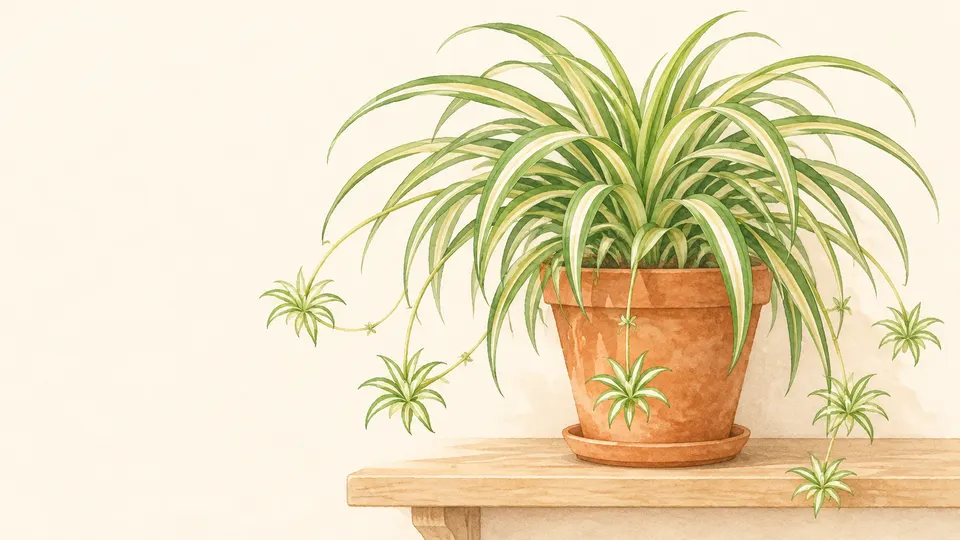
A spider plant (Chlorophytum comosum) is a clump-forming herbaceous perennial [3] in the asparagus family, Asparagaceae, native to tropical West Africa through Cameroon and from Ethiopia to South Africa [2]. Its narrow, strap-shaped leaves grow from a central point and can be solid green or striped lengthwise with white or yellow [3]. It is also called airplane plant, ribbon plant, or spider ivy [5] [7].
The name comes from the small plantlets that hang from long, wiry stems and loosely resemble spiders [3]. It is one of the easiest houseplants to grow, which helps explain its popularity [5]. Its thick, fleshy roots store water, so it can ride out uneven watering [3].
| Cultivar | What it looks like |
|---|---|
| 'Variegatum' | Green leaves with white or cream margins; the RHS calls it the traditional spider plant |
| 'Vittatum' | Medium to dark green leaves with a wide, creamy white central stripe |
| 'Milky Way' | Broad white to cream center with green margins |
| 'Bonnie' | Compact, with leaves that curl and twist |
| 'Ocean' | Reverse variegation: green central stripe, cream margins |
Sources for the table: NC State Extension, UW-Madison Extension, and the RHS [2] [3] [4].
How Much Light Does a Spider Plant Need?
Bright, indirect light is the safest target [1] [4]. Spider plants grow easily in medium to bright light all year [3].
Low light is tolerated, with trade-offs. The plant prefers medium light but can tolerate deep shade [2]. In low light, growth slows and the leaves may lose their variegation [4].
The sources differ on direct sun. Clemson says a spider plant can tolerate some direct sunlight but that midday light may scorch the leaves [1], while NC State describes it as intolerant of direct sunlight [2]. The RHS warns that too much strong sun can turn leaves yellow or brown and that variegated plants scorch in direct sun [4]. We suggest a middle ground: bright, indirect light where hot midday sun never reaches the leaves.
If the leaves look yellow and the plant is not sitting in strong sun, the RHS says the usual cause is too little light rather than a lack of nutrients, so try a brighter spot before reaching for fertilizer [4].
How Often Should You Water a Spider Plant?
Water when the soil has started to dry, not on a fixed schedule. Clemson says to let spider plants dry out briefly between waterings, and UW-Madison advises letting the soil dry slightly between thorough waterings [1] [3]. The RHS leans a little wetter: it suggests keeping the compost just lightly moist to the touch [4], and NC State says the plant grows best in moist soil, though it tolerates drought and dry soil [2].
Because those sources range from "dry briefly" to "lightly moist," there is no single number of days to follow. Check the soil with your finger before every watering, and water less in winter. University of Maryland Extension's general test for most houseplants is to push a finger about two inches into the soil; if it is dry, the plant probably needs water [6]. How fast the pot dries also depends on the potting mix, humidity, and temperature [6], so in a warm, dry room you may need to check more often. Cut back in winter, when growth slows [2] [4].
How to water:
- Water from the top until water runs out of the drainage holes [6].
- Pour away any water left in the saucer or outer pot; spider plants dislike standing in water [4].
- Wait for the soil to dry again before the next watering [1] [6].
Pale, dull leaves often mean the plant needs more water, and it revives quickly after a thorough drink [4]. Overwatering or a poorly drained mix can lead to root rot [1] [3]. For the same finger-test habit applied to a much drier plant, see our snake plant care guide.
Why Do Spider Plant Leaves Get Brown Tips?
Brown leaf tips have several possible causes: fluoride or chlorine in tap water, salt or fertilizer buildup, dry air, soil that gets too dry or too wet, and strong sun [2] [1] [3] [4]. Each source lists a slightly different set:
| Possible cause | Named by | What to try |
|---|---|---|
| Fluoride or chlorine in tap water | NC State, UW-Madison, RHS [2] [3] [4] | Use rainwater, distilled water, or filtered water |
| Salt buildup or too much fertilizer | Clemson, UW-Madison [1] [3] | Feed lightly; flush the pot with plain water [6] |
| Low humidity or very dry air | Clemson, UW-Madison, RHS [1] [3] [4] | Keep it away from radiators and other heat sources |
| Soil that gets too dry | Clemson, UW-Madison, RHS [1] [3] [4] | Check the soil more often |
| Too much water | RHS [4] | Let the soil dry a little and empty the saucer |
| Bright, strong sunlight | RHS [4] | Move it to bright, indirect light |
On water quality, the fixes line up: rainwater, distilled water, or filtered water [3] [4].
Salts are the other main thread. Brown leaf tips are one symptom of soluble salt buildup, along with a crust of salt deposits at the soil line, around the drainage hole, or on the outside of clay pots [6]. To prevent it, water until water runs out the bottom, flush the pot with at least twice its volume of clear water every four to six months, and avoid softened water [6].
Snip off brown tips, or whole leaves, for looks while you fix the growing conditions. [4] If dry air is the problem, mist the leaves now and then [4], or use a humidifier or a pebble tray with water [2].
How Do You Propagate Spider Plant Babies?
Spider plant babies, also called plantlets, spiderlings, or offsets, are an easy way to get new plants. Each one forms at the end of a long, wiry stem [3]. The plantlets can be removed and potted to produce more plants [5], and spider plants are extremely easy to propagate this way [3]. There are three common routes:
- Root it while still attached. Set the plantlet on the surface of a pot of potting mix, hold it in contact with a bent paper clip or piece of wire, and cut the connecting stem once it has rooted [3]. Plantlets root when they touch soil [1].
- Detach a plantlet that already has roots. Pot it directly into moist growing mix [1] [3]. Choose good-sized offsets and pin them down with a U-shaped piece of wire [4].
- Root it in water. Set a detached plantlet in a glass of water and pot it up once the roots lengthen [4].
Larger plants can also be divided [3]. The roots are thick and fleshy, so if the clump will not pull apart, slice through it with a knife and pot each healthy piece with at least one growing point [4]. Division also works for cultivars that do not make offsets [4]. For another houseplant that is easy to multiply, see our guide to pothos propagation.
Why Is My Spider Plant Not Making Babies?
Several factors can hold plantlets back:
- Age. Most spider plants will not flower or make plantlets until they are at least a year old [4].
- Day length. Plantlet stems form when the plant gets short days and long, uninterrupted nights, with less than 12 hours of light a day, for at least three weeks [2]. Indoors they may appear at any time of year [3].
- Light, cold, and pot size. Too little light, cool temperatures, and an overly large pot can discourage flowering [4]. Plants produce plantlets best when slightly pot bound [3].
- Too much fertilizer. Heavy feeding can reduce plantlet formation [2] [3].
- Cultivar. 'Variegatum' tends to produce fewer plantlets than other types [3], and some related plants, such as Chlorophytum capense 'Variegatum', do not produce offsets at all [4].
Soil, Repotting, Feeding, and Other Care
Use a general-purpose potting mix that drains well, repot as the roots fill the pot, and feed lightly, since too much fertilizer can reduce plantlets and brown the leaf tips [1] [3] [4].
Soil
A general-purpose potting soil suits spider plants [1] [3]. It needs to drain well, because root rot can follow a mix that does not drain quickly or excessive watering [1].
Repotting
Spider plants grow fast, and their fleshy roots fill a pot quickly [3] [4]. A newly bought plant can usually stay in its pot for the first year, then repot every year or two into a slightly larger pot [4]. Divide and repot before the roots can crack the container; repotting can be done at any time of year [1]. UW-Madison notes that plants make plantlets best when slightly pot bound [3], which fits the RHS advice to move up to a slightly larger pot [4].
Feeding
Go easy, and expect different advice from different sources. Clemson suggests a water-soluble or time-release houseplant fertilizer during active growth, and waiting four to six months before feeding a newly potted plant [1]. UW-Madison says feeding every 3 to 4 months is usually enough, or more often at half strength [3]. The RHS says spider plants do not generally need feeding if they are repotted regularly in fresh compost [4]. Too much fertilizer can cost you both plantlets and clean leaf tips. [3]
Temperature
Aim for 65 to 75°F during the day and 50 to 55°F at night, and move plants a few feet away from windows in winter to avoid drafts [1]. Keep temperatures above 45°F [2].
Pests
NC State lists no significant problems [2], while UW-Madison names scale and mealybugs, Clemson names whiteflies, spider mites, scales, and aphids, and the RHS names aphids [3] [1] [4]. Wash aphids off as soon as you see them [4]; for anything more, use a product labeled for that pest on houseplants and follow the label.
Renovating a Tired Plant
For a plant with many bent, split, or browning leaves, cut all the foliage back to 2 to 3 inches; new growth should emerge from the center if the plant is cared for well [4].
Is a Spider Plant Toxic to Cats and Dogs?
The ASPCA lists the spider plant (Chlorophytum comosum) as non-toxic to dogs and non-toxic to cats [7]. It appears on the ASPCA list under the additional common names ribbon plant, anthericum, and spider ivy [7].
If your pet has eaten part of any plant and seems unwell, contact your veterinarian or the ASPCA Animal Poison Control Center right away. ASPCA listings differ from plant to plant, so check each plant on its own; our peace lily care guide covers how the ASPCA lists that plant.
Frequently Asked Questions
How often should I water a spider plant?
Water when the soil has started to dry, not on a fixed schedule. Clemson says to let it dry out briefly between waterings, while the RHS suggests keeping the compost lightly moist. Check with your finger first, empty the saucer after watering, and water less in winter.
Why are the tips of my spider plant turning brown?
Several things can cause it. NC State, UW-Madison, and the RHS name fluoride or chlorine in tap water; Clemson and UW-Madison name salt buildup and too much fertilizer; and dry air, soil that gets too dry, overwatering, and strong sun are also listed. Try rainwater or filtered water, feed lightly, and trim the brown tips for looks.
Can I root spider plant babies in water?
Yes. The RHS says you can set a detached plantlet in a glass of water and pot it up once the roots lengthen. You can also pin a plantlet onto potting mix while it is still attached, or pot up a plantlet that already has roots.
Why is my spider plant not producing babies?
It may be too young, since the RHS says most plants do not produce plantlets until they are at least a year old. Too little light, cool temperatures, an overly large pot, heavy fertilizing, and some cultivars can also mean fewer or no plantlets.
Is a spider plant safe for cats?
The ASPCA lists the spider plant as non-toxic to cats and dogs. If your pet eats any plant and seems unwell, contact your veterinarian or the ASPCA Animal Poison Control Center right away.
Our Take
In our editorial view, the most useful thing to know about spider plants is that brown tips have more than one cause. NC State, UW-Madison, and the RHS point to fluoride or chlorine in tap water, while Clemson and UW-Madison also name salts and too much fertilizer, and several sources add dry air and uneven watering. Rather than changing everything at once, we suggest starting with the easiest fixes: switch to rainwater, distilled, or filtered water, feed less, and check the soil before watering. This is our opinion based on extension and RHS guidance, not a test we ran.
Sources
- Spider Plant. Clemson Cooperative Extension, Home & Garden Information Center (Karen Russ, Al Pertuit; updated December 12, 2025).
- Chlorophytum comosum (Spider Plant). NC State Extension Gardener Plant Toolbox.
- Spider plant, Chlorophytum comosum. University of Wisconsin-Madison Extension, Wisconsin Horticulture (Susan Mahr; revised January 6, 2025).
- How to grow spider plants. Royal Horticultural Society (published March 11, 2026).
- Easy, Low-Maintenance Houseplants. Iowa State University Extension and Outreach (Aaron Steil; last reviewed January 2025).
- Watering Indoor Plants. University of Maryland Extension (updated March 10, 2023).
- Spider Plant. ASPCA Toxic and Non-Toxic Plants.
Plant care advice is general guidance: adjust for your light, season and pot, and check the soil before you water. Pet toxicity follows the ASPCA list only; if a pet may have eaten part of a plant, contact your veterinarian or the ASPCA Animal Poison Control Center right away.Spotted an error? Tell us.
Related Guides
Snake Plant Care: Light, Water, and Common Mistakes
Snake plant care for beginners: bright indirect light, water only when the soil is dry (about every 2 to 6 weeks, less in winter), a snug pot, and rot traps.
How to Propagate Pothos (Water vs Soil)
How to propagate pothos from stem cuttings: where to cut around the nodes, rooting in water vs a moist mix, how long roots take, and when to pot water cuttings.
Peace Lily Care: Watering, Light, and Getting Blooms
Peace lily care for beginners: bright indirect light, moist but not soggy soil, why it droops, how to get blooms, and what brown tips and yellow leaves mean.
ZZ Plant Care: Light, Water, Soil, and Yellow Leaves
ZZ plant care: bright indirect light (low light tolerated), water 1 to 2 times a month only once the mix dries, a coarse mix, and how to fix yellow leaves.
Prayer Plant Care: Light, Water, Humidity, and Brown Tips
Prayer plant care: bright indirect light, evenly moist soil, high humidity, and steady warmth, plus why leaves fold at night and what brown edges can mean.
Orchid Care: How to Keep a Phalaenopsis Blooming
Moth orchid care for beginners: bright indirect light, a weekly soak in bark, the right temperatures, and how cool fall nights and spike pruning bring rebloom.