Christmas Cactus Care: How to Get It to Bloom
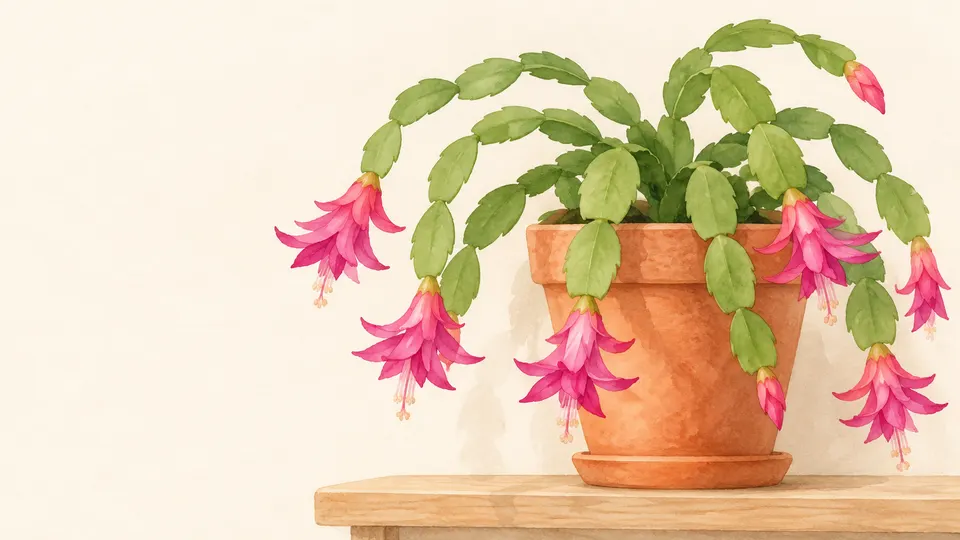
Quick Answer
Give a Christmas cactus bright, indirect light, well-drained soil, and water when the soil is nearly dry, roughly every 1 to 2 weeks. To make it bloom, start in late summer or early fall: keep it in a cool room around 55 to 65°F with about 14 hours of complete darkness each night. Buds usually appear in 3 to 4 weeks. Don't move the plant until the first flowers open.
On this page
- Christmas, Thanksgiving, or Easter Cactus: Which One Do You Have?
- Christmas Cactus Care at a Glance
- How Often Should You Water a Christmas Cactus?
- Soil, Feeding, and Repotting
- How Do You Get a Christmas Cactus to Bloom?
- Common Christmas Cactus Problems and Fixes
- How Do You Propagate a Christmas Cactus?
- Frequently Asked Questions
- Our Take
- Sources
Key Takeaways
- Check the stem segments: pointed teeth mean Thanksgiving cactus, rounded scallops mean Christmas cactus. Most plants sold as Christmas cactus are Thanksgiving cactus or hybrids.
- It is a forest cactus from Brazil, so it wants bright indirect light, more water than a desert cactus, and a fast-draining mix.
- Buds form with cool nights (55 to 65°F) and long, fully dark nights (about 14 hours, such as 6 p.m. to 8 a.m.) starting in late summer or early fall. Buds usually show after 3 to 4 weeks.
- Bud drop usually follows a sudden change, a move, or soil that is too dry or too wet. Leave the plant in one spot until the first flowers open.
- The ASPCA lists Christmas cactus as non-toxic to cats and dogs. If a pet eats a plant and seems unwell, call your veterinarian or ASPCA Animal Poison Control.
Christmas, Thanksgiving, or Easter Cactus: Which One Do You Have?
Check the edges of the flat stem segments first. A Thanksgiving cactus (Schlumbergera truncata) has 2 to 4 pointed, upward-facing teeth on each segment, while a true Christmas cactus (Schlumbergera × buckleyi) has rounded, scalloped segments with no sharp points [1] [2]. The Easter cactus has smoother segments with 4 to 6 slight ripples and brownish bristles at the tips [1].
Store labels are unreliable. Iowa State University Extension notes that most plants sold as "Christmas cactus" are actually Thanksgiving cactus or hybrids [1]. Commercial growers also time their plants with controlled light and darkness, so a plant bought in full December bloom often flowers in November the next year [2].
| Thanksgiving cactus | Christmas cactus | Easter cactus | |
|---|---|---|---|
| Botanical name | Schlumbergera truncata | Schlumbergera × buckleyi | Schlumbergera gaertneri (also Hatiora or Rhipsalidopsis gaertneri) |
| Segment edges | 2 to 4 pointed, upward teeth | Rounded, scalloped, no points | Smooth, 4 to 6 slight ripples, brownish bristles at tips |
| Flowers | Held more upright; yellow anthers | Hang down from the stem tips | Pink or red |
| Usual bloom time | Mid-November to late December | Late November to early February | March to May |
| Bloom trigger | Long nights and cool temperatures | Long nights and cool temperatures | A stricter fall dark and cold sequence |
Sources for the table: Iowa State University Extension and NC State Extension [1] [4].
Thanksgiving and Christmas cacti need the same care, and Iowa State says all three types grow under similar conditions [1]. The Easter cactus is the outlier only when it comes to getting flowers, so the rest of this guide focuses on the two late-fall bloomers.
Christmas Cactus Care at a Glance
Holiday cacti are true cacti, but they are not desert plants, so the usual succulent care rules do not carry over. They grow as epiphytes in the mountain forests of southeastern Brazil, rooting into tree crotches and shady rock ledges at roughly 3,000 to 5,000 feet [2] [1]. Think "forest plant" instead of "desert cactus": bright shade, more water, and gentler temperatures.
| Need | What works | Source |
|---|---|---|
| Light | Bright, indirect light; avoid long periods of strong direct sun | Iowa State, UW-Madison |
| Temperature | 60 to 70°F indoors; warmer is fine in the summer growing season (NC State gives 70 to 80°F); no frost, and not below about 55 to 60°F | Iowa State, NC State, UW-Madison |
| Water | When the soil is nearly dry, roughly every 1 to 2 weeks; evenly moist while in bud | NC State, Iowa State |
| Humidity | Benefits from higher humidity than a typical cactus | NC State |
| Potting mix | Well drained; all-purpose potting soil works if it drains well | Iowa State |
| Fertilizer | Monthly during the growing season, less in fall and early winter | Iowa State, NC State |
| Repotting | When it has outgrown the pot, in spring or early summer; fresh mix at least every 4 to 5 years | Iowa State, UW-Madison |
| Pets | ASPCA lists Christmas cactus as non-toxic to cats and dogs [6] | ASPCA |
In summer, the plant can live outdoors in a shaded spot, such as a covered porch or hanging in a shade tree, but keep it out of full sun [2]. NC State notes that the stems can turn yellow without summer shade, and direct sun can scorch them [4]. Bring it back inside before nights get cold; UW-Madison gives 55 to 60°F as the plant's minimum, and it cannot tolerate frost [2].
How Often Should You Water a Christmas Cactus?
Water when the soil is nearly dry, which usually works out to every 1 to 2 weeks [3]. Treat that as a starting point, not a schedule. Season, light, pot size, and potting mix all change how fast the soil dries, so touch the soil before you water.
How much water the plant wants also changes through the year [1]:
- While buds form and flowers are open: keep the soil evenly moist. Dry soil at this stage can make buds and flowers drop.
- After flowering: move the plant somewhere a little cooler and water less often.
- The rest of the year: keep it on the dry side and let the soil dry between waterings. Some growers also water a little less in August and September to firm up the stems that will carry flowers [2].
Unlike a desert cactus, a holiday cactus should not stay bone dry for long [1]. Too much water causes its own problems: Iowa State links overwatering to limp growth and root rot, and NC State to root rot and mushy stems [1] [3]. Always use a pot with a drainage hole, and empty the saucer after watering.
Soil, Feeding, and Repotting
Potting mix. You do not need a special cactus mix. Iowa State says all-purpose potting soil works as long as it drains well [1]. UW-Madison Extension describes an ideal mix as well drained, slightly acidic, and rich in organic matter, and mentions one commercial grower's blend of 60% peat moss and 40% perlite [2].
Fertilizer. Feed monthly during the growing season [1]. NC State suggests starting when new growth appears in spring and cutting back in fall and early winter [4].
Repotting. Holiday cacti grow best when slightly pot-bound and can go years without a new pot [1]. Repot in spring or early summer, not while the plant is in bloom [1]. Even if the plant has room, the old mix breaks down over time, so UW-Madison recommends repotting into fresh mix at least every 4 to 5 years [2].
How Do You Get a Christmas Cactus to Bloom?
Holiday cacti set buds in response to two signals in fall: long, unbroken nights and cool temperatures [1] [5]. Cool nights alone are enough for some plants. Long nights also work in a normal room, as long as nights stay below about 68°F [1] [5].
Option 1: Cool nights
Iowa State recommends placing the plant in a cool spot of 55 to 65°F starting in late summer, with bright light during the day and no artificial light at night. Some Thanksgiving and Christmas cacti will bloom at 55°F in fall regardless of day length [1]. An unused bedroom works well.
Option 2: Long, dark nights
If the room stays above about 60°F at night but below 68°F, control the darkness instead [2] [5]. Sources give different minimums: NC State recommends at least 13 hours of uninterrupted darkness from mid-September to mid-November, and Iowa State says most plants need 14 to 16 hours, though some bloom with as few as 12 [3] [1]. Aim for about 14 hours, such as 6 p.m. to 8 a.m. UW-Madison suggests covering the plant with black plastic or moving it into a dark closet each evening [2].
What cancels the treatment
Two things undo it:
- Artificial light at night. Lamps, kitchen lights, and even streetlights can interfere [1]. Illinois Extension warns that a couple of hours of light during the dark period can undo your effort [5].
- Warm nights. Temperatures above about 70°F prevent flowering even with short days [1]. Illinois Extension puts the cutoff for nights at 68°F [5].
After buds appear
Buds usually appear after about 3 to 4 weeks of short days [5] [2]. Once buds appear, UW-Madison says you can stop the dark treatment [2]. If you have been moving the plant into a closet, end that routine in the plant's final spot. Do not move the plant until the first flowers open, because moving it sooner can make buds drop. [1] Once flowers are open, it is safe to move the plant to a spot where you can enjoy it. At around 70°F, the blooms last about 2 to 3 weeks [2].
Each cultivar responds a little differently, so expect some trial and error before you can time blooms precisely [2]. If you have a Thanksgiving type, NC State notes it may even bloom a second time as days lengthen in February [4].
Common Christmas Cactus Problems and Fixes
Most problems trace back to light, water, or a sudden change. Use this table to match the symptom, then check the flowchart below if buds are falling.
| Symptom | Likely cause | What to do |
|---|---|---|
| Buds fall off before opening | Moving the plant, drafts or cold, or soil too dry or too wet while in bud [1] [3] | If it sits in a draft, move it once to a steady, bright spot; then leave it there until flowers open and keep the soil evenly moist |
| No buds at all | Light at night or nights warmer than about 68 to 70°F [1] [5] | Give it long, fully dark nights in a cool room starting in late summer or early fall |
| Limp or mushy stems while the soil is wet | Overwatering and root rot [1] [3] | Check the roots, trim dead ones, and repot in fresh, well-drained mix (repot now, whatever the season) |
| Young stems shrivel or segments drop even after watering | Root loss [2] | Unpot and inspect the roots; root a few cuttings as a backup |
| Yellow or scorched stems | Too much direct sun [4] | Move to bright, indirect light and give summer shade |
| Small brown bumps and sticky residue | Scale insects [1] | Scrape them off or dab with an alcohol-soaked cotton swab; insecticidal soap every 7 to 10 days, following the label |
| Mealybugs or spider mites on the stems | Pest insects [2] [4] | Use a houseplant insecticide labeled for the pest, following the label |
| Gray, fuzzy mold | High humidity with poor air circulation [4] | Improve air movement around the plant |
If stems look limp and the soil stays wet for days, act quickly. UW-Madison advises unpotting the plant, cutting back dead roots, letting the pruned roots air dry for a few days, and repotting into fresh mix, then cutting back on watering for a month or so while new roots form [2].
How Do You Propagate a Christmas Cactus?
Holiday cacti are easy to start from stem cuttings, and a few backup plants are good insurance for an old family heirloom [1] [2].
- Take a cutting. Remove a piece with 2 to 5 segments at a joint [1]. A clean, sharp knife works well [4].
- Let it callus. Iowa State lets cuttings callus overnight, while UW-Madison suggests 2 to 3 days in a shady spot [1] [2].
- Plant it right side up. Insert the cut end about 1 inch deep in moist perlite or coarse sand. Cuttings planted upside down will not root [1].
- Keep it lightly moist. Place it in bright light and water when the medium begins to dry [1].
- Pot it up. UW-Madison reports roots in 2 to 3 weeks, while Iowa State allows 6 to 8 weeks. Move the cutting to well-drained potting mix once its roots are about 1 inch long [2] [1]. When new growth starts, pinch the tips to encourage branching [2].
Cuttings can be taken any time, but UW-Madison says rooting tends to go better from late spring through summer [2]. Potting three rooted cuttings together gives you a fuller plant sooner [2]. The callusing step is the same idea used in propagating a snake plant. Our guides to orchid care and kalanchoe care cover two other flowering houseplants that are popular as winter gifts.
Frequently Asked Questions
How often should I water a Christmas cactus?
NC State Extension suggests about every 1 to 2 weeks, or when the soil is nearly dry. Iowa State Extension adds that the soil should stay evenly moist while buds and flowers are present, and drier the rest of the year. Check the soil with your finger first, and never let the pot sit in water.
Why does my Christmas cactus bloom at Thanksgiving?
It is most likely a Thanksgiving cactus or a hybrid. Iowa State Extension notes that most plants sold as Christmas cactus are actually Thanksgiving cactus or hybrids. Look for pointed teeth on the stem segments. Thanksgiving cactus usually blooms from mid-November to late December.
Is a Christmas cactus toxic to cats or dogs?
The ASPCA lists Christmas cactus (under Schlumbergera bridgesii, an older name Iowa State Extension lists for the Christmas cactus) as non-toxic to cats and dogs. If your pet eats any plant and seems unwell, contact your veterinarian or the ASPCA Animal Poison Control Center right away.
Can a Christmas cactus bloom more than once a year?
Sometimes. NC State Extension notes that a Thanksgiving cactus may bloom a second time as days lengthen in February, and Iowa State says an Easter cactus may rebloom in early fall. Timing depends on the cultivar and the light and temperature it gets.
When should I repot a Christmas cactus?
Only when it has outgrown its pot, in spring or early summer, and not while it is in bloom. Holiday cacti grow best slightly pot-bound. UW-Madison Extension still recommends fresh potting mix at least every 4 to 5 years because old mix breaks down.
Our Take
We think most people who struggle to get a Christmas cactus to rebloom are fighting their living room, not the plant. Every source we reviewed points to the same two triggers, cool nights and real darkness, and a warm room with evening lamps cancels both. In our view, the easiest approach for most homes is temperature, not a nightly closet routine: in late summer or early fall, move the plant to the coolest bright room you have that stays above about 55°F and dark at night, leave it there, and don't move it again until the first flowers open. This is our editorial opinion, based on extension guidance, not a controlled test.
Sources
- All About Holiday Cacti. Iowa State University Extension and Outreach (Richard Jauron, Aaron Steil; last reviewed December 2025).
- Holiday Cactus. University of Wisconsin-Madison Extension (Dan Mahr; updated by Bruce Spangenberg, 2025).
- Schlumbergera. NC State Extension, Gardener Plant Toolbox.
- Schlumbergera truncata (Thanksgiving Cactus). NC State Extension Gardener Plant Toolbox.
- Holiday Cacti. University of Illinois Extension (Ryan Pankau).
- Christmas Cactus. ASPCA Toxic and Non-Toxic Plants.
Plant care advice is general guidance: adjust for your light, season and pot, and check the soil before you water. Pet toxicity follows the ASPCA list only; if a pet may have eaten part of a plant, contact your veterinarian or the ASPCA Animal Poison Control Center right away.Spotted an error? Tell us.
Related Guides
Succulent Care for Beginners
Succulent care for beginners: bright light, a soak-and-dry watering rhythm, gritty soil in a pot with drainage, and how to read wrinkled or mushy leaves.
Orchid Care: How to Keep a Phalaenopsis Blooming
Moth orchid care for beginners: bright indirect light, a weekly soak in bark, the right temperatures, and how cool fall nights and spike pruning bring rebloom.
Kalanchoe Care: Light, Water, and Reblooming
Kalanchoe care for florist kalanchoe: bright light, soil that dries between waterings, and about 14 hours of nightly darkness for 6 weeks to bloom again.
How to Propagate a Snake Plant
How to propagate a snake plant by division, offsets, or leaf cuttings, step by step, and why leaf cuttings from variegated plants usually grow back all green.
Spider Plant Care: Light, Water, and Baby Plants
Spider plant care made simple: bright, indirect light, water when the soil starts to dry, what causes brown leaf tips, and how to root the baby plantlets.
Peace Lily Care: Watering, Light, and Getting Blooms
Peace lily care for beginners: bright indirect light, moist but not soggy soil, why it droops, how to get blooms, and what brown tips and yellow leaves mean.