Kalanchoe Care: Light, Water, and Reblooming
Quick Answer
Grow florist kalanchoe in bright light with some shade from hot afternoon sun, in a fast-draining cactus or succulent mix. Let the soil dry between waterings, then water deeply, and never let the pot sit in water. To make it bloom again, give it about 14 hours of total darkness each night for at least 6 weeks in fall. Keep it away from pets: the ASPCA lists kalanchoe as toxic to cats and dogs.
On this page
- Kalanchoe Care at a Glance
- How Much Light and Warmth Does a Kalanchoe Need?
- How Often Should You Water a Kalanchoe?
- How Do You Get a Kalanchoe to Bloom Again?
- Common Kalanchoe Problems and Fixes
- How Do You Propagate a Kalanchoe?
- Is Kalanchoe Toxic to Cats and Dogs?
- Frequently Asked Questions
- Our Take
- Sources
Key Takeaways
- Florist kalanchoe (Kalanchoe blossfeldiana) wants bright light; Clemson says full sun, while NC State prefers bright indirect light with afternoon shade.
- Let the soil dry between waterings, then water deeply. Check the soil first, because season, light, and pot change how fast it dries.
- To rebloom, give about 14 hours of uninterrupted darkness a night for at least 6 weeks in fall. Once buds show above the leaves, night light no longer matters.
- Overwatering and slow-draining mix can lead to root and stem rot. Clemson names mealybugs, aphids, and brown scale as the most common insect pests, and powdery mildew is possible.
- The ASPCA lists Kalanchoe spp. as toxic to cats and dogs, with vomiting, diarrhea, and rarely abnormal heart rhythm as clinical signs.
Kalanchoe Care at a Glance
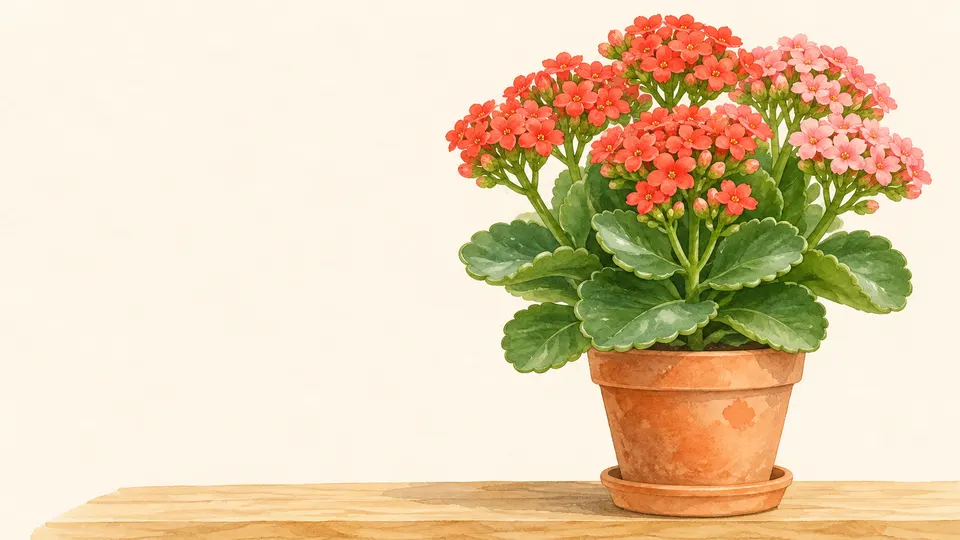
This guide covers florist kalanchoe, Kalanchoe blossfeldiana, a flowering succulent from Madagascar in the stonecrop family (Crassulaceae) [2] [1]. NC State Extension describes it as a compact plant 6 to 18 inches tall with thick, glossy, scalloped leaves and large clusters of tiny red, orange, yellow, pink, or white flowers, in single and double forms [2]. Clemson Extension notes that it is usually sold in late winter and spring [1].
Florist kalanchoe needs bright light, a fast-draining mix, and soil that dries between waterings. It also needs long, dark nights in fall and winter if you want it to flower again.
| Need | What works | Source |
|---|---|---|
| Light | Clemson: full sun, tolerates bright indoor light. NC State: bright indirect light with afternoon shade | Clemson, NC State |
| Temperature | Nights about 45 to 65°F and days about 50 to 70°F (Clemson); NC State gives 60°F at night and 70°F by day | Clemson, NC State |
| Water | Let the soil dry between waterings, then water deeply; never let the pot sit in water | NC State, Clemson |
| Potting mix | Well drained; a cactus or succulent mix | NC State, Clemson |
| Fertilizer | Any houseplant fertilizer once a month while it is actively growing | Clemson |
| Reblooming | About 14 hours of total darkness a night for at least 6 weeks in fall and winter | NC State, Clemson |
| Pets | ASPCA lists Kalanchoe spp. as toxic to cats and dogs | ASPCA |
Sources for the table: Clemson Cooperative Extension, NC State Extension, and the ASPCA [1] [2] [3].
This guide covers florist kalanchoe only. The genus also includes other species, such as the flapjack plant (Kalanchoe luciae) pictured in Iowa State Extension's guide to succulent problems [5], and their care may differ. For the basics that most succulents share, see our succulent care guide.
How Much Light and Warmth Does a Kalanchoe Need?
Give it the brightest indoor spot you have, but protect it from long hours of hot direct sun. The two extension sources lean in different directions here. Clemson says kalanchoe grows best in full sun and tolerates bright indoor light well, though plants get spindly in low light [1]. NC State prefers bright indirect sunlight or partial shade, warns that prolonged direct sun can scorch the leaves, and recommends afternoon shade [2]. NC State also says the plant should receive 6 to 8 hours of bright light a day to bloom [2].
A sunny window with some relief from the harshest afternoon sun fits both pieces of advice. That middle ground is our reading, not a quote from either source. If you move a plant from a dim spot into strong sun, do it gradually: Iowa State explains that succulents moved suddenly from low light into bright or direct sun can get sun scald, tan or brown patches that do not recover [5].
Kalanchoe likes cool to moderate temperatures. Clemson gives ideal ranges of 45 to 65°F at night and 50 to 70°F during the day, and notes that cool nights make the flowers last longer [1]. NC State lists 60°F at night and 70°F during the day, and says the plant cannot take frost and should come indoors before temperatures drop to 45°F [2]. Outdoors it is hardy only in USDA zones 10 to 12 [2].
How Often Should You Water a Kalanchoe?
Water when the soil has dried, then water thoroughly. Clemson says to let the soil dry slightly between waterings and warns that kalanchoe can be damaged by overwatering [1]. NC State calls the plant drought tolerant and says it is best to let the soil dry out between waterings and then water deeply [2].
Neither page gives a number of days. For indoor succulents in general, Iowa State says watering once every two or three weeks typically works well, but that the right frequency depends on soil type, light level, humidity, and container [4]. Treat that as a loose starting point only. Season, light, pot size, and mix all change how fast the soil dries, so touch the soil before you water, every time. Our succulent watering guide explains how to check.
Watch the leaves, too. In succulents generally, Iowa State links wrinkled or drying lower leaves to conditions that are too dry, and yellowing leaves with soft, weak stems to conditions that may be too wet [4].
Soil, pots, and feeding
- Potting mix. NC State recommends a well-drained potting mix suited to cactus or succulents [2]. Clemson describes a well-drained, well-aerated mix such as 60% peat moss and 40% perlite [1]. Our succulent soil guide compares common mixes.
- Drainage. Clemson says root rot usually comes from a mix that does not drain quickly or from watering too often, and warns not to let plants sit in water [1]. Use a pot with a drainage hole and empty the saucer.
- Fertilizer. Feed actively growing plants with any houseplant fertilizer once a month [1].
How Do You Get a Kalanchoe to Bloom Again?
Florist kalanchoe is a short-day plant. Clemson says it, like the poinsettia, needs short days (long nights) to form flower buds, and that with good care it can rebloom the next season [1]. NC State says the plant needs total darkness for 14 hours a day for at least 6 weeks in fall and winter [2]. If a kalanchoe will not flower, NC State says the cause may be a missing dark period. [2]
Step 1: After the flowers fade
NC State suggests deadheading spent flowers to encourage more blooms [2]. When flowering ends, Clemson recommends cutting back tall growth and old flower stems, moving the plant to a slightly larger pot, and keeping it well watered in a sunny, warm window [1].
Step 2: Summer outdoors (optional)
After danger of frost, Clemson says the plant can go outdoors to a bright, lightly shaded spot for summer. Move it there gradually, then bring it back inside before the first frost or about 3 months before you want flowers [1].
Step 3: Long, dark nights in fall
Clemson explains that natural day lengths between October 1 and March 1 let buds form, giving the plant a 14 to 16 hour night, and that about six weeks of these natural winter day lengths are needed [1]. The catch is indoor lighting. Keep the plant in a room where lights stay off during the naturally dark hours, or move it into a closet in late afternoon and back into bright light each morning [1].
Warm nights can also get in the way. Clemson warns that temperatures above 80°F during the long night period can cause a "heat delay" that holds back flower development [1].
Step 4: Once buds show
When the buds are large enough to see above the leaves, day length no longer matters, and Clemson says you can put the plant anywhere, whatever the night lighting [1]. Plants that start natural short days in early October should begin flowering by January [1]. NC State says blooming occurs in late winter or spring and that the flowers are long lasting, about 4 weeks [2]. Read together, we would watch for flowers from about January into spring; that window is our reading of the two sources, not a quote from either.
For another plant people bring back into bloom each year, see our Christmas cactus care guide.
Common Kalanchoe Problems and Fixes
Clemson names too much or too little water and insects as the main problems [1]. Match the symptom below, then fix the cause.
| Symptom | Likely cause | What to do |
|---|---|---|
| Soft stems, yellowing leaves, or collapse while the soil stays wet | Overwatering or slow-draining mix; NC State says overwatering can cause root or stem rot [2] [1] [4] | Let the soil dry thoroughly, repot into sharp-draining mix, and make sure the pot drains [5] |
| Soft, mushy stem lesions, sometimes with a bad smell | Bacterial soft stem rot, which UC IPM lists for Kalanchoe [7] | UC IPM says discarding infected plants is often the best approach; prevent it with sparse watering and light feeding |
| No flowers | No long dark period, or nights above 80°F during the dark period [2] [1] | Give about 14 hours of total darkness a night for at least 6 weeks in fall, and keep nights below 80°F during that period |
| Tall, spindly growth | Low light [1] | Move to brighter light; cut back tall stems after flowering |
| Scorched or tan patches on leaves | Prolonged direct sun, or a sudden move into strong sun [2] [5] | Give afternoon shade and change light levels gradually |
| Mottled leaves, yellow spots, fine webbing, stunting | Powdery mildew [1] [7] | Improve air flow; water early in the day; move to brighter light, away from cold drafts |
| Cottony masses where leaves join stems | Mealybugs [1] [5] | Isolate the plant; wipe pests off with a cotton swab dipped in rubbing alcohol |
| Brown scale insects | Brown scale [1] | Scrape them off |
| Aphids on the plant | Aphids [1] | Remove them by hand |
Fixes without a named source are our suggestions based on the listed cause.
UC IPM notes that powdery mildew occurs often on kalanchoe and usually will not kill the plant, though it spoils its looks [7]. NC State also lists spider mites among the most common insect pests [2]. For powdery mildew that keeps returning or for heavy pest problems, use a product labeled for the problem and for use on kalanchoe, and follow the label directions.
How Do You Propagate a Kalanchoe?
Stem cuttings are the method NC State recommends, though it notes that leaf cuttings also work [2]. Clemson suggests taking stem cuttings in spring or early summer [1].
- Choose a non-flowering shoot. Clemson says vegetative shoots root better than flowering shoots [1].
- Cut 2 to 3 inches. Take a tip cutting with two pairs of leaves and remove the bottom leaves [1].
- Let it callus. Leave the cut end to dry for several days. No rooting hormone is needed [1].
- Stick it in a light mix. Clemson suggests 50% peat moss and 50% perlite [1].
- Keep humidity high. Place the pot in bright, indirect light inside a large, closed plastic bag [1].
- Pot it up. Cuttings should be ready to transplant in 14 to 21 days [1].
For leaf cuttings, Iowa State lists Kalanchoe among succulents that root from whole leaves. The entire leaf, including the point where it attached to the stem, must come off cleanly. Lay it on slightly damp, well-drained media with the stem end at the surface, and keep the surface damp but not wet [6]. Iowa State also lists Crassula, the genus of the jade plant, among succulents that root from callused stem cuttings [6].
Is Kalanchoe Toxic to Cats and Dogs?
Yes. The ASPCA lists Kalanchoe (Kalanchoe spp.) as toxic to dogs and toxic to cats [3]. The listing covers the whole genus, and the ASPCA gives additional common names including mother-in-law plant, devil's backbone, chandelier plant, and mother of millions [3].
| ASPCA field | What the ASPCA lists |
|---|---|
| Toxicity | Toxic to dogs, toxic to cats |
| Toxic principles | Bufodienolides |
| Clinical signs | Vomiting, diarrhea, abnormal heart rhythm (rare) |
Source for the table: ASPCA Toxic and Non-Toxic Plants [3].
If you think your pet has eaten any part of a kalanchoe, contact your veterinarian or the ASPCA Animal Poison Control Center right away.
Frequently Asked Questions
How often should I water a kalanchoe?
Water when the soil has dried, then water deeply. Clemson says to let the soil dry slightly between waterings, and NC State says to let it dry out. Neither gives a fixed number of days, so check the soil with your finger before each watering and empty the saucer afterward.
Why won't my kalanchoe bloom again?
NC State says the cause may be a missing dark period: it says the plant needs total darkness for 14 hours a day for at least 6 weeks in fall and winter. Clemson adds that night temperatures above 80°F during that period can delay flowering.
Should I deadhead kalanchoe flowers?
Yes. NC State suggests deadheading spent flowers to encourage more blooms. When flowering is finished, Clemson recommends cutting back tall growth and old flower stems.
Is kalanchoe toxic to cats and dogs?
Yes. The ASPCA lists Kalanchoe spp. as toxic to cats and dogs. It names bufodienolides as the toxic principle and lists vomiting, diarrhea, and abnormal heart rhythm (rare) as clinical signs. Contact your veterinarian or the ASPCA Animal Poison Control Center right away if your pet eats any.
Can kalanchoe live outdoors?
Only in warm climates or in summer. NC State says it is hardy in USDA zones 10 to 12 and should come indoors before temperatures drop to 45°F. Clemson suggests a bright, lightly shaded spot outdoors after the danger of frost, moved there gradually.
Our Take
In our editorial view, reblooming is the step most likely to trip up a beginner, because it depends on the room more than on care skill. A plant in a living room where lamps go on each evening may not get the long, uninterrupted nights that Clemson and NC State describe. We think the simplest fix for most homes is to move the plant in early October to a bright room nobody uses after dark, such as a spare bedroom, rather than carrying it to a closet every afternoon. That is our opinion, based on the extension guidance cited here, not on a test we ran.
Sources
- Kalanchoe (HGIC 1563). Clemson Cooperative Extension, Home and Garden Information Center (Millie Davenport; published April 20, 2007).
- Kalanchoe blossfeldiana. NC State Extension, Gardener Plant Toolbox.
- Kalanchoe. ASPCA Toxic and Non-Toxic Plants.
- Growing Succulents Indoors. Iowa State University Extension and Outreach (Aaron Steil; last reviewed December 2024).
- Common Problems and Issues of Succulents. Iowa State University Extension and Outreach (Aaron Steil; last reviewed August 2023).
- How to Propagate Succulents. Iowa State University Extension and Outreach (Aaron Steil; last reviewed August 2023).
- Houseplant Problems. UC Statewide IPM Program, University of California Agriculture and Natural Resources.
Plant care advice is general guidance: adjust for your light, season and pot, and check the soil before you water. Pet toxicity follows the ASPCA list only; if a pet may have eaten part of a plant, contact your veterinarian or the ASPCA Animal Poison Control Center right away.Spotted an error? Tell us.
Related Guides
Christmas Cactus Care: How to Get It to Bloom
Christmas cactus care for beginners: tell it from a Thanksgiving cactus, water when the soil is nearly dry, and use cool, fully dark fall nights to set buds.
Succulent Care for Beginners
Succulent care for beginners: bright light, a soak-and-dry watering rhythm, gritty soil in a pot with drainage, and how to read wrinkled or mushy leaves.
How Often to Water Succulents
How often to water succulents: check about every 2 to 3 weeks, water only when dry several inches down, water less in winter, and tell rot from thirst.
The Best Soil for Succulents (and How to Mix Your Own)
Succulent soil guide: why regular potting soil stays too wet, how organic and mineral parts compare, four DIY recipes, the right pot, and when to repot.
Jade Plant Care: Light, Water, Pruning, and Propagation
Jade plant care: 4+ hours of direct sun, deep watering once the soil dries, less water in winter, a heavy pot, spring pruning, easy cuttings, leaf drop fixes.
Types of Succulents: An Illustrated Guide
Types of succulents grouped by shape: rosette, upright, tree-like, trailing, flowering, and cacti, with current botanical names, light needs, and pet listings.