Hens and Chicks Care: Sun, Water, Winter Dormancy and Offsets
Quick Answer
Give hens and chicks (Sempervivum) full sun, about 6 or more hours a day, and a gritty, sharply drained soil. Water sparingly and let the soil dry between waterings, because overwatering causes crown rot. Outdoors they are hardy in USDA zones 3 to 8 and may go dormant in winter. Gently pull or cut rooted offsets to replant them.
On this page
- What Are Hens and Chicks, and Where Do They Grow Best?
- How Much Sun Do Hens and Chicks Need?
- How Often Should You Water, and What Soil Is Best?
- What Happens to Hens and Chicks in Winter?
- Can You Grow Hens and Chicks Indoors?
- How Do You Remove and Replant Offsets?
- Why Are My Hens and Chicks Rotting, Stretching, or Dying?
- Frequently Asked Questions
- Our Take
- Sources
Key Takeaways
- Hens and chicks need full sun, 6 or more hours of direct sun a day, per NC State Extension.
- Sharp drainage matters most; overwatering can lead to crown rot, so let the soil dry between waterings.
- Sempervivum tectorum is hardy in USDA zones 3 to 8, and plants may go dormant in winter.
- Soggy soil and cracked pots are bigger winter risks than cold, so shelter containers.
- Remove rooted offsets by pulling or cutting them with leaves and roots attached, then pot them in a well-drained mix.
What Are Hens and Chicks, and Where Do They Grow Best?
Hens and chicks are hardy, low-water rosette succulents that want full sun and sharply drained soil. The common name belongs to Sempervivum tectorum (also called common houseleek) and its relatives: the original rosette is the "hen," and the small offsets it sends out are the "chicks" [2]. NC State Extension says the genus gets its "Hens & Chicks" name from those offsets [3].
These are not tender houseplant succulents. Missouri Botanical Garden lists S. tectorum as hardy in USDA zones 3 to 8 [1], and NC State gives zones 3a to 8b for the species and 4a to 8b for the genus [2] [3]. NC State adds that many of them "thrive in much colder temperatures than other succulents," while heat tolerance is weaker, especially in zone 8 and above [3].
| Care point | What the sources say |
|---|---|
| Light | Full sun, 6 or more hours of direct sun a day [2] |
| Soil | Average, well-drained, with sharp drainage [1] |
| Water | Dry to medium moisture; avoid overwatering [1] |
| Hardiness | USDA zones 3 to 8 for S. tectorum [1] |
| Spread | By offsets that form colonies [1] |
How Much Sun Do Hens and Chicks Need?
Plan on full sun. NC State Extension describes the light requirement as full sun, meaning 6 or more hours of direct sunlight a day, and says the plant tolerates some light shade but needs some afternoon shade in extremely hot, sunny places [2]. Missouri Botanical Garden also says full sun, with tolerance for some light shade [1].
Too little light shows up as stretching. Iowa State Extension says tall, spindly, pale new growth means light levels are too low, and that rosette succulents may flatten their leaves to catch more light [5]. The opposite problem is sun scald: brown or tan patches on leaves, most likely when a plant moves suddenly from low light to bright sun. Iowa State advises moving plants gradually, and says burned areas do not recover [5].
How Often Should You Water, and What Soil Is Best?
Water sparingly and make drainage your priority. NC State says hens and chicks need sharp soil drainage, and that overwatering can lead to crown rot, so let the plants dry out between waterings [2]. Missouri Botanical Garden gives the same advice and lists rust, leaf and stem rot, and root rot as the issues to watch for [1].
For a pot, NC State describes well-drained compost containing up to 50 percent sand or other gritty material as suitable [3]. Use a container with a drainage hole, because pots and windowsills dry differently from a garden bed.
How much and how often depends on your climate. The Old Farmer's Almanac suggests a new planting gets a deep watering, then very little afterward, no more than about 1 cup every two weeks, and notes established plants may need no extra water at all [6]. We read that as a ceiling, not a schedule. Iowa State's simple test is a chopstick pushed into the soil: if it comes out with moisture or a darker color, the plant does not need water yet [5]. For general succulent watering rules, see our succulent watering guide, and for a gritty mix see our succulent soil guide.
What Happens to Hens and Chicks in Winter?
Outdoors, they usually need little help. The Old Farmer's Almanac says hens and chicks generally do not need winter protection, but they can go dormant in cold weather, or rot if the soil stays soggy, and it suggests clearing fallen leaves in autumn to reduce that risk [6]. NC State describes the genus as preferring "cool nights and cold-dormant seasons" [3]. We have not found a university source that sets a cold-hardiness figure below the zone ranges above, so we do not give a specific temperature.
Pots are the exception. The Almanac says containers should be moved to a sheltered spot because pots can freeze and crack [6]. NC State adds that frost-tender types can be moved indoors in cooler months [3]. The main winter risk to plan for is wet soil, not cold alone, so keep containers where rain and snowmelt will not leave them sitting in water. That last point is our reading of the rot warnings above.
Can You Grow Hens and Chicks Indoors?
Yes, but light decides how well it goes. The Almanac says these plants can be grown indoors, and prefer low humidity and temperatures of 65 to 75°F, but they still need full sun; insufficient light makes them leggy and reduces offset production [6]. The same article lists spider mites, whiteflies, mealybugs, and aphids as pests that may appear, especially indoors [6]. Our reading is that a south-facing window or a grow light is the minimum, because the outdoor requirement is 6 or more hours of direct sun [2].
Indoor plants still follow the drainage rule: a pot with a hole and a gritty mix, watered only after the soil dries. If you grow other sun-loving succulents, the succulent care guide and the jade plant care guide show how similar light and watering habits apply across the group.
How Do You Remove and Replant Offsets?
Offsets are how hens and chicks multiply, and removing them is optional. Missouri Botanical Garden says plants spread by offsets to form colonies [1]. NC State notes that overcrowding can trigger early blooming, which suggests the plant is stressed [3], so dividing a crowded clump is reasonable.
- Choose a chick that has its own roots. The Almanac says to wait for your plant to produce rooted chicks [6].
- Separate it. Iowa State says to gently pull or cut the offset, taking care that both leaves and roots stay attached [4]. The Almanac suggests digging around the base of the offsets and cutting them from the parent with a knife or pruners, keeping the roots as intact as possible [6].
- Pot or plant it quickly. Iowa State says to pot the offset in a well-drained medium such as cactus potting soil, in a container with a drainage hole, then water lightly [4]. The Almanac suggests replanting quickly and watering deeply after planting [6]. The two sources differ, so we would water lightly and check the soil with a chopstick.
- Wait a few weeks. Iowa State says a new propagule should establish on its own after a few weeks [4].
The sources we used do not give a best season for removing offsets, so we do not name one. Also note that a rosette that flowers will not live on: Missouri Botanical Garden says individual rosettes die after bloom and should be removed [1], and NC State calls the plant monocarpic, meaning the flowering rosette dies while its offsets keep living [3]. Handle with care, since NC State says the leaf sap can irritate skin [3].
Why Are My Hens and Chicks Rotting, Stretching, or Dying?
Match the symptom to the cause.
- Soft, mushy, or yellowing leaves. Iowa State links these to overwatering, with leaves eventually dropping and mold or fungus gnats in severe cases [5]. Stop watering and let the soil dry.
- Pale, stretched center growth. Too little light [5]. Move it into more direct sun gradually.
- Brown or tan patches. Sun scald after a sudden move into bright light [5].
- Center rosette dies after flowering. Normal for the genus [3]; remove the spent rosette [1].
- Rot at the crown. NC State ties crown rot to overwatering [2].
If a hen has died but the chicks around it are healthy, that is the usual life cycle rather than a failure. To compare hens and chicks with other popular succulents, see our types of succulents guide and the kalanchoe care guide.
Frequently Asked Questions
Do hens and chicks need full sun?
Yes. NC State Extension lists full sun, meaning 6 or more hours of direct sunlight a day, and says plants may need some afternoon shade in extremely hot, sunny places.
Can hens and chicks survive winter outside?
Usually. Missouri Botanical Garden lists Sempervivum tectorum as hardy in USDA zones 3 to 8, and the Old Farmer's Almanac says they generally do not need winter protection but can go dormant or rot if the soil stays soggy. Containers can freeze and crack, so move pots to shelter.
Can you grow hens and chicks indoors?
Yes, according to the Old Farmer's Almanac, but they still need full sun. Too little light makes them leggy and reduces offset production.
When should you remove the chicks?
The sources we used give no best season. The Old Farmer's Almanac says to wait until a chick is rooted, and Iowa State Extension says to pull or cut it with leaves and roots attached, then pot it in a well-drained medium.
Why did my hen rosette die?
If it flowered, that is normal. NC State says the flowering rosette dies and the offsets keep living, and Missouri Botanical Garden says to remove the spent rosette.
Our Take
Our Take: for hens and chicks, we would spend effort on the pot and the spot rather than on a watering schedule. The extension pages we used agree on full sun and sharp drainage, but they give no day counts, and the only water amount we found comes from the Old Farmer's Almanac, so we treat it as a ceiling. Indoors, we would only try them in a south-facing window or under a grow light, since low light makes them stretch and make fewer chicks. This is our reading of the sources, not a test we ran.
Sources
- Sempervivum tectorum (house leek). Missouri Botanical Garden Plant Finder, 2026.
- Sempervivum tectorum. NC State Extension Gardener Plant Toolbox, 2026.
- Sempervivum. NC State Extension Gardener Plant Toolbox, 2026.
- How to Propagate Succulents. Iowa State University Extension and Outreach, 2023.
- Common Problems and Issues of Succulents. Iowa State University Extension and Outreach, 2023.
- Hen and Chicks Plant Care: How to Grow and Propagate. Old Farmer's Almanac, 2026.
Plant care advice is general guidance: adjust for your light, season and pot, and check the soil before you water. Pet toxicity follows the ASPCA list only; if a pet may have eaten part of a plant, contact your veterinarian or the ASPCA Animal Poison Control Center right away. Spotted an error? Tell us.
Related Guides
Succulent Care for Beginners
Succulent care for beginners: bright light, a soak-and-dry watering rhythm, gritty soil in a pot with drainage, and how to read wrinkled or mushy leaves.
How Often to Water Succulents
How often to water succulents: check about every 2 to 3 weeks, water only when dry several inches down, water less in winter, and tell rot from thirst.
The Best Soil for Succulents (and How to Mix Your Own)
Succulent soil guide: why regular potting soil stays too wet, how organic and mineral parts compare, four DIY recipes, the right pot, and when to repot.
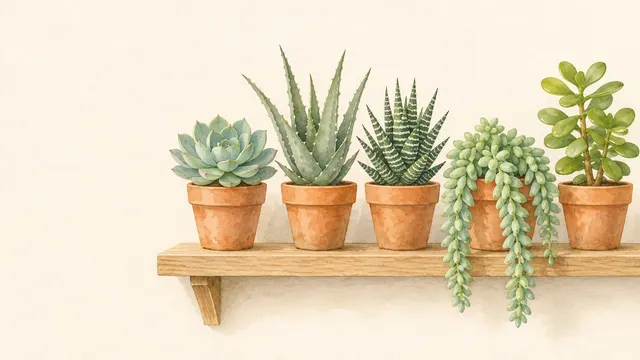
Types of Succulents: An Illustrated Guide
Types of succulents grouped by shape: rosette, upright, tree-like, trailing, flowering, and cacti, with current botanical names, light needs, and pet listings.
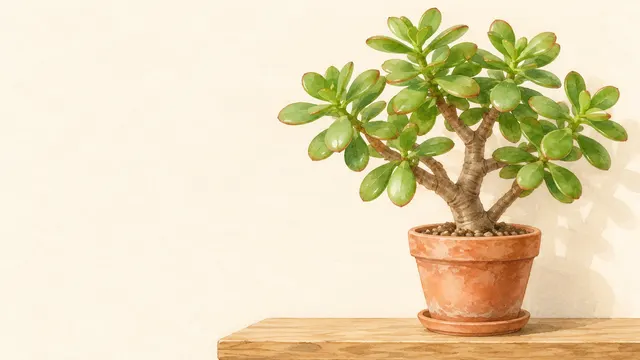
Jade Plant Care: Light, Water, Pruning, and Propagation
Jade plant care: 4+ hours of direct sun, deep watering once the soil dries, less water in winter, a heavy pot, spring pruning, easy cuttings, leaf drop fixes.
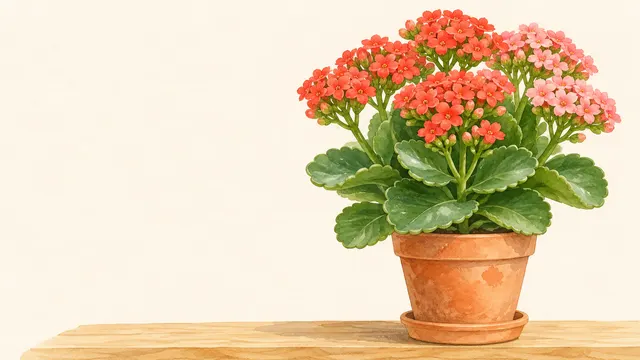
Kalanchoe Care: Light, Water, and Reblooming
Kalanchoe care for florist kalanchoe: bright light, soil that dries between waterings, and about 14 hours of nightly darkness for 6 weeks to bloom again.