Best Pots for Succulents: Drainage, Material and Size
Quick Answer
The best succulent pot has a drainage hole and is only slightly larger than the root ball. Unglazed terracotta dries soil quickest and suits most succulents; glazed ceramic and plastic can work if you water carefully. A decorative pot without a hole works only as an outer cover around a smaller pot that drains.
On this page
- Why Does the Pot Matter So Much for Succulents?
- Do Succulent Pots Need Drainage Holes?
- Terracotta, Glazed Ceramic, or Plastic: Which Material Is Best?
- What Size Pot Should a Succulent Have?
- Which Pot Fits Which Succulent?
- How Does the Pot Change the Way You Water?
- What Should You Check Before You Buy or Repot?
- Frequently Asked Questions
- Our Take
- Sources
Key Takeaways
- A drainage hole matters more than the material; Iowa State says a gravel layer is not a suitable replacement for a hole.
- Iowa State calls clay or terracotta ideal for succulents because it is porous and lets soil dry quicker; Penn State notes that plants in unglazed clay need more frequent watering.
- Choose a pot just big enough for the roots; the RHS warns that a much larger pot holds spare compost that stays damp.
- A decorative pot with no hole can hold a smaller draining pot, and water should never sit in saucers or outer sleeves.
- Shallow pots dry fast, but in a short pot most roots sit in the saturated zone, so pair them with a gritty mix.
Why Does the Pot Matter So Much for Succulents?
A pot decides how fast the soil dries, and that is the main thing a succulent cares about. Iowa State Extension says succulents thrive in small or shallow containers because the small volume of soil dries out quickly, and it warns that overly large containers often take longer to dry out [1]. Overwatering signs such as yellowing, soft and mushy leaves and stems, and a wet soil surface are what a pot that stays wet tends to produce [6].
So three choices matter, in this order: drainage, size, and material. This guide covers each one, then how to match a pot to your watering habits. If you are also picking a mix, read our succulent soil guide alongside this one, because pot and soil work as a pair.
Do Succulent Pots Need Drainage Holes?
Yes. Iowa State Extension says succulent containers must have drainage holes, and that a gravel "drainage layer" in the bottom is not a suitable replacement for a hole [1]. Penn State Extension gives the same basic rule for houseplants: a container with drainage holes is necessary for excess water to drain [2]. A drainage hole matters more than whether the pot is terracotta, ceramic, or plastic.
Why does water stay at the bottom? After watering, the lowest part of any container holds a nearly saturated zone, and finer-textured mixes push that zone higher [5]. A hole lets the excess leave, and a coarse mix keeps the wet zone small.
If you love a decorative pot that has no hole, you have two documented options:
- Double pot. Iowa State suggests growing the plant in a slightly smaller container with adequate drainage and setting it inside the decorative one [1]. Penn State describes the same idea for cachepots, which usually have no drainage holes, and says to remove excess water from the cachepot after watering [2].
- Add a hole. Penn State also suggests drilling a hole in a decorative container that lacks one [2]. Whether that is practical depends on the material and your tools.
Saucers and outer sleeves have one rule: never let water sit in them [1]. A pot with a hole that stands in a full saucer is, in practice, a pot without one.
Terracotta, Glazed Ceramic, or Plastic: Which Material Is Best?
For most succulents, unglazed terracotta is the safest material. Iowa State says clay or terracotta pots are ideal since they are porous and allow quicker soil drying [1]. Penn State makes the cost side of that plain: because unglazed clay is porous, plants in clay need more frequent watering [2].
| Material | How it affects watering | Other points |
|---|---|---|
| Unglazed terracotta | Porous, so soil dries quicker [1]; needs more frequent watering [2] | Breaks more easily [2] |
| Glazed ceramic | Penn State lists glazed clay and ceramic as options but calls only unglazed clay porous [2]; we infer the glaze slows drying | Breaks more easily [2]; many decorative pieces have no hole |
| Plastic | Compared with plastic, plants in unglazed clay need more frequent watering [2] | Durable and less expensive [2] |
Iowa State also lists glazed pottery, ceramic, plastic, and glass as acceptable succulent containers, with clay and terracotta as the preferred choice [1]. So no material is wrong. The difference is how forgiving it is.
A practical way to choose. This part is our suggestion, built on the sources above:
- If you tend to water too often, choose terracotta, because it dries the soil quicker.
- If you tend to forget your plants, a glazed or plastic pot keeps soil damp longer, which can help in a dry, warm room.
- If you are not sure, start with terracotta and a gritty mix, then adjust. Our succulent watering guide explains how to judge when to water.
One more caution: Penn State notes that terracotta and ceramic break more easily, while plastic is durable [2]. That matters if you move pots often or have pets and children around.
What Size Pot Should a Succulent Have?
Choose a pot just big enough for the roots. Iowa State Extension recommends a container just large enough for the plant's roots, and says succulents don't need frequent repotting and often thrive in slightly smaller containers [1]. Missouri Botanical Garden suggests moving an unbalanced plant into a pot about 1 inch larger than the old one [3].
Oversized pots work against you. In its guide to sansevierias, the RHS warns that a much larger pot holds a lot of spare compost that tends to stay damp after watering, encouraging root rot [4].
| Situation | What the sources say |
|---|---|
| Choosing a new pot | Just big enough for the roots [1]; slightly larger than the current one [2] |
| Size step when repotting | About 1 inch larger than the old pot [3] |
| Setting the plant | Top of the root ball about an inch below the pot rim [2] |
| Tall or top-heavy plant | Pot diameter at least half the plant's height [3] |
| Overly large pot | Takes longer to dry [1]; spare compost stays damp [4] |
Shallow or Deep?
Shallow pots dry fast, but Iowa State's potting media article points out a catch. Taller pots or airier media are used for plants that need excellent drainage, because in a short pot most of the roots sit in the saturated zone [5]. Our takeaway: pair a shallow dish with a very gritty mix and careful watering, and use a deeper pot for plants with long roots or tall growth.
Which Pot Fits Which Succulent?
Match the pot to how the plant grows and how you water. The sources give a few specific anchors, and we add our own reading where they do not:
| Plant or habit | Pot guidance |
|---|---|
| Most desert-type succulents | Terracotta or another quick-drying pot with a hole [1] |
| Snake plants | Pot with plenty of drainage holes, only slightly larger than the roots [4]; see our snake plant care guide |
| Plants you water often | Terracotta, since it dries quicker (our suggestion) |
| Top-heavy, tall plants | Wider pot, at least half the height in diameter [3] |
| Small rosettes such as hens and chicks | Small, shallow containers suit succulents [1]; see our hens and chicks care guide |
| Jade plants | See our jade plant care guide for its routine |
Holiday cacti are forest plants that want more moisture than most cacti [3], so a pot that dries more slowly can suit them; our Christmas cactus care guide covers the routine. Not sure which type you own? Our succulent types guide helps you identify it first.
How Does the Pot Change the Way You Water?
The pot sets the rhythm, but the method stays the same. Iowa State Extension describes watering thoroughly until the root ball is wet and water drains, then letting the soil dry before watering again [1]. That method only works if the extra water can leave, which is why the hole comes first. Iowa State also says standing water should not remain more than a few hours [1].
Here is how the pot choices play out in practice, based on the sources above:
- Terracotta: soil dries quicker [1], so expect to water more often than you would with plastic [2]. Check the soil before you water rather than following a calendar.
- Glazed or plastic: expect longer gaps between waterings. This part is our reasoning from the sources, so test the soil with a finger or a stick before each watering.
- Small pot: the small soil volume dries quickly [1], so it is forgiving of a missed watering but not of a full saucer.
- Big pot: drying takes longer [1], so water less often and less generously.
Our succulent watering guide goes through how often to water through the seasons.
Which Pot Mistakes Hurt Succulents Most?
Most pot problems trace back to water that cannot leave or soil that stays wet. These are the usual culprits, each tied back to a source:
- No hole and a gravel layer. Plants in pots without holes often stay too wet to thrive, and gravel is not a fix [1].
- A pot that is far too big. Spare compost stays damp and encourages root rot [4].
- A full saucer or cachepot. Water that sits there keeps the roots wet, so empty it after watering [2] [1].
- Repotting at the wrong time. Plants repotted while dormant are set back [3].
- A fine mix in a short pot. Roots in short pots sit in the saturated zone, so the mix should be airier [5].
If your plant already shows the warning signs (yellowing, soft and mushy leaves and stems, a wet soil surface), Iowa State's first step is to stop watering and let the soil dry, then repot into sharp-draining mix if the soil is too fine to dry [6].
What Should You Check Before You Buy or Repot?
Run through this checklist at the shop or at home:
- Is there a hole? If not, plan a double pot [1] or a drilled hole [2].
- Is it snug? Only slightly larger than the root ball, not a "room to grow" bowl [1] [4].
- Is the material right for your habits? Terracotta for heavy waterers, glazed or plastic for forgetful ones (our suggestion).
- Is there a saucer, and will you empty it? Never let water sit in saucers or outer sleeves [1].
- Is the mix right? A good pot cannot fix a mix that stays wet.
Timing for repotting also matters. Missouri Botanical Garden recommends repotting when growth begins in spring, because plants repotted while dormant are set back and slow to recover [3]. To repot, gently remove loose soil from the root ball, set the plant in its new pot, fill with well-drained soil, and water lightly [1]. For the full routine after repotting, see our succulent care guide.
Frequently Asked Questions
Do succulent pots need drainage holes?
Yes. Iowa State Extension says succulent containers must have drainage holes and that a gravel drainage layer is not a suitable replacement for a hole.
Is terracotta or ceramic better for succulents?
Iowa State Extension calls clay or terracotta pots ideal because they are porous and allow quicker soil drying. Glazed ceramic is also an acceptable container if it has a drainage hole, but our inference is that it dries more slowly, so water more carefully.
What size pot should I use for a succulent?
Use a pot just big enough for the roots. Missouri Botanical Garden suggests a pot about 1 inch larger than the old one when repotting an unbalanced plant, and the RHS warns that a much larger pot stays damp and encourages root rot.
Can I keep a succulent in a pot with no hole?
Only as an outer cover. Iowa State suggests growing the plant in a slightly smaller pot with adequate drainage and setting it inside the decorative one. Never let water sit in the outer container.
Our Take
In our editorial view, most people should stop shopping by looks and start by checking for a drainage hole, then size, then material. We lean toward unglazed terracotta for anyone who tends to overwater, because both Iowa State and Penn State describe clay as the pot that dries soil faster. For forgetful waterers, glazed or plastic pots are a fair choice. We also think the double-pot method deserves more credit: it lets you keep a favorite decorative container without drowning the roots. The glazed ceramic drying claim in this article is our inference from the sources, not a test we ran, and we have not tested specific products.
Sources
- Growing Succulents Indoors. Iowa State University Extension and Outreach (Aaron Steil; last reviewed December 2024).
- Repotting Houseplants. Penn State Extension (Mary Concklin and Susan Marquesen; updated February 23, 2026).
- Cacti and Succulents (fact sheet). Missouri Botanical Garden, Gardening Help.
- How to grow sansevierias. Royal Horticultural Society.
- Potting Media: Components and Handling. Iowa State University Extension and Outreach, Yard and Garden (Randall Vos, March 10, 2025).
- Common Problems and Issues of Succulents. Iowa State University Extension and Outreach (Aaron Steil; last reviewed August 2023).
Plant care advice is general guidance: adjust for your light, season and pot, and check the soil before you water. Pet toxicity follows the ASPCA list only; if a pet may have eaten part of a plant, contact your veterinarian or the ASPCA Animal Poison Control Center right away. Spotted an error? Tell us.
Related Guides
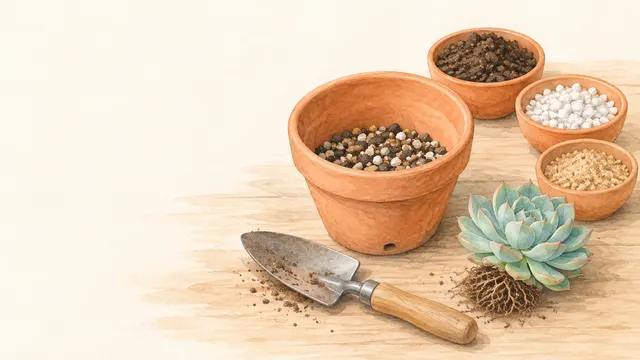
The Best Soil for Succulents (and How to Mix Your Own)
Succulent soil guide: why regular potting soil stays too wet, how organic and mineral parts compare, four DIY recipes, the right pot, and when to repot.
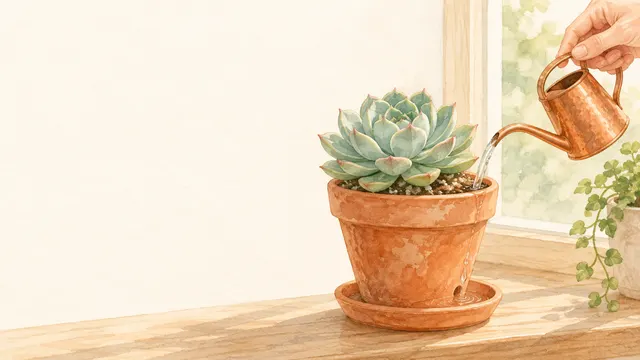
How Often to Water Succulents
How often to water succulents: check about every 2 to 3 weeks, water only when dry several inches down, water less in winter, and tell rot from thirst.
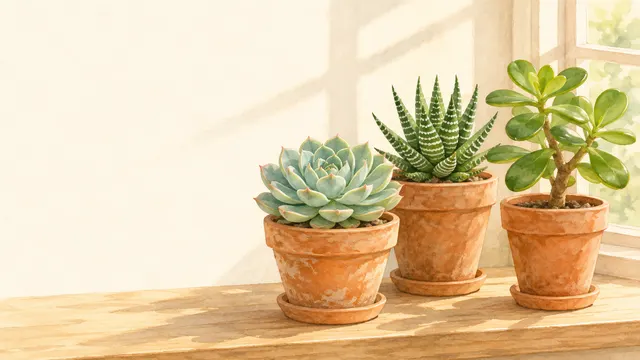
Succulent Care for Beginners
Succulent care for beginners: bright light, a soak-and-dry watering rhythm, gritty soil in a pot with drainage, and how to read wrinkled or mushy leaves.
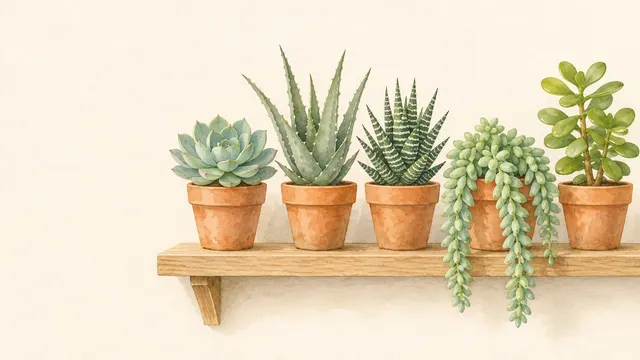
Types of Succulents: An Illustrated Guide
Types of succulents grouped by shape: rosette, upright, tree-like, trailing, flowering, and cacti, with current botanical names, light needs, and pet listings.
Hens and Chicks Care: Sun, Water, Winter Dormancy and Offsets
Hens and chicks care: full sun, sharp drainage, sparing water, what winter dormancy looks like, indoor versus outdoor growing, and how to remove offsets.
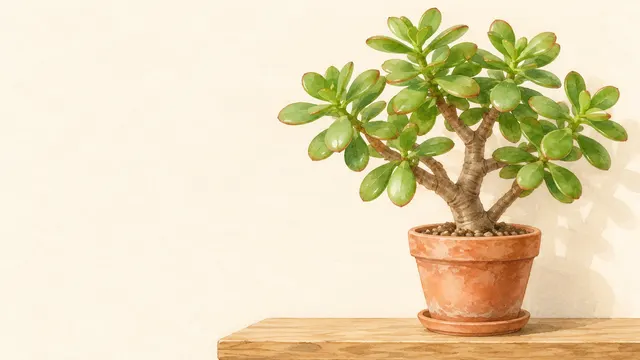
Jade Plant Care: Light, Water, Pruning, and Propagation
Jade plant care: 4+ hours of direct sun, deep watering once the soil dries, less water in winter, a heavy pot, spring pruning, easy cuttings, leaf drop fixes.