How to Propagate a Monstera: Water vs Soil, Node Cuttings Step by Step
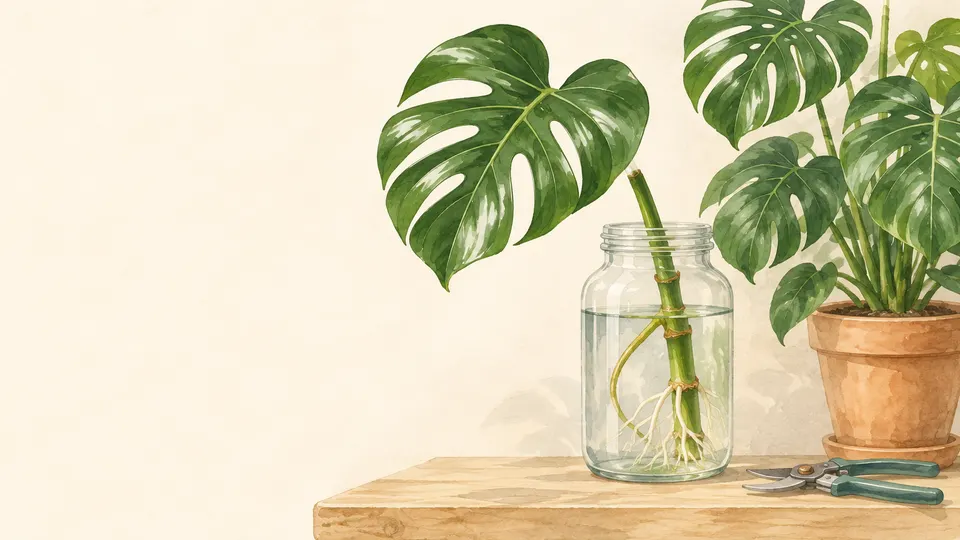
Quick Answer
To propagate a monstera, cut a healthy stem about 3 to 5 inches below a node, ideally with an aerial root, and root it in water or a moist medium. Keep the node under water or buried, change water once or twice a week, and pot up when roots are about 1 inch long. A cutting without a node has no growth point.
On this page
- Can You Propagate Monstera in Water or Soil?
- Where Do You Cut a Monstera?
- Water vs Soil: Which Is Better for Monstera Cuttings?
- How Do You Root a Monstera Cutting Step by Step?
- How Long Does It Take, and What Goes Wrong?
- What Are the Most Common Monstera Propagation Mistakes?
- Is Monstera Safe Around Pets?
- Frequently Asked Questions
- Our Take
- Sources
Key Takeaways
- Cut about 3 to 5 inches below a node, with an aerial root if possible, per UConn.
- The node is where new roots start; a leaf with no node has nothing to grow from.
- Water rooting works but water roots are coarser; pot up at about 1 inch.
- Most houseplant stem cuttings root in 3 to 6 weeks, per Iowa State.
- Monstera is toxic to dogs and cats, so keep cuttings away from pets.
Can You Propagate Monstera in Water or Soil?
Yes, both work, and what matters most is the cutting, not the container. Monstera (Monstera deliciosa) is propagated from stem cuttings, and University of Illinois Extension lists it among the houseplants for that method [2]. NC State Extension also gives stem cutting (or layering) as the way to propagate it [5].
Whichever medium you pick, the cutting must include a node. Iowa State Extension explains that new roots on a stem cutting form from buds on the lower part of the stem, and its method puts at least one node into the rooting medium [1]. Our reading: a leaf with only its leaf stalk has no bud, so it has nothing to grow a new stem from. Many plant blogs say the same, but we could not confirm it from a university page.
Iowa State says early spring is ideal for cuttings, though houseplants can be propagated any time of year [1]. Nevada Extension advises propagating while the plant is actively growing [3].
Where Do You Cut a Monstera?
UConn Home and Garden says an ideal stem cutting is taken 3 to 5 inches below a node, with as many aerial roots present as possible [4]. The node is the slightly swollen spot on the stem where a leaf joins; an aerial root often grows from it.
- Find a node. Pick a healthy stem with at least one node and a leaf, ideally with an aerial root [4].
- Sterilize your tools. Illinois Extension says to dip cutting tools in denatured alcohol before and between cuts [2].
- Cut below the node. Cut about 3 to 5 inches below it, as UConn describes [4]. Iowa State's general advice for stem cuttings is 3 to 6 inch pieces, with the bottom cut angled and no leaves buried in the medium [1].
- Trim large leaves and lower leaves. Iowa State says to remove the lower leaves and trim big leaves, and to work quickly or keep the cutting wrapped in a moist paper towel [1].
No node means no new plant. A cut that misses the node leaves a piece of stem or a lone leaf that, in our reading of the Iowa State method, has no bud to root from [1]. Do not count on a leaf-only cutting.
Water vs Soil: Which Is Better for Monstera Cuttings?
The sources we used do not test water against soil for monstera specifically, so this is a trade-off. Roots grown in water are coarser and less suited to potting soil, and the cutting may wilt, drop leaves, or show tip die-back after potting [1]. Illinois Extension goes further and does not recommend water rooting, because water roots are often weak and adapt less easily to potting mix [2]. On the other hand, Nevada Extension says some houseplants root in water, with roots appearing within about ten days for easy plants such as pothos [3].
| In water | In a moist medium | |
|---|---|---|
| Setup | Node under water in a clean jar | Node buried in perlite, a perlite and peat mix, or similar |
| Upkeep | Change water once or twice a week; keep roots covered | Keep evenly moist, not soggy |
| Root quality | Coarser; may wilt after potting | Roots form in the medium itself |
| Move to a pot | When roots are about 1 inch long | When roots are about 1 inch long or more |
Sources for the table: Iowa State, Illinois, and Nevada Extension [1] [2] [3].
Our take: if you want to watch roots form, water is fine as long as you pot early. For the smoothest start, a moist medium avoids the switch. This is our reading, not a test we ran. For a plant that roots easily either way, see our pothos propagation guide.
How Do You Root a Monstera Cutting Step by Step?
In water.
- Place the cutting so the node is under water and no leaf sits below the waterline [1].
- Keep it in bright, indirect light (Iowa State suggests 4 to 6 hours) and air around 65 to 75°F [1].
- Change the water once or twice a week and never let the level drop so that roots are exposed [1].
- Pot up when roots are about 1 inch long [1].
In a medium.
- Fill a container at least 2 inches deep, with drainage holes, with moist perlite or a perlite and peat mix. Plain potting soil should be only part of a mix [1].
- Bury at least one node and keep leaves above the surface [1].
- Keep the medium evenly moist but not soggy, and warm: Iowa State suggests 75 to 80°F for the medium and a loose bag or dome for humidity [1] [2].
- Rooting hormone is optional; Illinois says many houseplants root so easily that it is not important [2].
- Pot into regular potting soil once roots are about 1 inch long or more [1].
How Long Does It Take, and What Goes Wrong?
Iowa State says most houseplant stem cuttings root in 3 to 6 weeks [1]. We found no university timing specific to monstera, so treat that as a general range. Too little light slows rooting and cuttings may rot or dry out before roots form; too much light can burn them, especially under a bag or dome [1].
If the stem turns soft and brown below the node, trim to firm tissue, re-sterilize your tools, and start again with fresh water or fresh medium. Do not wait too long to pot a rooted cutting, advises Illinois Extension [2].
After potting, keep it well watered in bright, indirect light; Iowa State says it should establish within a few weeks, after which you can begin regular fertilizing [1]. NC State advises watering thoroughly, then letting the top quarter to one-third of the soil dry [5].
What Are the Most Common Monstera Propagation Mistakes?
Most failures trace back to a handful of avoidable slips, all of which follow from the guidance above.
- Cutting without checking for a node. A piece with no node has no bud to root from, so check before you cut [1].
- Burying leaves. Iowa State's method keeps leaves above the medium or waterline; our reading is that buried leaves are likely to rot [1].
- Leaving water to go stale or roots exposed. Change the water once or twice a week and keep developing roots covered [1].
- Waiting too long to pot up. Illinois Extension warns against leaving rooted cuttings too long before moving them into individual pots [2].
- Soggy medium. Keep it evenly moist, not soggy; a mix that stays wet invites rot [2].
- Wrong light. Too little light slows rooting, while too much can burn a cutting under a bag [1].
A practical habit we like is to take two or three cuttings rather than one, so a single failure does not end the project. That is our own tip, not something the extension sources test. Timing matters too: Iowa State calls early spring ideal [1].
Is Monstera Safe Around Pets?
No. The ASPCA lists Monstera deliciosa as toxic to dogs and cats because of insoluble calcium oxalates, with oral irritation, drooling, vomiting, and difficulty swallowing [6]. NC State notes the cell sap can irritate skin [5]. Keep cuttings and trimmings out of reach, and wear gloves if your skin is sensitive. Contact your veterinarian or the ASPCA Animal Poison Control Center if a pet chews on one.
If you like propagating, compare with the snake plant propagation guide, where leaf sections do work. Other houseplants worth getting to know include the rubber plant, money tree, fiddle leaf fig, and peace lily. For ideas on drainage, see our succulent soil guide, and the spider plant care guide covers another easy plant to multiply.
Frequently Asked Questions
Can you propagate a monstera leaf without a node?
We would not count on it. Iowa State Extension says roots on stem cuttings form from buds on the lower stem, and a leaf with only its stalk has no bud. Many plant blogs say it will not make a new plant, but we could not confirm that from a university page.
How long do monstera cuttings take to root?
Iowa State says most houseplant stem cuttings root in 3 to 6 weeks. We found no university figure specific to monstera.
When should I move a monstera cutting from water to soil?
Iowa State suggests potting when roots are about 1 inch long, and Illinois Extension warns not to wait too long.
Is monstera poisonous to cats and dogs?
Yes. The ASPCA lists Monstera deliciosa as toxic to dogs and cats.
Our Take
Our Take: we would root monstera in water only if you enjoy watching the roots and will pot up early, and otherwise use a moist perlite mix to skip the jar-to-pot switch. The extension sources we used do not test water against soil for monstera, so this is our reading of general houseplant guidance, not an experiment we ran. The one rule we would not bend is the node: check that every piece you cut has one before you cut.
Sources
- How to Propagate Houseplants by Stem Tip Cuttings. Iowa State University Extension and Outreach, 2025.
- Houseplant propagation. University of Illinois Extension, 2025.
- Propagating houseplants. University of Nevada Cooperative Extension, 1998.
- Monstera deliciosa. UConn Home and Garden Education Center, 2025.
- Monstera deliciosa. NC State Extension Plant Toolbox, 2025.
- Swiss Cheese Plant. ASPCA Toxic and Non-Toxic Plants, 2025.
Plant care advice is general guidance: adjust for your light, season and pot, and check the soil before you water. Pet toxicity follows the ASPCA list only; if a pet may have eaten part of a plant, contact your veterinarian or the ASPCA Animal Poison Control Center right away. Spotted an error? Tell us.
Related Guides
How to Propagate Pothos (Water vs Soil)
How to propagate pothos from stem cuttings: where to cut around the nodes, rooting in water vs a moist mix, how long roots take, and when to pot water cuttings.
How to Propagate a Snake Plant
How to propagate a snake plant by division, offsets, or leaf cuttings, step by step, and why leaf cuttings from variegated plants usually grow back all green.
Rubber Plant Care: Light, Water, Leaf Drop, and Pruning
Rubber plant care: bright light, water when the soil feels slightly dry, steady warmth away from drafts, plus leaf drop causes, pruning, air layering, and pets.
Money Tree Care: Light, Water, Humidity, and Leaf Problems
Money tree (Pachira aquatica) care: bright light without harsh sun, evenly moist but never soggy mix, 65 to 75°F warmth, humidity, and causes of leaf drop.
Fiddle Leaf Fig Care: Light, Water, and Leaf Drop
Fiddle leaf fig care from extension sources: bright indirect light, watering after a 2-inch soil check, drainage, and what can cause leaf drop and brown spots.
Peace Lily Care: Watering, Light, and Getting Blooms
Peace lily care for beginners: bright indirect light, moist but not soggy soil, why it droops, how to get blooms, and what brown tips and yellow leaves mean.