How to Propagate a Spider Plant: Plantlets, Division and Water Rooting
Quick Answer
To propagate a spider plant, use the plantlets (spiderettes) on its long stems. Pin an attached plantlet to moist mix until it roots, then cut the stem, or detach one that already has roots and pot it or set it in water. Plants with no babies can be divided, keeping a growing point in each piece.
On this page
- What Is the Easiest Way to Propagate a Spider Plant?
- How Do You Tell When a Spider Plant Baby Is Ready?
- Water, Soil or Division: Which Method Should You Use?
- How Do You Propagate a Spider Plant in Water?
- How Do You Divide a Spider Plant?
- Why Is My Spider Plant Not Making Babies?
- What Mistakes Should You Avoid, and Is It Pet Safe?
- Frequently Asked Questions
- Our Take
- Sources
Key Takeaways
- Plantlets root in soil or water; Clemson says they can be started at any time of year.
- Keep an unrooted plantlet attached until it roots, then cut the stem (UW-Madison).
- For water rooting, change the water once or twice a week and pot up at about 1 inch of root (Iowa State, general houseplant guidance).
- Division works when there are no plantlets; each piece needs a growing point (RHS).
- The ASPCA lists the spider plant as non-toxic to dogs and cats.
What Is the Easiest Way to Propagate a Spider Plant?
The easiest way is to use the baby plants, called plantlets, that dangle from the long stems of a healthy spider plant. The Royal Horticultural Society (RHS) calls spider plants easy to propagate from these offsets, and University of Wisconsin-Madison Extension says they are "extremely easy" to propagate by planting the plantlets [1] [2]. You can root them in soil, root them in water, or skip them entirely and divide a mature plant.
Pot up a plantlet only after it has its own roots, or keep it attached until it roots. Clemson Extension says to detach plantlets once roots have formed and pot them directly into moist growing mix [3]. The same page says you can start new plants from plantlets at any time of year [3].
Spiderettes, spider plant babies, offsets, and plantlets are all the same thing here: a small rosette that grows at the end of a trailing stem and can become a new plant.
How Do You Tell When a Spider Plant Baby Is Ready?
What matters is whether the plantlet already has roots. Some arrive with small roots forming while still hanging in the air; others are just a tuft of leaves. The diagram shows what to do at each stage.
- No roots yet. Leave it attached. UW-Madison Extension says to allow the plantlet to root before cutting the stem that connects it to the mother plant [2].
- Pinned to mix and rooting. Wisconsin describes holding the plantlet against the soil with a bent paper clip or piece of wire until it develops roots [2]. The RHS suggests a U-shaped wire to pin it into a pot of moist, peat-free compost [1].
- Already rooted. Detach it and pot it up, or set it in a glass of water [2] [1].
Clemson adds that plantlets will root on their own when they touch soil [3]. You can also leave them attached if you like the look of a fuller hanging basket [3].
Water, Soil or Division: Which Method Should You Use?
All three work. The right choice depends on what you have in hand. Here is how we would decide, based on the extension and RHS guidance.
| Soil (pinned or potted) | Water | Division | |
|---|---|---|---|
| Start with | A plantlet, attached or rooted | A detached plantlet | A mature, crowded plant |
| Needs | Moist mix and a pot | A glass of water | A knife if the roots will not pull apart |
| Move to a pot | Already in a pot | When roots lengthen | Each piece goes in its own pot |
| Best when | You want the simplest path | You like to watch roots | No plantlets, or the pot is full |
Sources for the table: RHS, UW-Madison Extension, Clemson Extension [1] [2] [3].
We would usually choose the soil route, because a plantlet pinned to mix never has to switch from a jar to a pot. That is our reading of the guidance, not a test we ran.
How Do You Propagate a Spider Plant in Water?
Spider plant propagation in water is quick to set up and satisfying to watch. The RHS says you can detach the plantlets, put them in a glass of water, and pot them up individually once the roots lengthen [1].
- Choose a plantlet. The RHS says to detach plantlets once they have their own roots; we would pick a healthy, good-sized one and cut it from the stem [1].
- Set it in a glass. Put just the base in water, and keep the leaves dry so they do not sit in it. The "leaves above water" detail comes from Iowa State's general houseplant cutting advice, not a spider-plant-specific page [5].
- Change the water. Iowa State advises changing the water frequently, one to two times a week [5].
- Pot up. Iowa State says to transplant cuttings when roots are about 1 inch long [5]. The RHS does not give a length, so treat the figure as general houseplant guidance.
Roots that form in water are coarser in texture than roots that form in a medium, says Iowa State [5]. That is the reason to pot up early rather than leave a plantlet in the jar for a long time. Iowa State gives no water-specific timeline; for stem cuttings in general it says most form roots in 3 to 6 weeks [5]. A spider plant plantlet is not a stem cutting, so we would treat that range as a loose guide only.
How Do You Divide a Spider Plant?
Division is the best fallback when a plant makes no plantlets, or when the pot is full of roots. The RHS says mature plants can be divided into several smaller plants, and that division is especially useful for cultivars that do not produce offsets [1].
- Lift the plant out of its pot. The roots are thick and fleshy, so expect a heavy clump [1] [3].
- Pull the clump apart. If it will not come apart, the RHS says to slice through it with a knife [1].
- Check each piece. Each healthy piece needs at least one growing point [1].
- Repot each piece in its own pot with fresh moist mix [1].
Clemson says to divide and repot before the roots expand enough to crack the container, and that you can repot at any time of year [3]. The sources we used do not give a step-by-step method for the fertilizer or watering that follows. Clemson does say to wait four to six months before feeding newly potted plants [3].
Why Is My Spider Plant Not Making Babies?
If you want plantlets, the plant itself has to cooperate. Several things can hold them back:
- Age. The RHS says most spider plants will not produce plantlets until they are at least a year old, so a young plant with none is not a problem [1].
- Light. NC State Extension says stolons and plantlets are light dependent and develop when the mother plant receives short days, which the page puts at fewer than 12 hours of light for at least three weeks [4]. Clemson also notes that plants produce most of their offshoots when the days shorten in the fall [3].
- Too much fertilizer. NC State says not to over-fertilize, as this decreases plantlet formation, and UW-Madison agrees that heavily fertilized plants may not form as many plantlets [4] [2].
- Pot size. UW-Madison says plants grow and produce plantlets best when slightly pot bound [2]. The RHS also lists large pots among the things that discourage flowering, which comes before plantlets form [1].
- Cultivar. Some cultivars produce few or no plantlets, which is where division comes in [1].
For the basics of light and watering that keep a plant healthy enough to produce babies, see our spider plant care guide.
What Mistakes Should You Avoid, and Is It Pet Safe?
Most propagation failures are simple to avoid.
- Cutting an unrooted plantlet too soon. If it has no roots, leave it attached or pin it until it roots [2].
- Leaving water to go stale. Change it once or twice a week [5].
- Waiting too long to pot a water-rooted plantlet. Water roots are coarser than soil roots [5].
- Waiting too long to divide. Clemson says to divide before the roots crack the pot [3].
The ASPCA lists the spider plant (Chlorophytum comosum) as non-toxic to dogs and cats [6]. If a pet eats plant material and seems unwell, contact your veterinarian or the ASPCA Animal Poison Control Center.
If you enjoy multiplying plants, the same ideas of rooting early and keeping the medium moist show up in our pothos propagation guide and monstera propagation guide. The snake plant propagation guide covers a plant that is divided and cut very differently. For a deeper look at potting mix, see the succulent soil guide, and for another easy plant to pass around, see the ZZ plant care guide.
Frequently Asked Questions
How do you propagate a spider plant in water?
The RHS says to detach the plantlets, set them in a glass of water, and pot them up individually once the roots lengthen. Iowa State's general houseplant advice is to change the water one to two times a week and transplant when roots are about 1 inch long.
Can you cut spider plant babies off before they have roots?
It is safer to wait. UW-Madison Extension says to allow the plantlet to root before cutting the stem that connects it to the mother plant, and describes holding it against the soil with a bent paper clip or wire. The RHS says to detach offsets once they have their own roots.
When is the best time to propagate a spider plant?
Clemson Extension says you can start new plants from plantlets at any time of year. It also notes that spider plants produce most of their offshoots when days shorten in the fall.
Can you propagate a spider plant without babies?
Yes, by division. The RHS says mature plants can be divided, slicing through the clump with a knife if needed, and each piece needs at least one growing point.
Is a spider plant safe for pets?
The ASPCA lists Chlorophytum comosum as non-toxic to dogs and cats. If a pet seems unwell after eating any plant, contact your veterinarian or the ASPCA Animal Poison Control Center.
Our Take
Our Take: we would usually pin a plantlet to moist mix and let it root while still attached, because that avoids the jar-to-pot switch and the coarse roots water produces. Water rooting is fine if you enjoy watching it, as long as you pot up early, and division is the right call when a plant is crowded or makes no babies. The sources we used do not compare water and soil for spider plants, so this is our reading of general houseplant guidance, not a test we ran.
Sources
- How to grow spider plants. Royal Horticultural Society, 2026.
- Spider plant, Chlorophytum comosum. University of Wisconsin-Madison Extension, Wisconsin Horticulture, 2025.
- Spider Plant. Clemson Cooperative Extension, Home & Garden Information Center, 2025.
- Chlorophytum comosum (Spider Plant). NC State Extension Plant Toolbox, 2025.
- How to Propagate Houseplants by Stem Tip Cuttings. Iowa State University Extension and Outreach, 2025.
- Spider Plant. ASPCA Toxic and Non-Toxic Plants, 2025.
Plant care advice is general guidance: adjust for your light, season and pot, and check the soil before you water. Pet toxicity follows the ASPCA list only; if a pet may have eaten part of a plant, contact your veterinarian or the ASPCA Animal Poison Control Center right away. Spotted an error? Tell us.
Related Guides
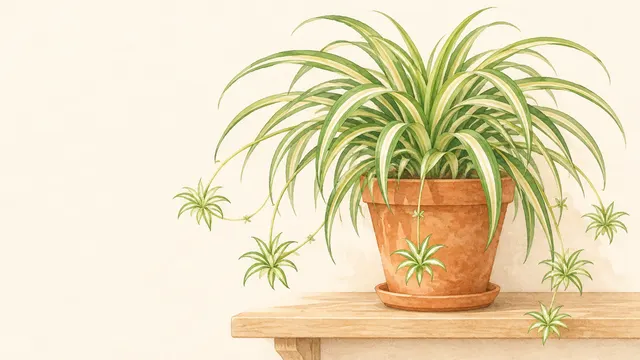
Spider Plant Care: Light, Water, and Baby Plants
Spider plant care made simple: bright, indirect light, water when the soil starts to dry, what causes brown leaf tips, and how to root the baby plantlets.
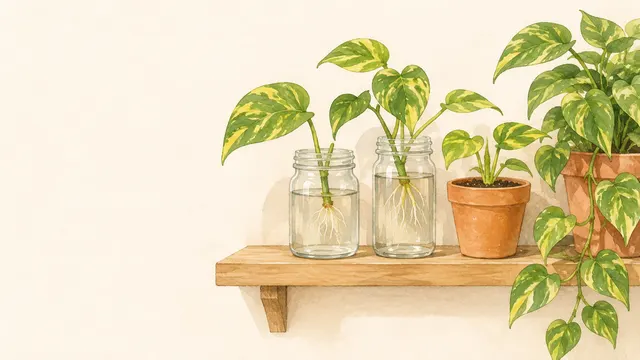
How to Propagate Pothos (Water vs Soil)
How to propagate pothos from stem cuttings: where to cut around the nodes, rooting in water vs a moist mix, how long roots take, and when to pot water cuttings.
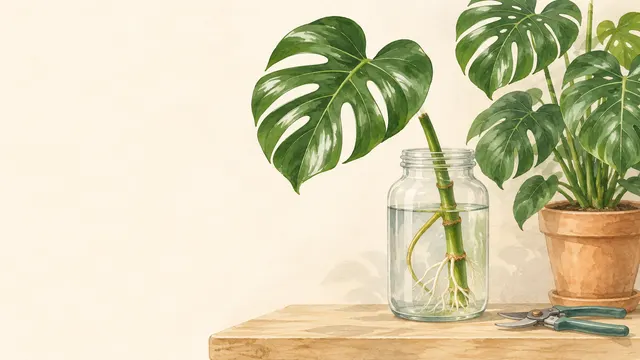
How to Propagate a Monstera: Water vs Soil, Node Cuttings Step by Step
How to propagate a monstera from a stem cutting: where to cut below the node, water versus soil, rooting time, and why a cutting with no node will not root.
How to Propagate a Snake Plant
How to propagate a snake plant by division, offsets, or leaf cuttings, step by step, and why leaf cuttings from variegated plants usually grow back all green.
ZZ Plant Care: Light, Water, Soil, and Yellow Leaves
ZZ plant care: bright indirect light (low light tolerated), water 1 to 2 times a month only once the mix dries, a coarse mix, and how to fix yellow leaves.
Peace Lily Care: Watering, Light, and Getting Blooms
Peace lily care for beginners: bright indirect light, moist but not soggy soil, why it droops, how to get blooms, and what brown tips and yellow leaves mean.